
Iran's 'Dancing Missile' Sejjil Debuts In West Asia War: How Deadly Is It And What Makes It Different?
Due to its high-altitude maneuvering, the Sejjil has earned the nickname the 'dancing missile.' This agility allows it to shift path mid-flight, specifically designed to outmaneuver and evade advanced air defense networks like Israel's Iron Dome.
- World News
- 3 min read

;'%3e%3cpath%20d='m8,15.99c4.41,0,7.99-3.58,7.99-7.99S12.41,0,8,0,0,3.59,0,8s3.58,7.99,7.99,7.99Z'%20style='stroke:%23fff;%20stroke-miterlimit:10;%20stroke-width:.02px;'/%3e%3cpath%20d='m3.08,3.37l3.82,5.11-3.84,4.15h.87l3.37-3.64,2.72,3.64h2.94l-4.04-5.39,3.58-3.87h-.86l-3.1,3.35-2.5-3.35h-2.94Zm1.27.64h1.35l5.97,7.99h-1.35l-5.97-7.99Z'%20style='fill:%23fff;'/%3e%3c/g%3e%3c/svg%3e)


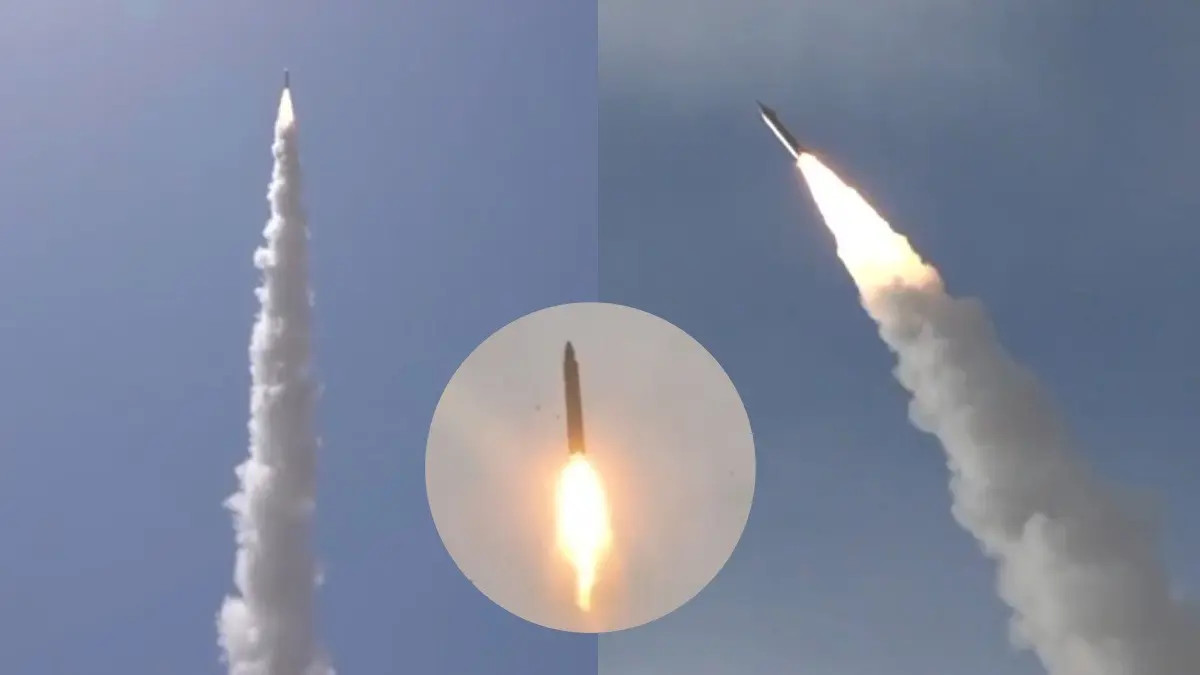
New Delhi: As the Middle East war intensifies, Iran on Sunday deployed a range of advanced weaponry against Israeli and U.S. targets, marking the first combat use of the Sejjil missile since the conflict erupted on February 28, according to the state-run PressTV.
The sudden deployment of the Sejjil missile has captured global attention, emerging as a high-stakes turning point amid a relentless wave of missile barrages and heavy fighting.
What Is The Sejjil Missile?
The Sejjil, also identified as the Sajjil, Ashoura, or Ashura, is a domestically produced, two-stage ballistic missile that utilizes a solid-propellant engine, unlike earlier liquid-fueled models such as the Shahab series.
According to the Center for Strategic and International Studies (CSIS), the Sejjil is classified as a medium-range ballistic missile (MRBM).
Advertisement
It boasts an estimated strike range of roughly 2,000 kilometres and is capable of carrying a 700-kilogram payload.
Why it is called ‘dancing missile’
Due to its high-altitude maneuvering, the Sejjil has earned the nickname "the dancing missile." This agility allows it to shift path mid-flight, specifically designed to outmaneuver and evade advanced air defense networks like Israel's Iron Dome.
Advertisement
The missile's capabilities
Standing roughly 18 metres long with a diameter of 1.25 metres, this massive weapon weighs in at approximately 23,600 kilograms.
Missile's solid-fuel design
The Sejjil’s development traces back to the early 1990s, with its first test launch in 2008 reaching 800 kilometres.
By May 2009, a second test successfully evaluated advanced guidance and navigation systems. Since then, four additional flight tests have been conducted, including a sixth launch where the missile traveled approximately 1,900 kilometres into the Indian Ocean.
Crucially, its solid-fuel design provides a major strategic edge over older liquid-fuel models like the Shahab series, as it can be prepped and launched with much higher speed and efficiency.
This allows the missile to be stored fully fueled, which makes quick launch possible, making it much harder for adversaries to detect and destroy before liftoff compared to liquid-fueled counterparts.
Sejjil-3 missiles
Modernizing the Sejjil line, Iran is now deploying the Sejjil-2, which features a sophisticated dual-guidance system combining GPS and inertial navigation for pinpoint accuracy.
Looking ahead, reports indicate that Tehran is already testing the Sejjil-3, a three-stage powerhouse designed to extend its reach to a staggering 4,000 kilometres.
Despite these advancements, many military analysts argue that the debut of the Sejjil in the current conflict is not a display of power, but rather a sign of strategic desperation as the regime's conventional options dwindle.