
Iran’s $700 Million Hit: Tehran Claims Destruction Of Rare US AWACS Spy Plane In Missile Strike At Saudi Base
An Iranian missile strike on a Saudi base reportedly damaged a rare USD 700 million US AWACS plane and wounded 15 troops, escalating a conflict that has already injured 300 Americans and disrupted global oil markets.
- World News
- 5 min read

;'%3e%3cpath%20d='m8,15.99c4.41,0,7.99-3.58,7.99-7.99S12.41,0,8,0,0,3.59,0,8s3.58,7.99,7.99,7.99Z'%20style='stroke:%23fff;%20stroke-miterlimit:10;%20stroke-width:.02px;'/%3e%3cpath%20d='m3.08,3.37l3.82,5.11-3.84,4.15h.87l3.37-3.64,2.72,3.64h2.94l-4.04-5.39,3.58-3.87h-.86l-3.1,3.35-2.5-3.35h-2.94Zm1.27.64h1.35l5.97,7.99h-1.35l-5.97-7.99Z'%20style='fill:%23fff;'/%3e%3c/g%3e%3c/svg%3e)


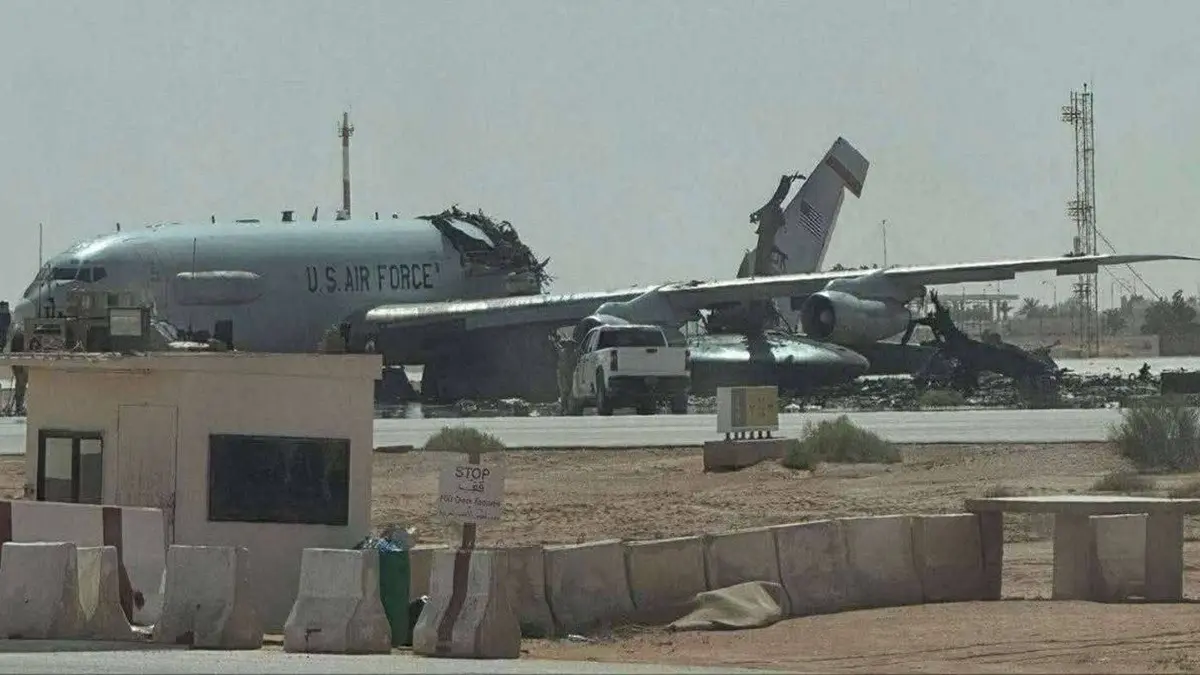
Tehran: Amidst an intense war in West Asia, Tehran on Sunday asserted that a sophisticated missile and drone offensive on Prince Sultan Air Base in Saudi Arabia has reportedly damaged a high-value US Air Force E-3 Sentry AWACS and wounded 15 American service members. The strike, which reportedly occurred early Friday, involved 6 ballistic missiles and 29 drones.
Social Media images appearing to show the charred fuselage and shattered radar dome of airframe 81-0005 have circulated widely. However, the Pentagon has not yet officially confirmed the extent of the hardware damage.
According to reports from Iran’s state-owned Press TV, the operation focused on Prince Sultan Air Base, a key hub for American personnel. The Iranian outlet alleged that a Boeing E-3 Sentry, a vital airborne early-warning and control platform used for tracking threats and managing complex battlefield communications, sustained massive hits, alongside several aerial refuelling tankers.
Visuals aired by Press TV purportedly depicted the wreckage of the aircraft, with claims suggesting that only fragments of the fuselage survived the impact. The loss of such a platform is strategic, as the E-3 Sentry belongs to a declining American inventory with no immediate successor, carrying a price tag estimated at more than USD 700 million, the Wall Street Journal reported.
Advertisement

According to Iranian officials, the scale of the bombardment involved six ballistic missiles and 29 drones launched toward the facility. The strike resulted in injuries to at least 15 US service members, 5 of whom are in serious condition, with 2 listed as critical. The latest incident brings the total number of US troops wounded in the month-long conflict in West Asia to over 300, with 13 reported fatalities.
The experts asserted that located nearly 96 km from Riyadh, Prince Sultan Air Base is a Royal Saudi Air Force installation that hosts US troops. The air base has faced repeated volatility since hostilities erupted nearly a month ago.
Advertisement
Earlier this week, a separate attack left 14 US personnel wounded. United States Central Command has withheld an official confirmation regarding the specific scale of the casualties or the extent of the hardware destruction.
Impact On US Air Operations
The E-3 Sentry is a critical component of US air superiority, acting as a flying command hub that can track threats across 375 km. The loss is massive because the Air Force maintained a small fleet of only 16 of these aging platforms.
The military experts suggested Iran is pursuing an "asymmetric counter-air campaign" by targeting the specific surveillance and refuelling aircraft that enable American long-range operations.
Meanwhile, in response to the intensifying friction, the US has accelerated its regional military build-up. After being diverted from drills near Taiwan, the USS Tripoli has reached Middle Eastern waters, bringing a contingent of around 2500 Marines.
The Pentagon has further strengthened its presence by ordering the USS Boxer and 2 additional vessels, accompanied by another Marine Expeditionary Unit, to the area. The deployment increases the available amphibious power and aircraft carrier capacity in the theatre.
Addressing the strategy, US Secretary of State Marco Rubio noted that Washington could meet its objectives without deploying ground troops but added that President Donald Trump must remain prepared for “multiple contingencies”.
Aviation And Energy Crisis, Economic Risks
The war, now entering its 5th week, has severely hampered international aviation and energy exports. Disruption surrounding the Strait of Hormuz has triggered a spike in global fuel costs and spread economic anxiety globally.
Donald Trump has established an April 6 ultimatum for Tehran to restore access to the essential maritime corridor. Trump characterized the diplomatic situation by stating that talks to end the conflict were “going very well”, despite Iran’s public insistence that no such negotiations are taking place.
The strike coincided with reports that the Trump administration is considering a military seizure of Kharg Island, which handles 90% of Iran’s oil exports. In response, Iranian officials have issued sharp warnings.
Parliament Speaker Mohammad Bagher Qalibaf stated the country is prepared to "set on fire" any ground troops, while state media warned that soldiers entering Iranian territory would leave "in a coffin”.
Meanwhile, the ongoing war has already triggered a global energy crisis. Iran has targeted civilian infrastructure, including Saudi Aramco’s Ras Tanura and Yanbu refineries, to disrupt oil supplies. In Washington, the Department of Defense has requested an additional $200 billion to sustain the war effort as regional stability continues to deteriorate.
Despite the attacks on their soil, Saudi Arabia and other Gulf Cooperation Council (GCC) members have remained aligned with Washington. The partnership is built on a long-standing "oil-for-security" arrangement intended to counter Iranian influence.
For these nations, the growth of Iran’s missile programme and its history of "exporting revolution" represent an existential threat that outweighs the current risks of staying allied with the US.