
Iran’s Assembly of Experts Selects Mojtaba Khamenei, Son of Ali Khamenei, as Supreme Leader
Mojtaba Khamenei, 56, has been named Iran’s new Supreme Leader following the death of his father, Ayatollah Ali Khamenei. The Assembly of Experts reportedly selected him under pressure from the Revolutionary Guard, despite his lack of clerical rank or public office. His appointment represents a dynastic succession unprecedented in the Islamic Republic, sparking debate over legitimacy, hereditary rule, and the growing dominance of the IRGC in Iran’s politics.
- World News
- 3 min read

;'%3e%3cpath%20d='m8,15.99c4.41,0,7.99-3.58,7.99-7.99S12.41,0,8,0,0,3.59,0,8s3.58,7.99,7.99,7.99Z'%20style='stroke:%23fff;%20stroke-miterlimit:10;%20stroke-width:.02px;'/%3e%3cpath%20d='m3.08,3.37l3.82,5.11-3.84,4.15h.87l3.37-3.64,2.72,3.64h2.94l-4.04-5.39,3.58-3.87h-.86l-3.1,3.35-2.5-3.35h-2.94Zm1.27.64h1.35l5.97,7.99h-1.35l-5.97-7.99Z'%20style='fill:%23fff;'/%3e%3c/g%3e%3c/svg%3e)


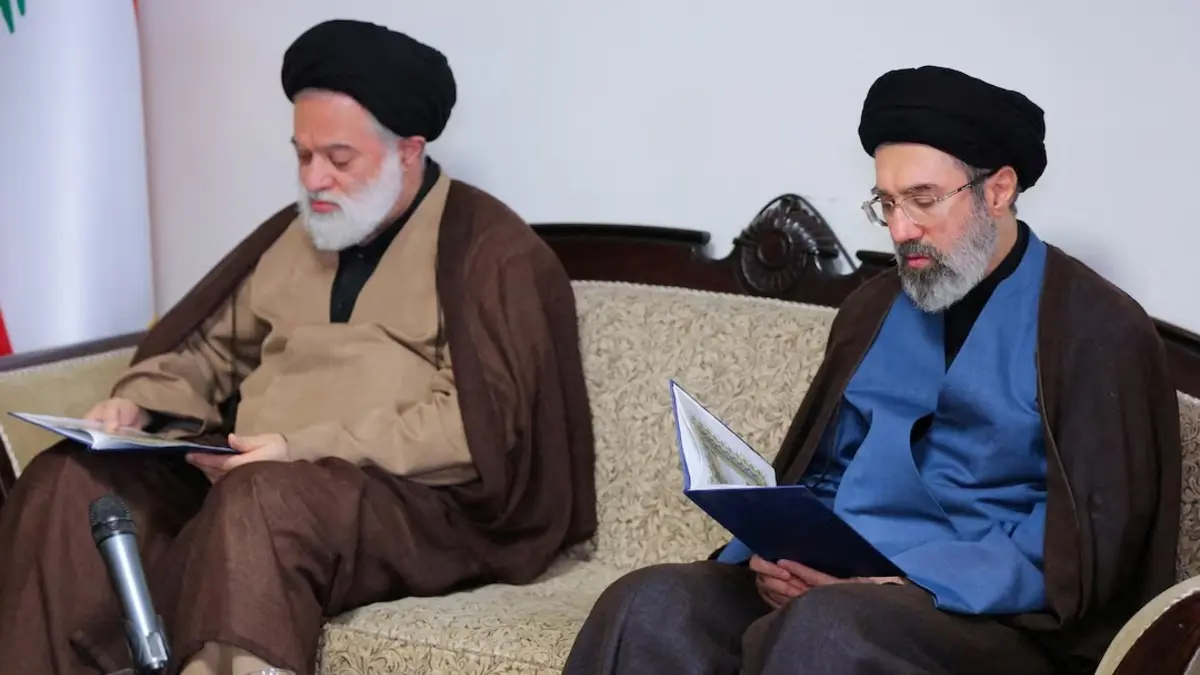
New Delhi: Iran has entered a new era of leadership. Mojtaba Khamenei, the 56‑year‑old son of the slain leader Ayatollah Ali Khamenei, has been appointed as the country’s new Supreme Leader by the Assembly of Experts, according to reports from Iran International. His rise marks a historic and controversial dynastic succession in a system that has long rejected hereditary rule.
Mojtaba’s appointment is unprecedented. Unlike his father, who was elevated in 1989 after years of clerical and political experience, Mojtaba has never held public office and is not a senior cleric. Yet his influence behind the scenes, his close ties to the Islamic Revolutionary Guard Corps (IRGC), and the reported pressure exerted by the Guards on the Assembly of Experts ensured his selection.
The decision comes amid extraordinary circumstances- the assassination of Ali Khamenei in late February 2026 during US -Israeli strikes on Tehran, escalating regional tensions, and mounting internal divisions.
Mojtaba was born in 1969 in Mashhad, Iran. He grew up during his father’s rise as a revolutionary cleric opposing the Shah. He fought in the Iran-Iraq war gaining credibility among hardliners for his military service.
Advertisement
Mojtaba, despite lacking formal office experience comes with behind-the-scenes influence. He has long been seen as a powerful figure within the regime, managing networks of clerics and Revolutionary Guard commanders.
In 2019, the US Treasury sanctioned him, alleging he acted on behalf of his father in an official capacity despite never being elected or appointed. Reports suggest Mojtaba survived wartime attacks that killed several members of the Khamenei family, further cementing his image as a figure shaped by conflict.
Advertisement
The Assembly of Experts, a body of clerics constitutionally tasked with selecting the Supreme Leader, convened in emergency session following Ali Khamenei’s death. According to Iran International, the Islamic Revolutionary Guard Corps (IRGC) exerted heavy pressure on the clerics to back Mojtaba.
This dynamic underscores the growing dominance of the IRGC in Iran’s political system. Once a military force, the Guards have become a parallel state apparatus, controlling vast economic assets and wielding decisive influence in leadership transitions. Mojtaba’s close ties to the IRGC made him their preferred candidate, ensuring continuity of their power.
The Islamic Republic has long criticised hereditary rule, portraying itself as a just alternative to monarchy. Yet Mojtaba’s succession represents precisely that - a dynastic handover. This contradiction is not lost on Iranians, many of whom see the move as undermining the revolution’s founding principles. Many Iranians see the move as hypocrisy, reinforcing cynicism about the regime’s claims of justice.