
From Airstrikes on Venezuela to a New York Trial for President Maduro: Did US Cross the Line on International Law?
The United States has captured Venezuelan President Nicolás Maduro and his wife in a military operation to stand trial on U.S. drug trafficking charges, an action drawing international legal concerns.
- World News
- 5 min read

;'%3e%3cpath%20d='m8,15.99c4.41,0,7.99-3.58,7.99-7.99S12.41,0,8,0,0,3.59,0,8s3.58,7.99,7.99,7.99Z'%20style='stroke:%23fff;%20stroke-miterlimit:10;%20stroke-width:.02px;'/%3e%3cpath%20d='m3.08,3.37l3.82,5.11-3.84,4.15h.87l3.37-3.64,2.72,3.64h2.94l-4.04-5.39,3.58-3.87h-.86l-3.1,3.35-2.5-3.35h-2.94Zm1.27.64h1.35l5.97,7.99h-1.35l-5.97-7.99Z'%20style='fill:%23fff;'/%3e%3c/g%3e%3c/svg%3e)


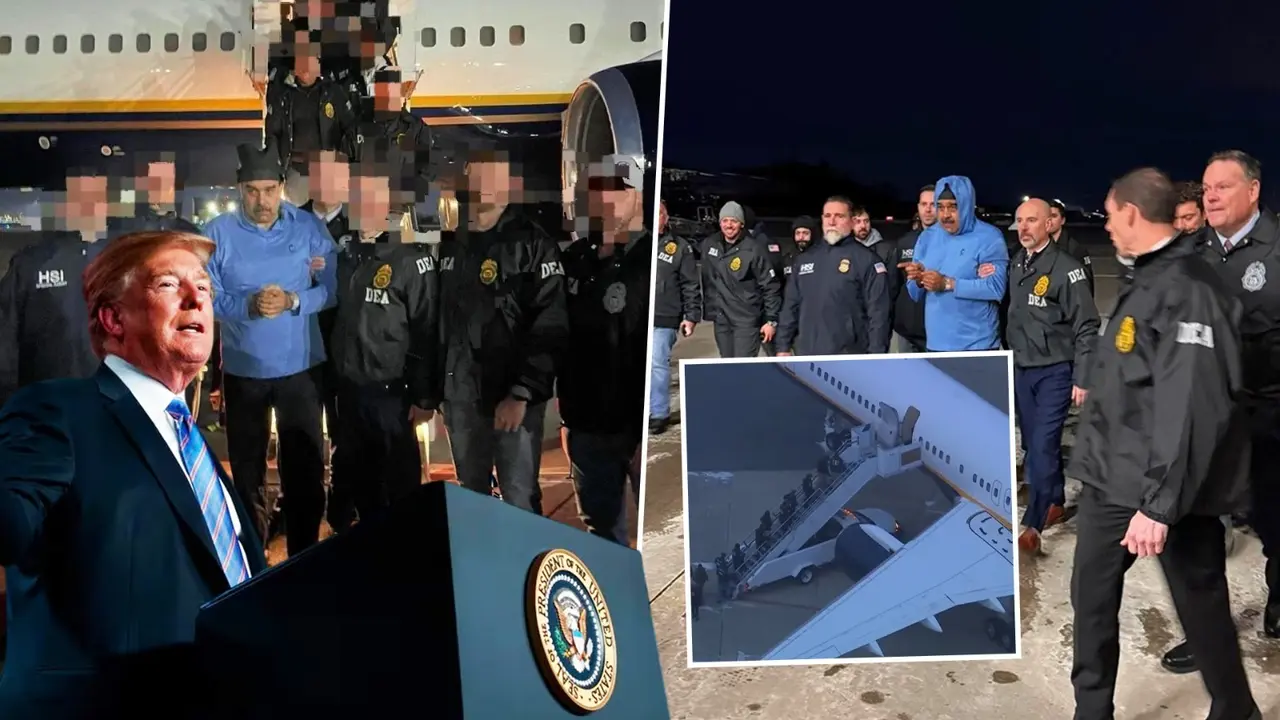
Washington: The United States launched military strikes on Venezuela early Saturday, capturing President Nicolás Maduro and his wife, Cilia Flores, after targeting the capital, Caracas, and key installations, including the country’s defence headquarters.
Maduro, long condemned by Washington as an illegitimate leader, was taken into U.S. custody and flown to New York along with Flores. The couple is set to be tried on charges of drug trafficking stemming from a 2020 narcoterrorism indictment filed during the first administration of Donald Trump.
Earlier, Trump and the US Attorney General made the announcement on social media that Maduro and Flores would face “the full wrath of American justice on American soil, in American courts,” warns US Attorney General. The indictment accuses them of drug trafficking, terrorism-related offences, and weapons charges.
Amid the dramatic escalation, multiple world leaders and international bodies raised concerns over whether the action complied with international law.
Advertisement
Rules of international law not respected: UN
The United Nations voiced serious alarm over the U.S. military action. In a statement issued by UN spokesperson Stéphane Dujarric, the organisation said that António Guterres was “deeply alarmed by the recent escalation in Venezuela, culminating with today’s United States military action in the country, which has potential worrying implications for the region.”
“Independently of the situation in Venezuela, these developments constitute a dangerous precedent,” the statement said. It stressed the need for full respect for international law, including the UN Charter.
Advertisement
The Secretary-General expressed deep concern that the rules of international law had not been respected and urged all parties to engage in inclusive dialogue in line with human rights and international legal principles.
What does the law say?
Under U.S. law, Congress holds the power to declare war, though the president serves as commander-in-chief. Past presidents from both parties have justified limited military actions as necessary to protect national interests.
International law, however, generally prohibits the use of force in international relations except under narrow circumstances, such as self-defence or authorisation by the UN Security Council.
Legal experts say drug trafficking and gang-related crimes do not meet the international threshold of armed conflict that would justify military intervention.
“A criminal indictment alone doesn’t provide authority to use military force to depose a foreign government,” said Matthew Waxman, a professor of national security law at Columbia University. He added that the administration would likely attempt to justify the action under a self-defence theory.
The U.S. has not recognised Maduro as Venezuela’s legitimate leader since 2019, following an election Washington said was rigged.
How did the U.S. justify the action?

U.S. authorities said the Justice Department had sought military assistance to apprehend Maduro, who was indicted by a New York grand jury along with his wife, their son, two political allies, and an alleged leader of an international gang. The charges relate to terrorism, drug trafficking, and weapons offences.
Attorney General Pam Bondi said on social media that the defendants would soon face justice in American courts.
However, during a press conference, Trump offered a broader justification, accusing Venezuela of stealing U.S. oil interests. He said Washington planned to reclaim those interests and indicated that the United States would run Venezuela for a period of time, though he provided no specific details.
International law experts said these statements blurred the legal basis of the operation.
“You cannot say this was a law enforcement operation and then turn around and say now we need to run the country,” said Jeremy Paul to Reuters, a constitutional law professor at Northeastern University. “It just doesn’t make any sense.”
What comes next for Venezuela?
Following Maduro’s detention, Venezuela’s Supreme Court ordered that Vice President Delcy Rodríguez assume the role of acting president. According to a report by Reuters, the court said Rodríguez would take over “the office of President of the Bolivarian Republic of Venezuela” to ensure administrative continuity and national defence.
Rodríguez, a lawyer and diplomat, has held several senior roles under Maduro and his predecessor Hugo Chávez. She previously served as Minister of Communication and Information, Foreign Minister, and President of the Constituent Assembly.
Leaders criticise Trump strikes
Former U.S. Vice President Kamala Harris sharply criticised Trump’s actions, calling the operation driven by oil interests rather than concerns over drugs or security.
In a post on X, Harris said the move would not make the United States safer and warned that forced regime change could destabilise the region.
“Donald Trump’s actions in Venezuela do not make America safer, stronger, or more affordable,” she wrote. “That Maduro is a brutal, illegitimate dictator does not change the fact that this action was both unlawful and unwise.”
New York City Mayor Zohran Mamdani also condemned the operation, calling it an act of war and a violation of international law.
“Unilaterally attacking a sovereign nation is an act of war and a violation of federal and international law,” Mamdani said in a post on X, confirming that Maduro and Flores were expected to be held in federal custody in New York.
US plans to ‘run’ Venezuela and tap its oil reserves
Hours after the military operation, Trump said the United States would temporarily run Venezuela and tap its vast oil reserves to sell to other nations. The announcement capped months of covert planning and pressure by the Trump administration and marked the most aggressive U.S. effort at regime change since the 2003 invasion of Iraq.