
Mahatma Gandhi Statue In London's Tavistock Square Defaced, Indian High Commission Condemns Vandalism
Indian High Commission in London condemns vandalism of Mahatma Gandhi's statue at Tavistock Square, urges immediate action to restore dignity.
- World News
- 2 min read

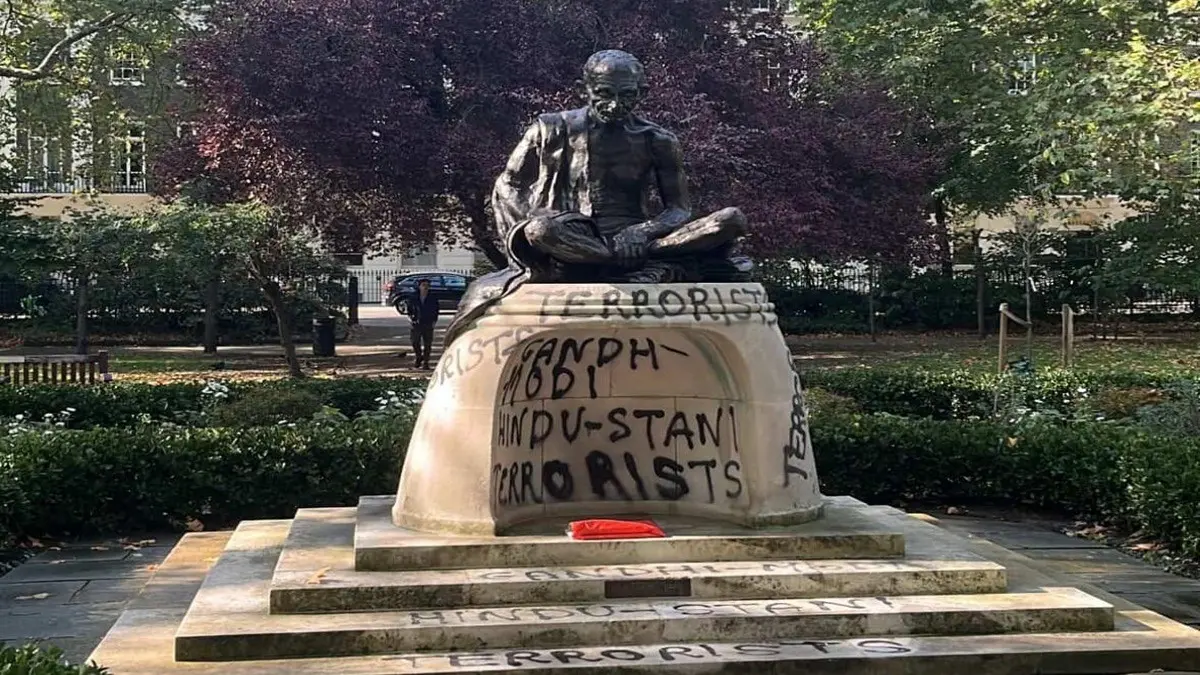
London: The Indian High Commission in London has strongly condemned the vandalism of Mahatma Gandhi's statue at Tavistock Square, terming it a shameful act that assaults the legacy of non-violence. The vandalism of Mahatma Gandhi's statue in London has drawn massive outrage, with the High Commission urging immediate action to restore the statue to its original dignity.
The Gandhi statue at Tavistock Square has stood for over half a century as a symbol of peace and resilience. Sculpted by artist Fredda Brilliant, it was unveiled on May 17, 1968, by then British Prime Minister Harold Wilson.
The statue portrays Gandhi seated in a meditative pose and has become an iconic landmark in London. For many years, especially during the 1970s and 1980s, the seated figure of Gandhi was used by state broadcaster Doordarshan as the visual identifier for its news bulletins.
The Tavistock Square area has earned the reputation of being London's ‘peace park’ due to the presence of several peace memorials. These include a cherry tree planted in memory of the victims of the Hiroshima bombing, a field maple planted in 1986 by the League of Jewish Women to mark the United Nations' International Year of Peace, and a granite memorial unveiled in 1995 by composer Michael Tippett to honour conscientious objectors.
Advertisement
The square lies close to University College London, which lists the chief architect of the Indian independence movement among its alumni.
The Indian High Commission has taken up the matter strongly with the local administration, urging them to take immediate action against the perpetrators. The embassy's team has already reached the site and is coordinating with officials to ensure the statue is restored to its original dignity.
Advertisement
The attack on the statue is seen as not just an act of vandalism but a violent attack on the idea of nonviolence, especially given its timing just three days before the International Day of Nonviolence.