
Map Says It All: US Map in India-US Trade Framework Shows PoK, Aksai Chin as Part of India
India and the U.S. revealed an interim trade agreement framework, featuring a U.S. map that designates Jammu and Kashmir, including Pakistan-occupied Kashmir and Aksai Chin, entirely as part of India.
- World News
- 2 min read

;'%3e%3cpath%20d='m8,15.99c4.41,0,7.99-3.58,7.99-7.99S12.41,0,8,0,0,3.59,0,8s3.58,7.99,7.99,7.99Z'%20style='stroke:%23fff;%20stroke-miterlimit:10;%20stroke-width:.02px;'/%3e%3cpath%20d='m3.08,3.37l3.82,5.11-3.84,4.15h.87l3.37-3.64,2.72,3.64h2.94l-4.04-5.39,3.58-3.87h-.86l-3.1,3.35-2.5-3.35h-2.94Zm1.27.64h1.35l5.97,7.99h-1.35l-5.97-7.99Z'%20style='fill:%23fff;'/%3e%3c/g%3e%3c/svg%3e)


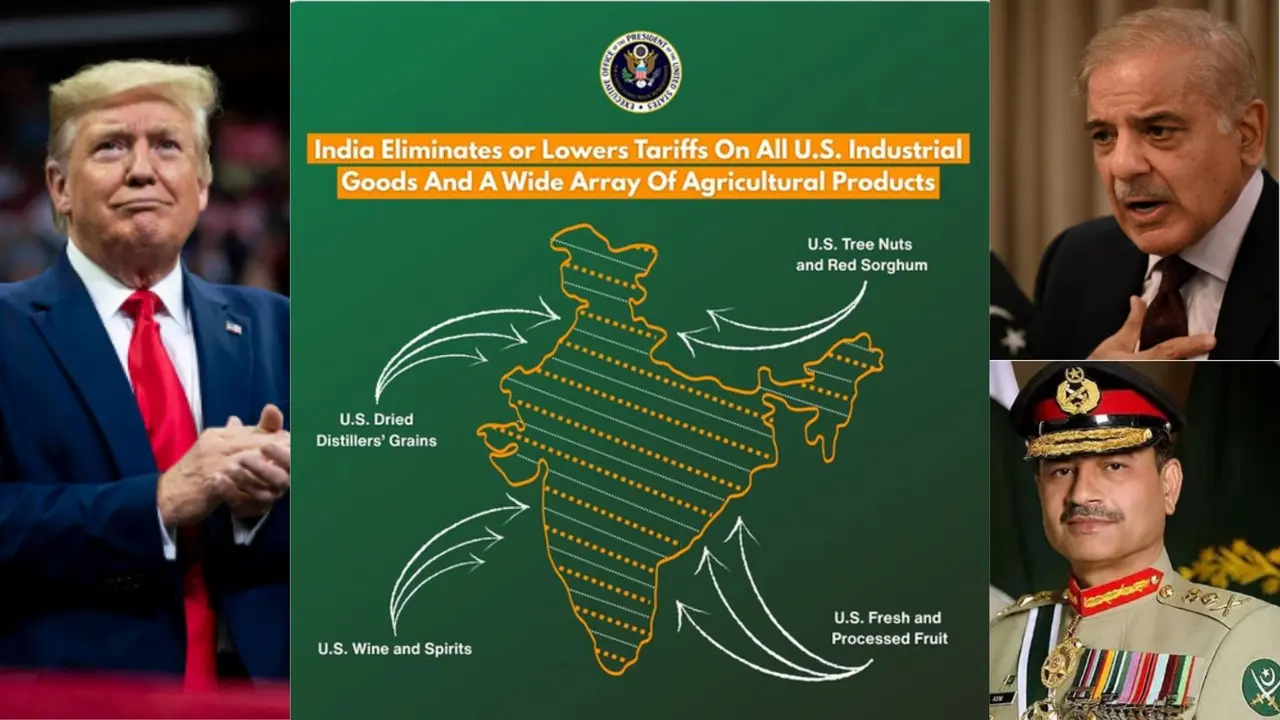
New Delhi: As India and the United States unveiled a framework for an interim trade agreement, a map released by the United States Trade Representative (USTR) drew significant attention by depicting the entire region of Jammu & Kashmir, including Pakistan-occupied Kashmir (PoK), as part of India.
The map, shared by the USTR alongside details of the new trade deal framework, showed no Line of Control or disputed boundary between Indian-administered Kashmir and PoK - a break from previous practice where U.S. government maps often depicted disputed territories with clear demarcations or annotations.
The map also showed Aksai Chin as part of India, without any separate marking or note indicating it as a disputed territory. Aksai Chin, a high-altitude region in eastern Ladakh, has been under Chinese control since the 1962 India-China war, but is claimed by India as its sovereign territory. The depiction marks a departure from earlier US maps, which have typically shown the region with dotted lines or disclaimers acknowledging competing claims.
While India has long maintained that PoK is an integral and inalienable part of its territory, the explicit depiction on an official U.S. government map is being seen by analysts and political commentators as a symbolic diplomatic signal that aligns, at least cartographically, with India’s position on the territorial dispute.
Advertisement
In the past, maps on U.S. government websites occasionally showed PoK as part of Pakistan, prompting objections from New Delhi and subsequent removals or revisions. In one notable instance, the U.S. State Department acknowledged inaccuracies and temporarily pulled such maps after India protested.
The trade framework itself focuses on strengthening economic ties between the world’s two largest democracies, addressing market access, tariff reforms and broader cooperation — but the map has overshadowed much of the diplomatic discourse on social media and political platforms.
Advertisement
For New Delhi, however, the map’s inclusion in a major policy document of the U.S. administration represents a noteworthy moment in bilateral engagement and territorial diplomacy, even if the trade agreement itself is still under negotiation.