
'We're unified': Egypt's Sisi meets Iraqi PM, Jordan's King on his maiden trip to Baghdad
Egyptian President Abdel Fattah al-Sisi, on June 27, met Iraqi Prime Minister Mustafa al-Kadhimi and Jordan’s King Abdullah in Baghdad.
- World News
- 2 min read

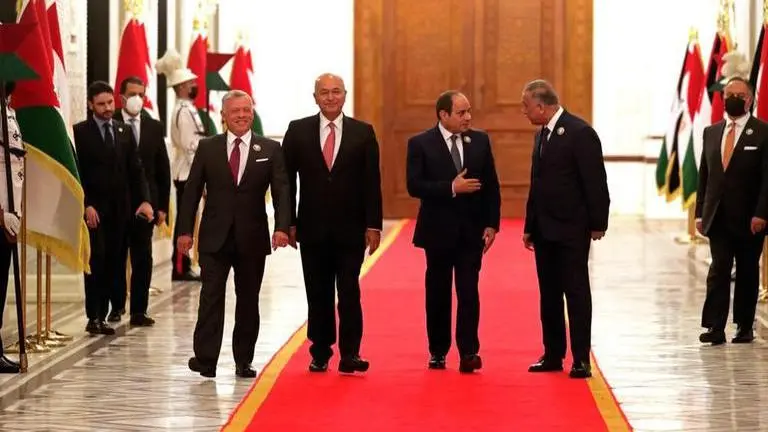
Egyptian President Abdel Fattah al-Sisi, on June 27, met Iraqi Prime Minister Mustafa al-Kadhimi and Jordan’s King Abdullah in Baghdad, marking the first-ever visit of an Egyptian leader to Iraq since Saddam Hussein invaded Kuwait in 1990. The three leaders were scheduled to hold the aforementioned summit back in April, but a train crash in Sohag led to its rescheduling. However, on Sunday, the three Middle Eastern statesmen deliberated upon a range of issues including the recent Palestinian crisis, combating regional territories and economic cooperation. Additionally, the Grand Renaissance Dam project and crisis in Syria was also discussed.
“This visit is an important message to our people that we are mutually supportive and unified to serve our people and the people of the region,” al-Kadhimi said, according to a statement from his office.
During the meet, the leaders stressed “the need to intensify consultation and coordination between the three countries on the most important regional issues,” according to a statement by the Egyptian presidency. A statement issued after the meeting said the three sides also agreed on the importance of security and intelligence coordination to combat terrorism, drug trafficking and cybercrime.
PM @MAKadhimi hosts in Baghdad a tripartite summit meeting with @KingAbdullahII of Jordan and President @AlsisiOfficial of Egypt.
— Government of Iraq - الحكومة العراقية (@IraqiGovt) June 28, 2021
Click here for more details: https://t.co/6emayFuiSq
Last February, Egypt signed 15 deals and memoranda of understanding in sectors including oil, roads, housing, construction and trade with Iraq after the latter approved the renewal of a contract to supply crude oil to EGPC in 2021. Meanwhile, Iraq had also signed cooperation deals in the energy, health and education sectors with both countries.
Al-Sisi's trip and 'Arab alliance'
The tripartite summit is a part of a tripartite cooperation framework launched in March 2019 by Cairo to enhance ties with Amman and Baghdad. Experts say that the potential “Arab alliance” could lead to several benefits, including in the field of energy diplomacy. It could also aid Iraq in reeling out of Iran's orbit of influence, which has been long encouraged by Washington, an arch-enemy of the Hassan Rouhani led Islamic Republic. Diplomacy between Cairo and Baghdad ruptured following the First Gulf War, which saw the US-led alliance (including Egypt) wage a war against Iraq in 1991. However, with al-Sisi landing in Baghdad, observers saw revitalized cooperation between the two states.
Advertisement
Image: AP