
NASA's Webb telescope reaches its final destination in space, 1 mln miles away from Earth
NASA's James Webb Space Telescope successfully fired a planned rocket on-course correction in a bid to manoeuvre itself into a permanent stable position.
- World News
- 2 min read

;'%3e%3cpath%20d='m8,15.99c4.41,0,7.99-3.58,7.99-7.99S12.41,0,8,0,0,3.59,0,8s3.58,7.99,7.99,7.99Z'%20style='stroke:%23fff;%20stroke-miterlimit:10;%20stroke-width:.02px;'/%3e%3cpath%20d='m3.08,3.37l3.82,5.11-3.84,4.15h.87l3.37-3.64,2.72,3.64h2.94l-4.04-5.39,3.58-3.87h-.86l-3.1,3.35-2.5-3.35h-2.94Zm1.27.64h1.35l5.97,7.99h-1.35l-5.97-7.99Z'%20style='fill:%23fff;'/%3e%3c/g%3e%3c/svg%3e)


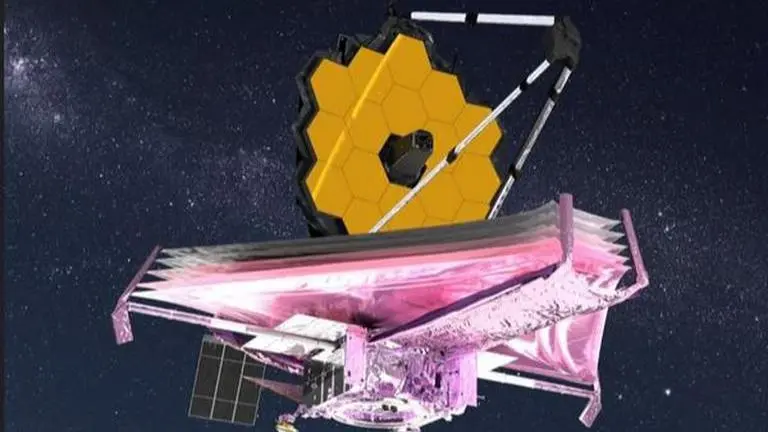
NASA on Monday informed that the James Webb Space Telescope (JWST) successfully fired a planned rocket on-course correction in a bid to manoeuvre itself into a permanent stable position at a point between the Earth and the Sun. According to a blog post, the giant golden mirror, which lifted off on Christmas Day last year, fully unfolded about 700,000 miles from Earth. The Webb fired its onboard thrusters for nearly five minutes to complete the final post-launch course correction to its trajectory, the US Space agency said.
“This mid-course correction burn inserted Webb toward its final orbit around the second Sun-Earth Lagrange point, or L2, nearly 1 million miles away from the Earth,” NASA added.
🏠 Home, home on Lagrange! We successfully completed our burn to start #NASAWebb on its orbit of the 2nd Lagrange point (L2), about a million miles (1.5 million km) from Earth. It will orbit the Sun, in line with Earth, as it orbits L2. https://t.co/bsIU3vccAj #UnfoldTheUniverse pic.twitter.com/WDhuANEP5h
— NASA Webb Telescope (@NASAWebb) January 24, 2022
As per the NASA blog post, Webb’s orbit will allow it a wide view of the cosmos at any given moment, as well as the opportunity for its telescope optics and scientific instruments to get cold enough to function and perform optimal science. The US space agency informed that now that Webb’s primary mirror segments and secondary mirror have been deployed from their launch positions, engineers will begin the sophisticated three-month process of aligning the telescope’s optics to nearly nanometer precision.
About James Webb Space Telescope
The $10 billion project, which is a collaboration between NASA, the European Space Agency and the Canadian Space Agency, hopes to look further back in time than ever before in order to find out more about the creation of the first stars and the beginnings of our Universe. The telescope could help researchers understand the origins of the universe and begin to answer key questions about our existence. Moreover, the James Webb Space Telescope is believed to be the most powerful space telescope ever built.
According to ESA, this device is fully capable of penetrating thick layers of dust obscuring regions of intense star birth. This would allow Webb to the very first generation of galaxies from billions of years ago as well as study the sites of planet formation. In addition to this, the telescope using MIRI will be able to detect the light emitted, reflected or transmitted by exoplanets orbiting other stars outside our solar system.