
Netanyahu Pushes ‘Greater Israel’ Agenda with Gaza City Operation Despite Opposition
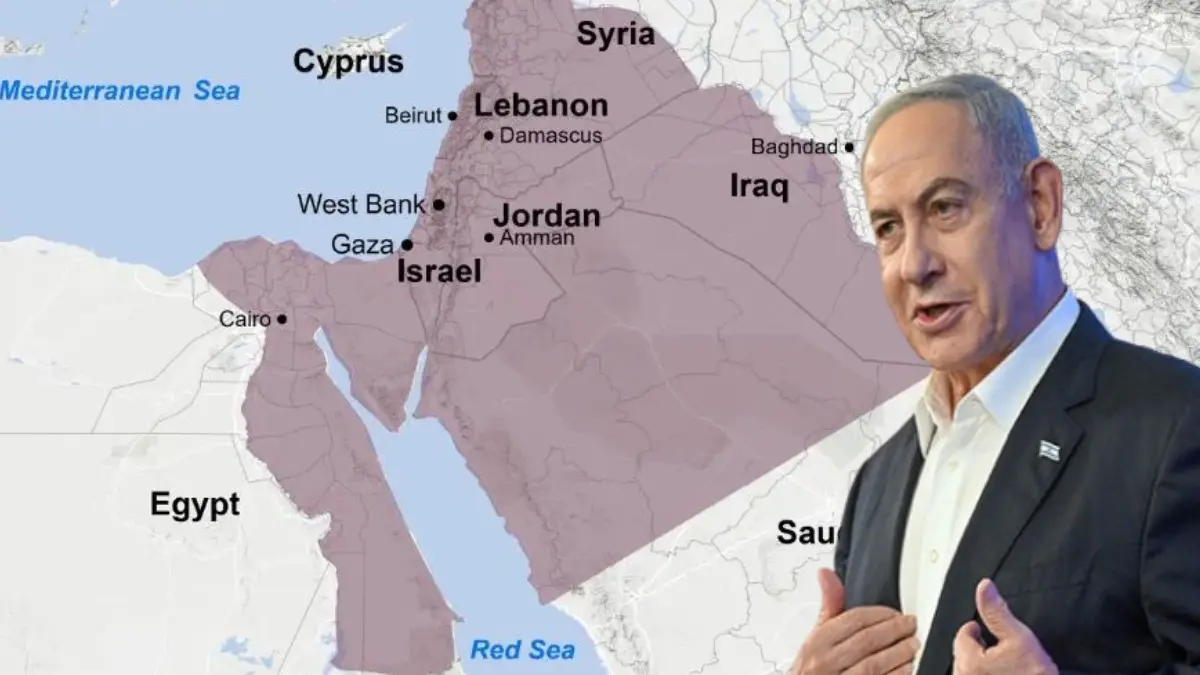
Netanyahu has also openly endorsed the ultranationalist vision of a “Greater Israel,” calling it his “historic and spiritual mission,” sparking outrage across the globe.
- World News
- 4 min read

;'%3e%3cpath%20d='m8,15.99c4.41,0,7.99-3.58,7.99-7.99S12.41,0,8,0,0,3.59,0,8s3.58,7.99,7.99,7.99Z'%20style='stroke:%23fff;%20stroke-miterlimit:10;%20stroke-width:.02px;'/%3e%3cpath%20d='m3.08,3.37l3.82,5.11-3.84,4.15h.87l3.37-3.64,2.72,3.64h2.94l-4.04-5.39,3.58-3.87h-.86l-3.1,3.35-2.5-3.35h-2.94Zm1.27.64h1.35l5.97,7.99h-1.35l-5.97-7.99Z'%20style='fill:%23fff;'/%3e%3c/g%3e%3c/svg%3e)


Tel Aviv: Nearly two years into the Gaza war, Israel shows no sign of de-escalating despite mounting domestic unrest and growing unease among some of its closest allies. Prime Minister Benjamin Netanyahu continues to press forward with an expanded military campaign in Gaza City, a move seen by critics as tied to his openly declared vision of a “Greater Israel.”
On Thursday, the Israeli military reached out to medical teams and international organisations in northern Gaza, urging them to evacuate ahead of what officials described as a major escalation. The announcement came just a day after the call-up of 60,000 reservists and the extension of service for another 20,000 soldiers already in uniform, signalling preparations for an extensive and prolonged campaign.
Netanyahu is expected to give his final approval for the operation during a late-night Security Cabinet meeting, according to an Israeli official, who spoke on condition of anonymity. Meanwhile, at least 36 Palestinians were reported killed in fresh airstrikes across central and southern Gaza on Thursday, even as protests erupted in both Gaza and Israel against the government’s military plans.
Although Israel claims to have eliminated much of Hamas’ senior leadership, officials acknowledge that the group has managed to regroup and carry out fresh attacks, including rocket launches. Israeli forces have already been operating in Gaza City’s Zeitoun neighbourhood and Jabaliya refugee camp, laying the groundwork for the upcoming offensive.
Advertisement
The anticipated assault has drawn sharp international criticism, particularly over Israel’s restrictions on humanitarian aid such as food and medicine. Concerns remain high that an intensified offensive could trigger another wave of forced displacement for Palestinians.
At a press briefing in Tokyo, UN Secretary-General Antonio Guterres renewed his appeal for an immediate ceasefire and the unconditional release of hostages. He warned that a new offensive in Gaza City would inevitably lead to “massive death and destruction.”
Advertisement
On Thursday, rare public protests took place in Gaza City, where displaced families gathered among rubble and makeshift shelters, carrying banners that read “Save Gaza” and “Stop the war.” Women and children joined the demonstration, chanting against the ongoing offensive and forced migration. “We want the war on Gaza to stop. We don’t want to migrate. Twenty-two months … it’s enough,” said Bisan Ghazal, a woman displaced from eastern Gaza City.
Amjad Al-Shawa, director of the Palestinian NGO Network, described the humanitarian toll as catastrophic. “We have lost more than 10% of our residents, 85% of our buildings and infrastructure, and much of our cultural and historic heritage. All of Gaza is threatened with destruction,” he said.
Additional protests are planned in Tel Aviv, as public frustration grows over the government’s handling of the conflict. Meanwhile, the Palestinian Health Ministry reported that the death toll since the start of the war has climbed to 62,192. Starvation and malnutrition have claimed 271 lives so far, including 112 children.
Netanyahu’s ‘Greater Israel’ Vision
While the military campaign dominates headlines, Netanyahu’s recent remarks have added a new layer of controversy. In an interview, the prime minister openly embraced the idea of “Greater Israel,” describing his commitment as both “historic” and “spiritual.”

When asked directly by former right-wing MP Sharon Gal whether he identified with the vision of Greater Israel, Netanyahu replied, “Very much.” Pressed further, he repeated the phrase with emphasis, later explaining: “My parents’ generation had to establish the state. Our generation has to guarantee its continued existence. I see that as a great mission.”
During the interview, Gal presented Netanyahu with an amulet symbolising a map of the Promised Land. Though the exact map was not displayed, the concept of “Greater Israel” traditionally includes not only Israel, Gaza, and the West Bank, but also parts of Egypt, Lebanon, Syria, and Jordan.
The remarks have provoked a storm of condemnation across the Arab world. Saudi Arabia’s foreign ministry issued a strong statement rejecting what it called Israel’s “expansionist ideas,” warning that such ambitions posed “a threat to regional and global security.”
The idea of “Greater Israel” is not new. It has been part of ultranationalist discourse for more than a century, predating the modern Israeli state itself. Theodor Herzl, widely regarded as the founder of Zionism, recorded in his diaries that Eretz Yisrael was envisioned not only within the confines of historic Palestine but stretching from “the brook of Egypt to the Euphrates.” This expansive view included the Sinai Peninsula, parts of Egypt, Cyprus, and beyond.
Although only a fringe segment of Israeli society has consistently supported this maximalist vision, Netanyahu’s open endorsement has brought the concept back into mainstream political debate at a time of intense conflict and humanitarian crisis.