
Netanyahu Vows Israeli Forces Will Stay in Southern Lebanon 'As Long as Necessary' Despite Growing Pressure From Trump and Ceasefire
Despite a US-Iran ceasefire deal, Netanyahu vows Israeli forces will remain in southern Lebanon as drone strikes and cross-border violence continue.
- World News
- 4 min read

;'%3e%3cpath%20d='m8,15.99c4.41,0,7.99-3.58,7.99-7.99S12.41,0,8,0,0,3.59,0,8s3.58,7.99,7.99,7.99Z'%20style='stroke:%23fff;%20stroke-miterlimit:10;%20stroke-width:.02px;'/%3e%3cpath%20d='m3.08,3.37l3.82,5.11-3.84,4.15h.87l3.37-3.64,2.72,3.64h2.94l-4.04-5.39,3.58-3.87h-.86l-3.1,3.35-2.5-3.35h-2.94Zm1.27.64h1.35l5.97,7.99h-1.35l-5.97-7.99Z'%20style='fill:%23fff;'/%3e%3c/g%3e%3c/svg%3e)


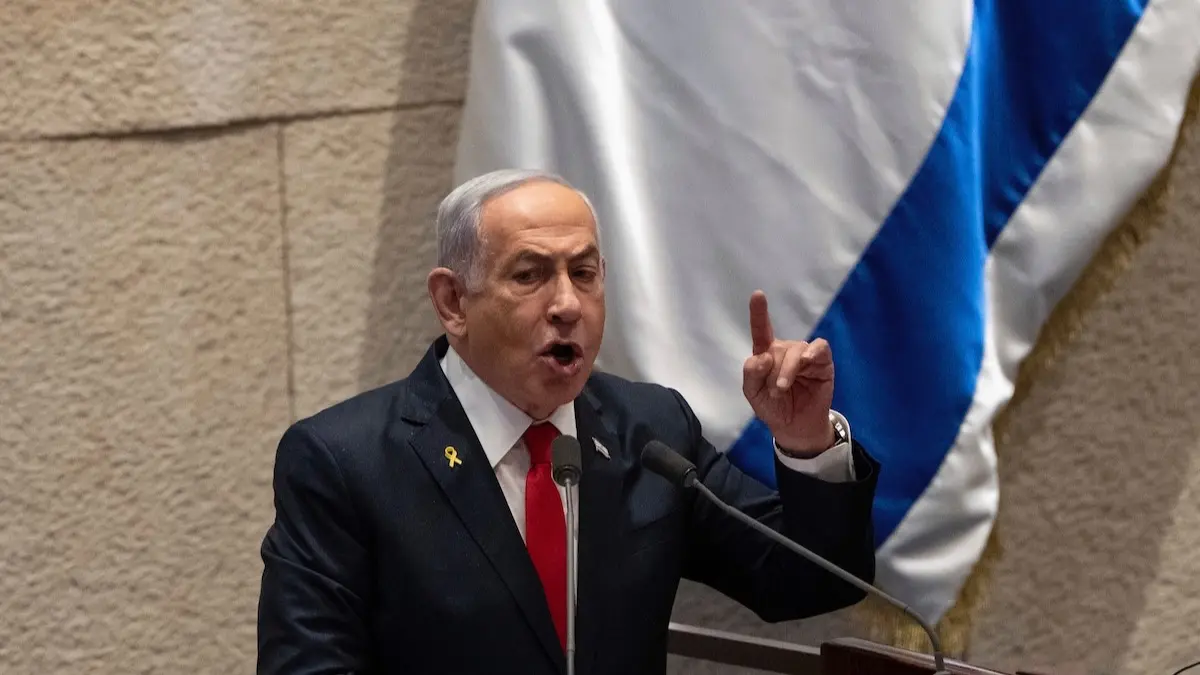
Israeli military forces will remain positioned in southern Lebanon "for as long as Israel’s security needs require it," Prime Minister Benjamin Netanyahu has vowed. The statement comes amid a fresh wave of violence, with Lebanese state media reporting that recent Israeli air attacks have killed at least three people.
The deadly strikes occurred just days after the United States and Iran signed an interim agreement aimed at ending their war across all fronts, including Lebanon.
Casualties Rise Amid Continued Drone Strikes
Lebanon’s National News Agency (NNA) reported on Thursday that an Israeli drone strike targeted a vehicle near the town of Kfar Tebnit, killing two people. A separate Israeli attack in Zabadin claimed at least one more life.
Additionally, another drone strike in the town of Beit Yahoun, located within the Nabatieh governorate, left two people wounded.
Advertisement
These operations coincide with mounting international pressure on Israel to halt its military actions in Lebanon and withdraw its occupying forces, as outlined under the US-Iran ceasefire extension agreement.
Israel Outlines Military Positions and Territorial Claims
Defying pullout pressures, the Israeli military released a map on Thursday detailing its current troop positions inside southern Lebanon. The map shows forces extending roughly 10 kilometers (6.2 miles) into Lebanese territory along a designated "Yellow Line"—a framework mirroring the Israeli military strategy utilized in the besieged Gaza Strip.
Advertisement
According to maritime legal experts, this mapped zone extends beyond land borders into Lebanon’s maritime territory, a move that would violate the 2022 Lebanon-Israel maritime agreement. This specific marine area contains Lebanon’s Qana gas project, an asset whose exploration rights were explicitly guaranteed to Lebanon under the 2022 US-brokered border pact.
Domestic Pressure and Political Defiance
Domestically, Netanyahu is facing intense scrutiny from within his own political circle to adopt a firmer stance against US demands regarding Lebanon.
“Prime Minister Netanyahu needs to tell Trump ‘enough’,” Moshe Saada, a politician from Netanyahu’s ruling Likud party, told Reuters. “I am bound to defend Israelis, and withdrawing from Lebanon right now poses an existential threat to Israel. Duty demands that we strike Lebanon everywhere, around the clock, with maximum force and with no proportionality.”
Trump Criticizes Netanyahu’s Military Actions
The latest string of military operations in southern Lebanon has drawn sharp criticism from US President Donald Trump. On Wednesday, Israeli drone strikes wounded several individuals in Mansouri and Aaziyyeh, while fighter jets struck Nabatieh al-Fawqa and Kfar Tebnit.
While the Israeli military has not commented directly on these specific attacks, it confirmed that five of its soldiers were wounded in a separate drone strike launched by the Iran-backed armed group Hezbollah. Meanwhile, Pakistan, acting as a mediator, affirmed that the comprehensive peace agreement signed between the US and Iran explicitly encompasses Lebanon.
On Tuesday, speaking at the G7 summit in France, President Trump remarked that Israel's prime minister needed "to be more responsible with respect to Lebanon." Trump noted that Israel had been fighting Hezbollah for "too long and too many people are being killed."
Strained Relations and the History of the Conflict
Despite the announcement of the US-Iran agreement on Sunday night, both Israel and Hezbollah have continued to trade cross-border attacks. Earlier that same day, an Israeli air strike hit Beirut following a Hezbollah rocket attack, complicates final efforts to solidify the diplomatic deal. Trump emphasized his "great relationship" with Netanyahu during the G7 summit, but openly expressed dissatisfaction with the timing of the escalations, stating, "I didn't like that he did an attack... that was too much." He further underscored US leverage, adding: “Without the United States, there would be no Israel. Without me, there would be no Israel because no other president was willing to do what I did.”
Netanyahu countered on Monday, reiterating that Israeli forces will stay stationed in Lebanon "for as long as necessary." Following reports of four civilian deaths from subsequent Israeli strikes on Tuesday, Iran's top military command issued a stern warning, promising a "harsh response" if Israel does not cease its military actions in southern Lebanon.
The broader conflict escalated on March 2, when Lebanon was drawn into the war after Hezbollah launched retaliatory rockets into Israel following a strike that killed Iran's supreme leader. Israel responded with an expansive bombing campaign and a ground invasion across the southern region of Lebanon. According to Lebanon's health ministry, more than 3,800 people have been killed in Lebanon throughout the conflict, though official figures do not differentiate between combatants and civilians. On the other side of the border, Israeli authorities state that 30 soldiers and four civilians have lost their lives.