
Updated 9 October 2022 at 16:08 IST
New supercontinent 'Amasia' will develop when Pacific Ocean disappears, finds new study
The world might develop a new 'supercontinent' within 200 million to 300 million years as the Pacific Ocean is seen to be shrinking and closing
- World News
- 3 min read

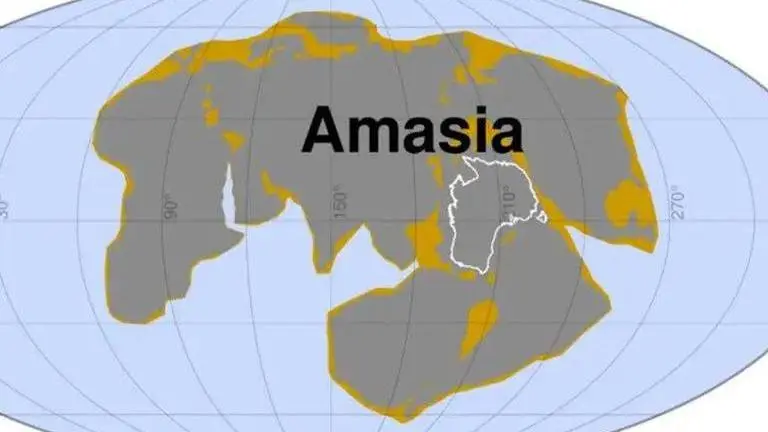
In the latest research, scientists discovered that Earth is undergoing certain unimaginable changes. The world might develop a new 'supercontinent' within 200 million to 300 million years as the Pacific Ocean is seen to be shrinking and closing. As per a Complex report, researchers from Curtin University in Australia and Peking University in China predicted that the Pacific Ocean's eventual disappearance would result in a geological reconfiguration of the planet.
The study, which has been published in the National Science Review, emphasises how the world's oldest and largest ocean started shrinking at the time of the dinosaurs and is still losing a few millimeters each year. This process, together with the shifting of tectonic plates, will result in the construction of the "Amasia" supercontinent.
Furthermore, the supercomputer was utilised by researchers to simulate the evolution of the tectonic plates of the planet and to witness the emergence of a potential supercontinent. On September 28, their findings were published in the journal.
According to the lead author and a research fellow in Curtin’s Earth Dynamics Research Group and the School of Earth and Planetary Sciences, Dr. Chuan Huang, “Over the past two billion years, Earth’s continents have collided together to form a supercontinent every 600 million years, known as the supercontinent cycle.” He further explained, “This means that the current continents are due to come together again in a couple of hundred of million years’ time”.
Advertisement
In addition to this, scientists hypothesise that supercontinents have formed in a broad variety of ways.
What is Amasia?
As per the estimations made by a supercomputer, researchers stated that Australia would join the continent Asia as the Americas will be dragged to the west. The masses will finally come together when Africa closes in on Europe and Antarctica will join South America.
Advertisement
The team's simulation revealed that the thickness and tensile strength of the tectonic plates beneath the seas had decreased over time as a result of Earth cooling over the course of billions of years since its birth, CNN reported. Further, the Atlantic or Indian oceans, which researchers believe to be relatively young oceans, probably developed as a result of the Earth's most recent supercontinent breaking apart and its fragments slowly drifting away.
According to the report from Complex, evidence suggests that every 600 million years, a supercontinent develops on Earth. Pangaea, the latest and most well-known, was founded around 300 million years ago and split between 120 and 130 million years later.
The research team discovered that the closing of a previous superocean that had previously encircled a once-colossal land mass increases the likelihood that a new supercontinent will arise when the tectonic plates lose strength and thickness.
Apart from this, the Earth's eco-system and biodiversity would be drastically altered by the collision of continents, according to research co-author Zheng-Xiang Li. “Earth as we know it will be drastically different when Amasia forms. The sea level is expected to be lower, and the vast interior of the supercontinent will be very arid with high daily temperature ranges,” citing Li, Complex reported.
(Image: Twitter/ @Umeshkd102)
Published By : Anwesha Majumdar
Published On: 9 October 2022 at 16:08 IST