
'On Their Way': Trump Signs Sweeping Order for 10% Global Tariffs After SC Setback, Says It Takes Effect 'Almost Immediately'
U.S. President Trump announced a 10% global tariffs on all imports, intensifying trade tensions following a Supreme Court ruling that deemed his previous tariff strategy unconstitutional. The Court ruled 6-3 that Trump lacked legal authority under the IEEPA Act to impose broad tariffs.
- World News
- 5 min read

;'%3e%3cpath%20d='m8,15.99c4.41,0,7.99-3.58,7.99-7.99S12.41,0,8,0,0,3.59,0,8s3.58,7.99,7.99,7.99Z'%20style='stroke:%23fff;%20stroke-miterlimit:10;%20stroke-width:.02px;'/%3e%3cpath%20d='m3.08,3.37l3.82,5.11-3.84,4.15h.87l3.37-3.64,2.72,3.64h2.94l-4.04-5.39,3.58-3.87h-.86l-3.1,3.35-2.5-3.35h-2.94Zm1.27.64h1.35l5.97,7.99h-1.35l-5.97-7.99Z'%20style='fill:%23fff;'/%3e%3c/g%3e%3c/svg%3e)


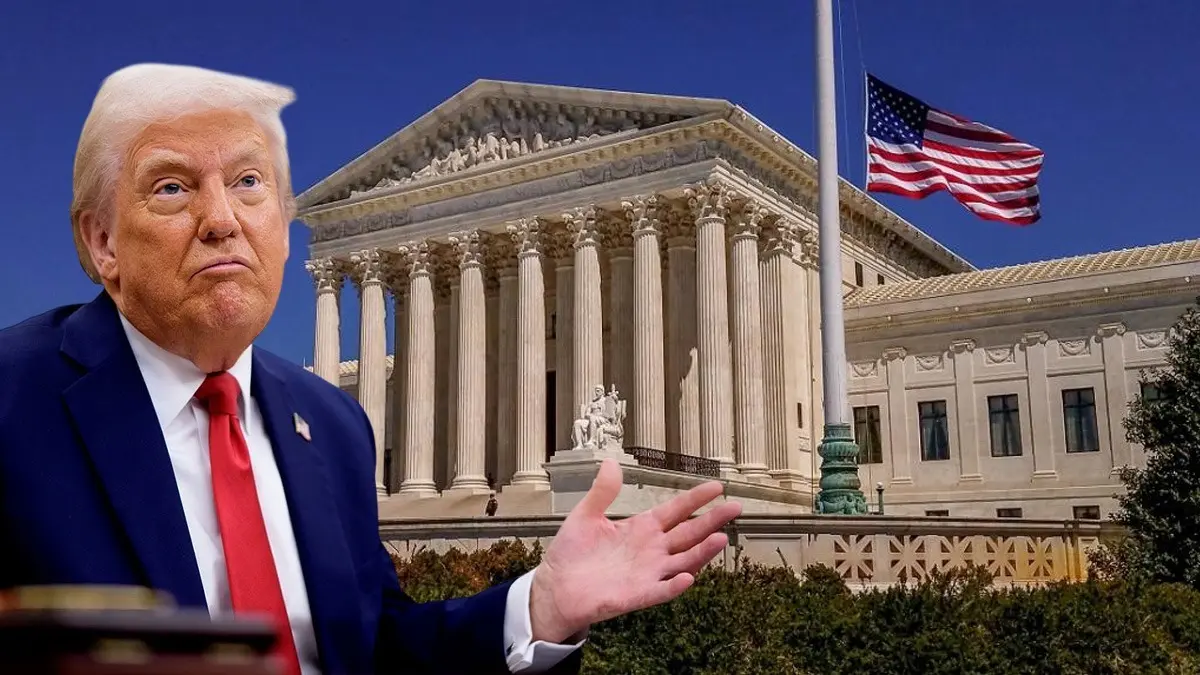
New Delhi: U.S. President Donald J. Trump announced sweeping new trade measures Saturday, signing an executive order to impose a 10 % global tariff on imports from all countries just hours after the U.S. Supreme Court dealt a major legal setback to his signature trade policy. The move marks a dramatic escalation in Washington’s trade agenda, intensifying economic uncertainty for global markets and diplomatic relations at a moment of heightened geopolitical tension.

Trump’s announcement came after the Supreme Court on Feb. 20, 2026, ruled that his earlier program of sweeping reciprocal tariffs - imposed under a broad emergency economic authority - was unconstitutional. In a 6-3 decision, the justices held that the president lacked the authority to impose broad import taxes using the International Emergency Economic Powers Act (IEEPA), a law Trump had cited to justify his tariffs on virtually all U.S. trading partners. The court emphasized that the Constitution grants exclusive taxing and tariff powers to Congress, not the executive branch.
Despite the legal rebuke, Trump made clear he is refusing to retreat from his trade offensive. In a televised press conference from the White House briefing room, he said he would sign a new order under Section 122 of the Trade Act of 1974, a far narrower legal authority - to impose a flat 10 % tariff on all imports over and above existing duties, effective within days.
“This will be over and above our normal tariffs already being charged,” Trump told reporters, framing the new tariff as an extension of his broader economic strategy aimed at “protecting American workers and fair competition.” He said the tariff would remain in place for about 150 days, the maximum period allowed under Section 122, during which the administration will pursue additional investigations and trade actions under other statutory provisions.
Advertisement
Supreme Court’s Rejection
The Supreme Court’s ruling struck down much of Trump’s so-called “reciprocal tariff” framework, which had imposed variable levies on imports from dozens of trading partners in an effort to pressure countries to negotiate better trade terms with the United States. Chief Justice John Roberts, writing for the majority, stressed that the Constitution’s allocation of taxing authority to Congress could not be overridden by executive claims of emergency powers.
The decision immediately invalidated large portions of Trump’s tariff regime and raised complex questions about the legality of hundreds of billions of dollars already collected in duties. The ruling also put in play potential refund claims by U.S. companies and importers who paid tariffs that were now deemed unlawful.
Trump’s Response
Trump responded to the ruling with unusually sharp criticism of the judiciary. In addition to his press briefing, he wrote on social media that the decision was “ridiculous” and declared he was “ashamed” of certain justices for what he said was an abandonment of “patriotic duty.” He also accused the court of being influenced by “foreign interests” and political opponents, claims that legal analysts say have no factual basis and which underscore the deep political tensions surrounding his trade agenda.
Advertisement
New Legal Pathways and Trade Strategy
Under the new plan, Trump said he would rely on Section 122 as well as Section 301 of the Trade Act of 1974 to sustain his tariff ambitions. Section 122 authorizes temporary import surcharges to address balance-of-payments issues and allows a tariff of up to 15 % for up to 150 days, a provision rarely used in modern trade law. Trump’s use of it would be unprecedented in recent decades. Section 301, on the other hand, permits trade actions against unfair foreign practices but generally requires lengthy investigations, limiting the speed and scope of additional levies.
Administration officials contend that these alternative authorities can maintain key elements of Trump’s strategy without congressional approval. However, critics say both tools are far more constrained than the broad powers Trump claimed under the emergency statute, and that future tariffs could be subject to litigation or legislative pushback.
Treasury officials, while supporting the administration’s right to pursue robust trade enforcement, have acknowledged that the loss of IEEPA authority complicates the legal foundation of the tariff regime. Markets reacted with volatility following the Supreme Court decision, with economists warning of potential disruptions to global supply chains and increased costs for U.S. consumers.
International Implications
Internationally, industry associations in Germany and the European Union have urged Brussels to clarify its trade strategy with Washington, warning that broad tariffs could undermine ongoing negotiations on critical trade deals and heighten trans-Atlantic tensions.
Some allies and trading partners celebrated the Supreme Court’s check on unilateral U.S. trade policy, while others expressed concern that Trump’s new 10 % tariff, even if temporary could reignite protectionist pressures and retaliatory measures. Analysts note that while sector-specific duties under other laws, such as national security tariffs, remain in place, the broader implications of Trump’s actions could reshape global commerce well into the next election cycle.
Future Developments
Trump’s new tariff authority under Section 122 will likely face immediate legal challenges, even as the administration seeks to fix loopholes left by the Supreme Court’s decision. Congress may also become more involved, with some lawmakers calling for clearer statutory boundaries on executive trade powers.
For now, the Trump administration’s aggressive trade stance underscores the deepening clash between branches of government over the scope of presidential authority and highlights the broader economic and geopolitical stakes of U.S. tariff policy on the global stage