
Pakistan’s Mineral Mirage, America’s Strategic Illusion and Why India Matters
Pakistan’s rare earth shipment to the US is more symbolism than substance. A deep dive into the geopolitical hype, structural flaws, China’s leverage, and what it really means for India and global supply chains.
- World News
- 5 min read

;'%3e%3cpath%20d='m8,15.99c4.41,0,7.99-3.58,7.99-7.99S12.41,0,8,0,0,3.59,0,8s3.58,7.99,7.99,7.99Z'%20style='stroke:%23fff;%20stroke-miterlimit:10;%20stroke-width:.02px;'/%3e%3cpath%20d='m3.08,3.37l3.82,5.11-3.84,4.15h.87l3.37-3.64,2.72,3.64h2.94l-4.04-5.39,3.58-3.87h-.86l-3.1,3.35-2.5-3.35h-2.94Zm1.27.64h1.35l5.97,7.99h-1.35l-5.97-7.99Z'%20style='fill:%23fff;'/%3e%3c/g%3e%3c/svg%3e)


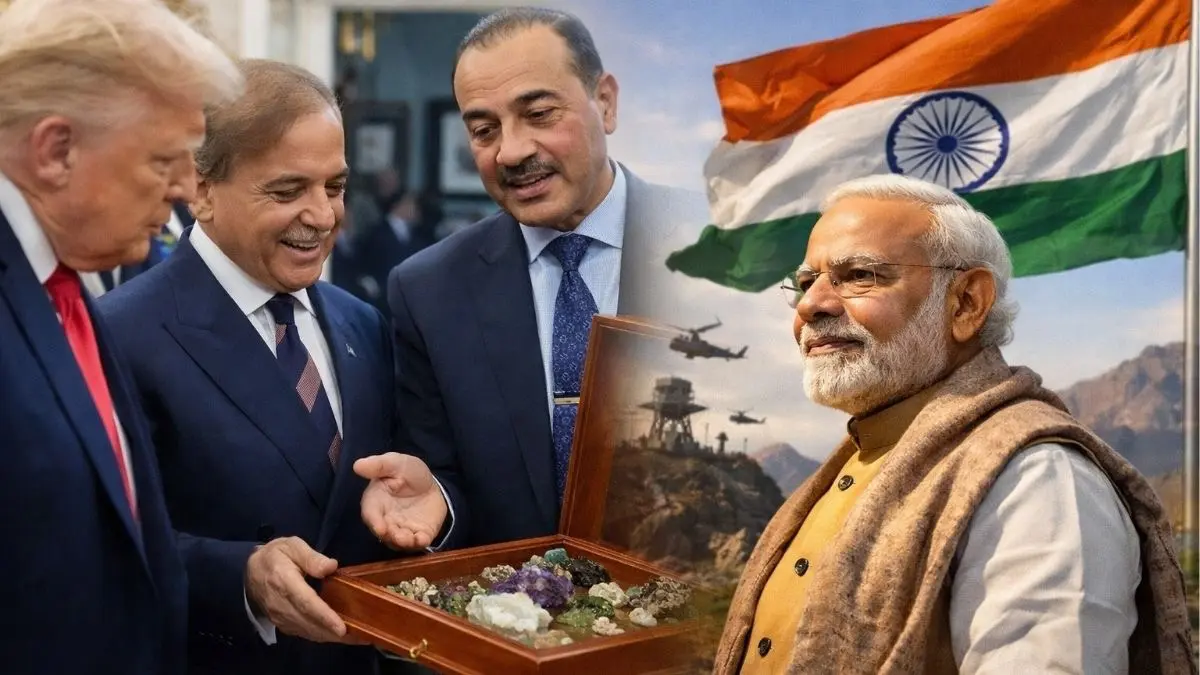
New Delhi: The October 2025 shipment of rare earth minerals from Pakistan to the United States was not about tonnage. It was about theatre. It was about optics. It was about two desperate states trying to convince the world - and themselves - that a new strategic chapter had begun. A $500 million agreement, a ceremonial first shipment, and grand declarations about resilient supply chains were carefully choreographed to send a message: Pakistan is “open for minerals business,” and America is “breaking free from China.”
But geopolitics does not run on press releases. It runs on geology, technology, governance, and cold economic logic. And when you scratch beneath the surface of this deal, what emerges is not a revolution in global supply chains but a fragile illusion built on hype, exaggeration, and strategic anxiety.
Pakistan’s claim that it sits atop $6 trillion worth of mineral wealth has been repeated so often that it has acquired the ring of truth through sheer repetition. Yet this figure exists in a vacuum. There is no JORC compliance. No NI 43-101 reporting. No independently certified feasibility studies. In the global mining industry, these are not optional niceties; they are the language of credibility. Major producers— Australia, Brazil, Canada, and yes, India - either follow these standards or operate under nationally recognised codes aligned with international norms. Pakistan does neither. What it offers instead are political numbers, not geological facts.
That distinction matters. Because possession of minerals is meaningless without the capacity to extract, process, refine, and export them at scale. Pakistan’s minerals sector contributes barely 3.2% to its GDP and an almost comical 0.1% to global mineral exports. These are not the numbers of a sleeping giant; they are the numbers of a structurally broken industry. When Prime Minister Shehbaz Sharif speaks of bidding farewell to the IMF on the back of mineral wealth, it is not optimism - it is economic fantasy. Mining does not rescue economies overnight. Even under ideal conditions, it takes decades.
Advertisement
Which brings us to the most uncomfortable question of all: if Pakistan’s mineral riches were so transformative, why has its “all-weather friend” China not already unlocked them?
China has invested over $65 billion into Pakistan through the China-Pakistan Economic Corridor. It controls over 90% of global rare earth refining and more than 60% of production. If any country had both the incentive and capability to turn Pakistan into a mineral powerhouse, it was China. Yet the results have been underwhelming, controversial, and in some cases environmentally disastrous. The Saindak copper mine stands as a cautionary tale - operational, yes, but opaque, locally resented, and accused of ecological damage and revenue suppression. For local communities, Chinese mining has brought neither prosperity nor sustainability.
Advertisement
This is the reality Washington is choosing to ignore in its eagerness to diversify away from China. Even if American firms help Pakistan extract rare earths, where will those minerals be refined? The United States does not have the industrial ecosystem to do it at scale. Pakistan certainly does not. That leaves China - the very dependency America claims it wants to escape.
The irony is brutal. The U.S. may mine in Pakistan only to knock on Beijing’s door for processing. And Beijing, being Beijing, will decide whether to open that door. China’s temporary suspension of export controls on five rare earth minerals may have bought Washington some breathing room, but it solved nothing structurally. It merely delayed vulnerability. When that suspension ends, leverage returns to China - undiminished and unapologetic.
Pakistan’s internal constraints further complicate the fantasy. Its mining technology is outdated, inefficient, and heavily skewed toward exporting raw materials. This is the colonial-era model of resource extraction - dig, ship, and surrender value addition to others. Every tonne of unprocessed mineral exported is revenue lost, jobs forfeited, and strategic leverage handed away. Building refining infrastructure across Pakistan’s sparsely distributed reserves would require astronomical investment, political stability, and regulatory clarity - three things Pakistan has chronically lacked.
Then there is the bureaucratic landmine known as the 18th Constitutional Amendment. By devolving control over natural resources to provincial governments, Pakistan effectively fragmented authority over its minerals. The federal government can sign agreements and make promises, but it cannot guarantee delivery. Provinces have veto power. Local politics matter. Tribal dynamics matter. Security risks matter. Any American firm entering this space will discover very quickly that Islamabad’s assurances mean little once ground realities intervene.
So what does all this mean for India?
First, it confirms a long-standing truth New Delhi understands far better than Washington: supply chain resilience is not built on shortcuts. India has quietly invested in mapping its own critical mineral reserves, building international partnerships, and developing domestic processing capacity. It has not announced trillion-dollar fantasies or IMF exit dreams. Instead, it has focused on incremental, institutional capacity-building - slow, unglamorous, but real.
Second, the U.S.-Pakistan mineral courtship will not significantly alter India-U.S. strategic relations. Washington’s engagement with Islamabad here is transactional, not transformational. It is driven by China anxiety, not Pakistan confidence. India remains America’s only credible long-term partner in building non-Chinese critical mineral ecosystems - precisely because India offers governance stability, regulatory coherence, and technological ambition Pakistan lacks.
Finally, this episode exposes Pakistan’s enduring problem: it wants strategic relevance without structural reform. Minerals are being marketed as salvation when they are, at best, a distant possibility. Without transparency, technology, environmental safeguards, and political coherence, Pakistan’s mineral wealth will remain what it has always been - potential energy trapped under layers of dysfunction.
In geopolitics, symbolism fades fast. Reality does not. And reality suggests that this shipment to America was less the beginning of a new era and more a reminder of how far Pakistan still is from becoming the mineral power it claims to be - and how cautiously India must watch, knowing that hype elsewhere often masks opportunity at home.