
PM Modi In The Hague: India-Netherlands Trade Ties Hit New High As 300 Dutch Firms Invest
PM Modi in The Hague said that over 300 Dutch firms are now part of India’s growth story as the Netherlands becomes India’s top European investor, announcing a strategic partnership and green hydrogen roadmap to deepen trade and tech ties.
- World News
- 6 min read

;'%3e%3cpath%20d='m8,15.99c4.41,0,7.99-3.58,7.99-7.99S12.41,0,8,0,0,3.59,0,8s3.58,7.99,7.99,7.99Z'%20style='stroke:%23fff;%20stroke-miterlimit:10;%20stroke-width:.02px;'/%3e%3cpath%20d='m3.08,3.37l3.82,5.11-3.84,4.15h.87l3.37-3.64,2.72,3.64h2.94l-4.04-5.39,3.58-3.87h-.86l-3.1,3.35-2.5-3.35h-2.94Zm1.27.64h1.35l5.97,7.99h-1.35l-5.97-7.99Z'%20style='fill:%23fff;'/%3e%3c/g%3e%3c/svg%3e)


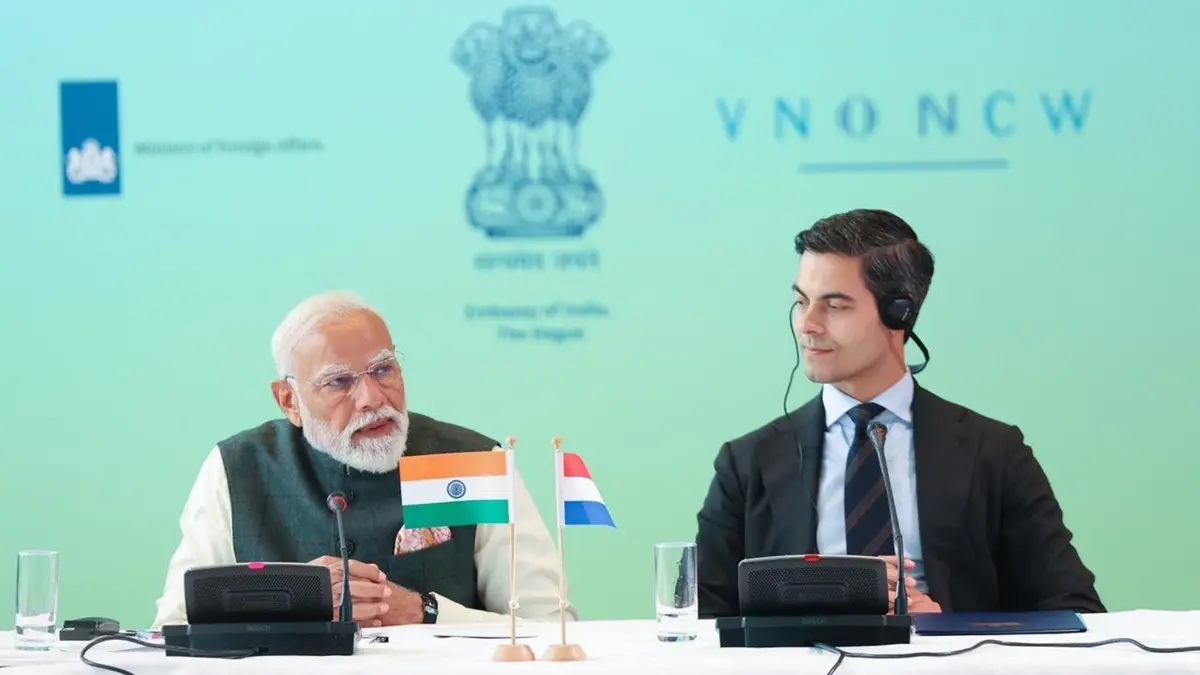
Amsterdam: Prime Minister Narendra Modi, who is on his visit to 5 nations, addressed business leaders in The Hague on Saturday, outlining that the economic partnership between India and the Netherlands had entered a new phase, underpinned by growing trade and investment flows. Speaking at a CEOs Roundtable, PM Modi declared that over 300 Dutch firms were now active participants in India’s growth story, which is an example of their confidence in the country’s trajectory.
Prime Minister Modi underlined that the Netherlands had become India’s largest investor from Europe and its second-largest trading partner. He credited this momentum to the shared vision of businesses on both sides, noting that Dutch companies were no longer just brands in India but active contributors to its industrial and technological advancement.
The prime minister visited the Netherlands as part of the second leg of his 5-nation tour, which included the UAE, the Netherlands, Sweden, Norway and Italy. After The Hague, the Prime Minister is set to travel to Sweden on May 17-18 for talks with Prime Minister Ulf Kristersson, with a joint address alongside European Commission President Ursula von der Leyen planned on AI, emerging technologies, green transition and resilient supply chains.
Dutch Companies Deepen Roots In India’s Growth Story
Addressing executives of some of the world’s most innovative firms, PM Modi asserted that the presence of over 300 Dutch companies reflected more than commercial interest. “Because of your vision and confidence in India, the Netherlands has become India’s largest investor from Europe and the second-largest trading partner,” he added.
Advertisement
The PM singled out several firms for their role in shaping India’s industrial sector. According to PM Narendra Modi, NXP, Philips and Prosus were developing world-leading solutions using Indian talent, while APM, Damen and Royal Vopak were transforming the country’s ports, shipping and logistics sectors. He also pointed to collaborations in agriculture and sustainability aimed at securing a better future globally.
A recent agreement between ASML and Tata was termed as a milestone for India’s semiconductor ambitions. “A short while ago, an MOU was signed between ASML and Tata; now, semiconductor chips will be manufactured in India with ASML’s equipment,” PM Modi said, framing it as a sign of deepening technological cooperation.
Advertisement
India's Positions On Scale And Stability Play
The Indian Prime Minister emphasised that India now embodied both scale and stability, two attributes that were evident in the optimism expressed by business leaders at the roundtable. He also pledged that his government would convert that optimism into tangible outcomes.
“Today’s India is a symbol of scale and stability…..We are the world’s fastest-growing major economy and also the world’s largest talent pool. No one in the world can match India’s speed in infrastructure, clean energy, or connectivity. For this reason, India is contributing 17% to global growth today,” he said.
Talking about the stability, the Prime Minister noted that he had completed 12 years as head of the world’s largest democracy, a period marked by continuous reforms to reshape India’s economic DNA. He explained that the focus had been on providing policy predictability and expanding opportunities for the private sector. Further, he added that the sectors once closed to private participation, including space, mining and nuclear energy, were now open.
PM Modi also pointed to efforts to reduce compliance burdens and improve the ease of doing business. “Recently, we have carried out next-generation reforms in areas like taxation, labour code, and governance. Now, manufacturing in India is becoming very cost-effective,” he noted.
What Are Next Phase Of Growth
The Prime Minister said that these reforms were already yielding results, with electronics emerging as India’s largest export item after years of being a major import. He stated that the government was offering incentives in key sectors to help companies manufacture in India for global markets.
Additionally, in services, PM Narendra Modi said that India had become an engine of efficiency and innovation, powered by its talent base. He noted that global technology companies had set up Global Capability Centres across the country and invited Dutch firms to follow suit. “We also invite all of you to design and innovate in India, and there could be no better time for this than today,” the PM encouraged the business firms.
Looking ahead, PM Modi outlined that 2026 would mark the start of a new golden era in India-Europe relations. He referenced the recently signed India-European Union (EU) Free Trade Agreement (FTA), calling it a foundation for shared prosperity between two of the world’s largest democratic and responsible powers.
Strategic Partnership And Green Ambitions
Prime Minister Modi declared that he and Dutch PM Dick Schoof would take several decisions to unlock the full possibility of the FTA. These moves will include elevating the trusted partnership between India and the Netherlands into a strategic partnership, launching an ambitious joint roadmap on green hydrogen, and making technology cooperation more future-ready.
He also announced plans to strengthen talent mobility, university partnerships and joint research and development. “The future of the India-Netherlands partnership is brighter than ever before,” the prime minister said.
PM Modi, while closing his address with a Dutch proverb, urged businesses to be bolder in their India engagement, saying, “Ships are safe in harbour, but ships are not built to stay in harbour….Your country has been moving forward for centuries in search of new opportunities. I assure you that your search in India will be successful and meaningful. Now you have to venture more boldly in India.”
After concluding engagements in the Netherlands, PM Narendra Modi will head to Sweden for bilateral talks with Prime Minister Ulf Kristersson. The leaders are expected to address the European Round Table for Industry alongside European Commission President Ursula von der Leyen. The discussions are likely to focus on AI, emerging technologies, the green transition and building resilient supply chains.
Netherlands Returns Chola Plates To India
Earlier, at a ceremony in the Netherlands, Leiden University Library handed over 11th-century Chola Copper Plates to the Indian government on Saturday, with PM Modi and his Dutch counterpart in attendance. The set consists of 21 large and three smaller plates, which serve as royal charters issued by Chola rulers during the 11th century CE.
The documents recorded the gifting of Anaimangalam village to the Chulamanivarma-vihara, a Buddhist monastery in Tamil Nadu's Nagapattinam, and are inscribed in both Tamil and Sanskrit. The officials noted that the plates are more than historical artefacts, calling them an invaluable record of India’s heritage and civilisation whose return carries deep emotional significance for the country. Prime Minister Modi called the restitution a joyous moment for every Indian.