
'Power Be To God': Message That Sparked Panic In Pentagon During US Airman’s 24-Hour Survival in Iran
During a rescue operation in Iran, a radio message-“Power be to God”-sent concerns through the Pentagon, raising fears that a downed US airman was captured. This phrase was deemed unusual under military survival protocols, signaling potential coercion.
- World News
- 3 min read

;'%3e%3cpath%20d='m8,15.99c4.41,0,7.99-3.58,7.99-7.99S12.41,0,8,0,0,3.59,0,8s3.58,7.99,7.99,7.99Z'%20style='stroke:%23fff;%20stroke-miterlimit:10;%20stroke-width:.02px;'/%3e%3cpath%20d='m3.08,3.37l3.82,5.11-3.84,4.15h.87l3.37-3.64,2.72,3.64h2.94l-4.04-5.39,3.58-3.87h-.86l-3.1,3.35-2.5-3.35h-2.94Zm1.27.64h1.35l5.97,7.99h-1.35l-5.97-7.99Z'%20style='fill:%23fff;'/%3e%3c/g%3e%3c/svg%3e)


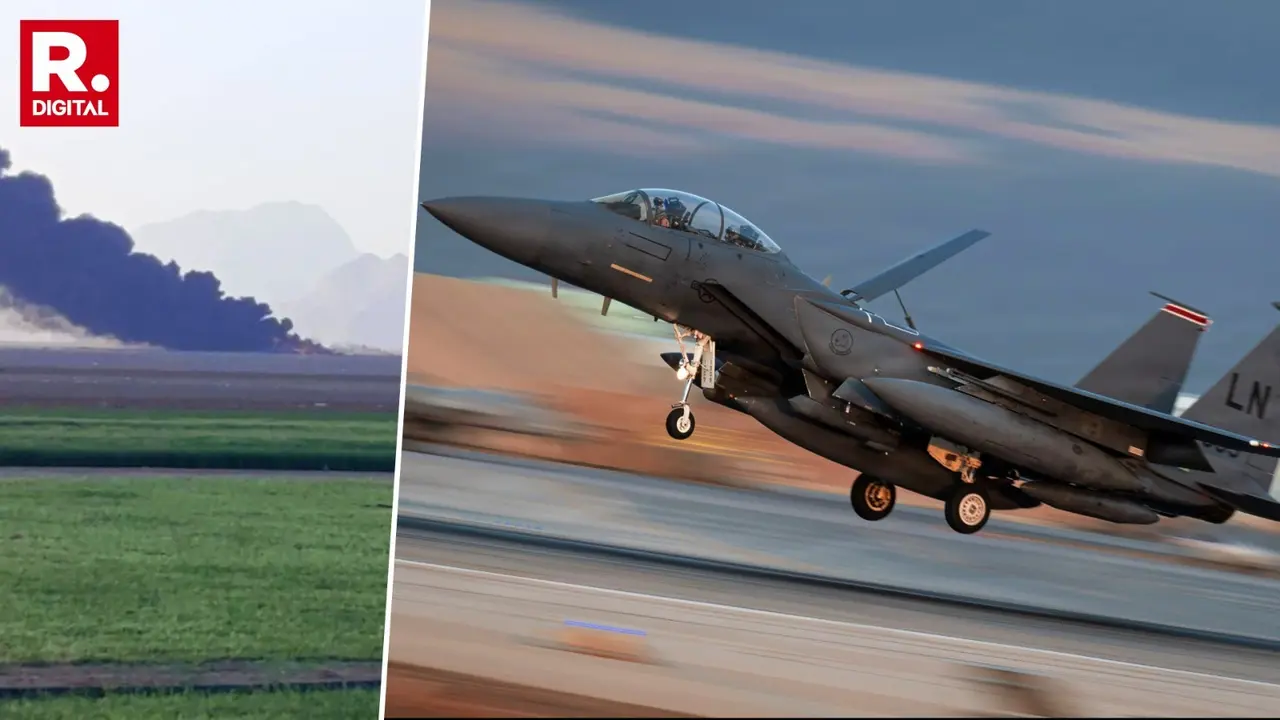
New Delhi: In the middle of a high-risk rescue operation deep inside Iran, a seemingly simple radio message — “Power be to God” — sent ripples of concern through the Pentagon, briefly raising fears that a downed American airman may have fallen into enemy hands.
The phrase, reportedly transmitted by the stranded U.S. weapons systems officer after his F-15 fighter jet was shot down over Iran, was considered “off-script” and unusual under strict military survival protocols. According to officials, such deviations can signal possible coercion, capture, or compromised communication — prompting immediate suspicion within U.S. defence circles.
Why the Phrase Raised Red Flags
Downed airmen are trained under Survival, Evasion, Resistance and Escape (SERE) protocols to use pre-approved authentication codes and neutral language when communicating.
Any unexpected phrasing especially one with religious overtones like “Power be to God” can be interpreted as a potential distress signal or indication that the individual is under duress.
Advertisement
To American listeners, it seemed linguistically and culturally mismatched, resembling expressions found in the Middle East rather than typical US military radio communications. That divergence was significant. According to Axios, in adversarial environments, even minor irregularities can indicate threats.
U.S. President Donald Trump himself acknowledged that the message triggered early doubts, with officials questioning whether the airman was free or being manipulated. The concern stemmed from the possibility of a trap a tactic historically feared in combat search-and-rescue missions, particularly in hostile territory like Iran.
Advertisement
24 Hours Behind Enemy Lines
The airman, a colonel and weapons systems officer, had ejected over mountainous terrain in Iran’s Isfahan region and survived for over 24 hours while evading Iranian forces. Injured but mobile, he relied heavily on his SERE training - climbing to elevations of nearly 7,000 feet, hiding in crevices, and avoiding populated areas to reduce the risk of capture.
Reports indicate that Iranian forces, along with local militias, were actively searching for him, with even bounties reportedly offered for his capture.
Despite the alarming radio message, U.S. intelligence and tracking systems eventually confirmed that the airman was acting independently and had not been captured.
High-Stakes Rescue Operation
What followed was one of the most complex rescue missions in recent U.S. military history. American special forces launched a large-scale operation involving dozens of aircraft, drones, and hundreds of personnel to extract the stranded officer.
The mission faced multiple setbacks - including damaged helicopters, aborted aircraft take-offs, and intense Iranian ground fire. At one point, U.S. forces even had to destroy stranded aircraft to prevent sensitive technology from falling into Iranian hands.
Ultimately, the airman was successfully rescued without any American fatalities, marking a significant operational success amid the ongoing U.S.-Iran conflict.
A Message That Nearly Changed the Mission
While the phrase “Power be to God” turned out to be harmless, it underscores the razor-thin margins in combat rescue operations. In such missions, even a few unexpected words can alter threat perceptions, delay decisions, or trigger fears of enemy deception.
Following his ejection, the absent weapons specialist exclaimed “God is good" over the radio, seemingly showcasing his strong religious convictions, Axios news outlet reported, quoting Trump and US officials. The airman sustained injuries after ejecting but was able to walk, allegedly climbing a 2,100-metre (7,000-foot) ridge in the mountains before concealing himself in a crevice, as reported by Axios.
In this case, what appeared to be a spontaneous expression of relief or faith briefly threatened to complicate an already dangerous mission - highlighting how every communication in a war zone is scrutinised for hidden meaning.