
Canada: Rogue wave 58-feet high breaks records off the coast of Vancouver Island
A record-breaking rogue wave that measured 58 feet (17.6 meters) tall was recorded off the coast of Vancouver Island, Canada, in November 2020.
- World News
- 3 min read

;'%3e%3cpath%20d='m8,15.99c4.41,0,7.99-3.58,7.99-7.99S12.41,0,8,0,0,3.59,0,8s3.58,7.99,7.99,7.99Z'%20style='stroke:%23fff;%20stroke-miterlimit:10;%20stroke-width:.02px;'/%3e%3cpath%20d='m3.08,3.37l3.82,5.11-3.84,4.15h.87l3.37-3.64,2.72,3.64h2.94l-4.04-5.39,3.58-3.87h-.86l-3.1,3.35-2.5-3.35h-2.94Zm1.27.64h1.35l5.97,7.99h-1.35l-5.97-7.99Z'%20style='fill:%23fff;'/%3e%3c/g%3e%3c/svg%3e)


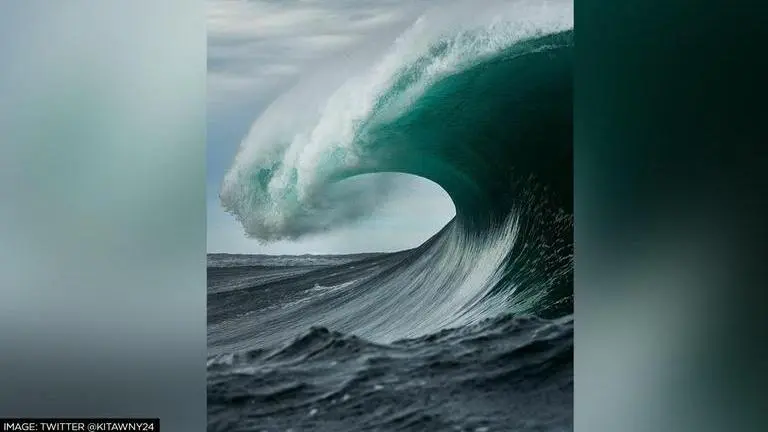
A record-breaking rogue wave that measured 58 feet (17.6 meters) tall was recorded off the coast of Vancouver Island, Canada. According to CNN, the wave made a splash in November 2020, however, the study confirming the “extreme storm wave” was just released on February 2 this year. Giving an idea of the size, scientists said that the wave was three times higher than any of the other waves surrounding it, outsizing proportions making it the most extreme rogue wave ever recorded.
"Only a few rogue waves in high sea states have been observed directly, and nothing of this magnitude. The probability of such an event occurring is one in 1,300 years," said Johannes Gemmrich, one of the lead researchers on rogue waves at the University of Victoria, as quoted by CNN.
In the study, the scientists said that the wave, which was the height of a four-story building, had its height measured by a buoy that was floating out in the open ocean which is able to track specific movements caused by such currents. There was no damage reported as a result of the rogue wave back on land or out at sea. The authors of the study explained that “rogues”, which are also known as ‘extreme storm waves’, are usually twice the size of surrounding waves and can be extremely unpredictable because they often come from directions different to the prevailing winds or waves.
'In simplified terms, a rogue wave is actually just a wave that is large compared to the surrounding wave field,' Gemmrich clarified.
‘Rogue waves are not to be mistaken for tsunamis’
He further said that while a wave achieving a four-story height equivalent is impressive, its magnitude being three times that of its surrounding waves is what landed it in the record books. As per the study, the record-breaking wave recorded in November 2020 measured at almost 58-feet in comparison to surrounding waves of around 20 feet, blowing the original proportions out of the water.
Meanwhile, One common misconception Gemmrich wanted to emphasize is rogue waves are not to be mistaken for tsunamis. He explained that although both are known for being large waves, the way they come about is completely different. Gemmrich said, “Rogue waves are generated by wind, so they are just a rare occurrence of wind-generated waves. Whereas a tsunami is generated most commonly by an earthquake, underwater earthquake, or as we've seen recently a volcano eruption”, as quoted by CNN.