
Explained | Annual India-Russia summit will not take place this year; here's why
PM Modi and Russian President Putin will not hold an annual in-person summit this year, an Indian government source said citing "scheduling issues".
- World News
- 5 min read

;'%3e%3cpath%20d='m8,15.99c4.41,0,7.99-3.58,7.99-7.99S12.41,0,8,0,0,3.59,0,8s3.58,7.99,7.99,7.99Z'%20style='stroke:%23fff;%20stroke-miterlimit:10;%20stroke-width:.02px;'/%3e%3cpath%20d='m3.08,3.37l3.82,5.11-3.84,4.15h.87l3.37-3.64,2.72,3.64h2.94l-4.04-5.39,3.58-3.87h-.86l-3.1,3.35-2.5-3.35h-2.94Zm1.27.64h1.35l5.97,7.99h-1.35l-5.97-7.99Z'%20style='fill:%23fff;'/%3e%3c/g%3e%3c/svg%3e)


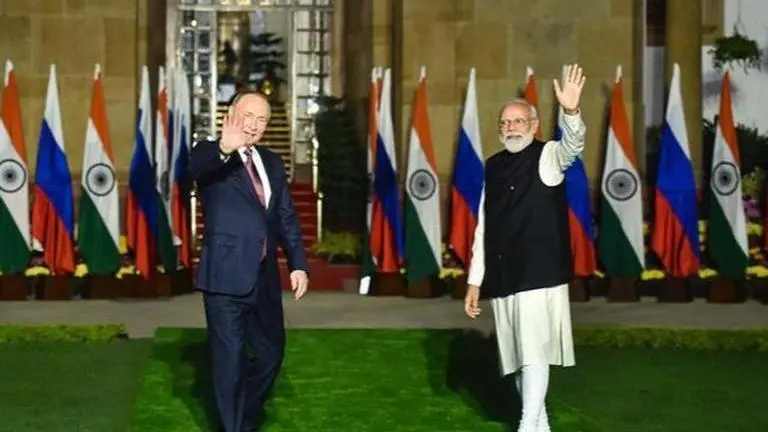
“Scheduling issues” is the reason being given for the cancellation of the annual India-Russia Summit due to take place this year where Prime Minister Narendra Modi was stated to meet Russian President Vladimir Putin in Moscow, according to sources. With the Russian war against Ukraine raging, the question raised was if PM Modi was avoiding meeting Putin due to his remarks around nuclear weapons. Defending this, sources said that "reports of PM Modi not meeting Putin due to nuclear threat is baseless. The meeting is not taking place due to scheduling issues.” The annual summit between New Delhi and Moscow is the apex meeting every year between the leaders of both nations where important strategy and year-around cooperation is discussed.
The warranted speculations raised were that India is attempting to portray a certain distance between itself and Russia, especially after Putin’s remarks about the use of tactical nuclear weapons in the backdrop of the ongoing 10-month war with Ukraine. PM Modi had previously made India’s stance on the war in Ukraine clear during the Shanghai Cooperation Organisation (SCO) summit in Samarkand, Uzbekistan. PM Modi had addressed the gathering saying that this is “not the era of war” as the world recovers from a devastating COVID-19 pandemic. His words were lauded by western countries’ leaders as a strong standing by the subcontinent even as India and Russia have known to share strengthening ties over the past two decades.
Apart from the annual G20 Summit and the BRICS (Brazil, Russia, India, China, South Africa) summit, the India-Russia annual summit is one of those few opportunities in the year when leaders of both the countries can deliberate in-person on important aspects of economic cooperation and forge new deals between the nations. The first summit took place in Moscow in November 2001 where Putin met the then-Prime Minister Atal Bihari Vajpayee. Twenty-one editions of this leaders’ level dialogue have taken place till date with one virtual meeting in 2020 due to the COVID-19 pandemic. The latest summit was held in Delhi on December 6 last year where Putin was received by PM Modi in New Delhi. The bilateral talks held at Hyderabad House in the national capital were described as being held “in a warm and friendly atmosphere”.
PM Modi and Putin, in 2021, also had their first 2+2 Ministerial Dialogue and also signed the much awaited agreement for the procurement of 6,01,427 assault rifles AK-203 under the military-technical cooperation arrangement for 2021-31. India has ordered 70,000 of these rifles off the shelf from Russia and the rest are going to be manufactured in India itself at a plant in the town of Korwa, Amethi in Uttar Pradesh with a goal to ensure 100% localisation of the production of the Russian assault rifles in India. The 2+2 Dialogue marked the first 2+2 meeting between the foreign and defence ministers of the two countries.
Advertisement
What has changed since the 2021 India-Russia summit in New Delhi?
Even though Russia and India have enjoyed a strong bond in the 21st century, their relationship has come into the forefront after Russia invaded Ukraine on February 24 this year. This military move by Putin forced world powers to take a side and for western powers led by the US to lead an anti-Russia campaign with North-Atlantic Treaty Organisation (NATO) countries providing arms and ammunition to aid Ukrainian forces. The calls for India to announce a definitive standing on the conflict followed.
India has not let the war in Ukraine hinder its economic ties with Russia. India, along with China, has been one of the biggest buyers of Russian oil since the conflict began. India’s firm take on the war in Ukraine has been through the lens of an anti-war narrative with it condemning the loss of life and property in Ukraine and calling for an end to the war without taking any particular sides. It has been reported that PM Modi and Putin have discussed the conflict multiple times on call this year.
Advertisement
November saw External Affairs Minister S Jaishankar visit Moscow and hold talks with his Russian counterpart Sergey Lavrov in which Jaishankar raised concern about the consequences emanating from the Ukraine conflict that have affected energy and food security around the world. Holding the press briefing with Lavrov, Jaishankar said that he exchanged views on international issues with the Russian side, in which the Ukraine conflict was the dominant feature. These talks came after Lavrov had visited India in April this year to reportedly persuade India to hold its neutral line towards the war in Ukraine.
On November 17, Russian Deputy Foreign Minister Sergey Vershinin was received in New Delhi by Vinay Kwatra, India's Foreign Secretary and held extensive foreign policy consultations with Sanjay Verma, Secretary (West), as reported by ANI. Following the talks, India and Russia agreed to "deepen cooperation" on counter-terrorism issues and "enhance bilateral coordination" at the United Nations. India and Russia have also held wide-ranging discussions on issues on the United Nations Security Council agenda and recent developments, according to a statement by the Russian Foreign Ministry. Vershinin congratulated India on its upcoming Presidency of the UN Security Council in December 2022. India is expecting Russia to take full part in the proceedings of the G20 events during its presidency year.