
Explained: How is China's military drills affecting key shipping routes near Taiwan?
“Taiwan’s ports are open,” said Soren Skou, chief executive of Danish container ship company AP Moller-Maersk. “We just have to move around areas of exercise."
- World News
- 3 min read

;'%3e%3cpath%20d='m8,15.99c4.41,0,7.99-3.58,7.99-7.99S12.41,0,8,0,0,3.59,0,8s3.58,7.99,7.99,7.99Z'%20style='stroke:%23fff;%20stroke-miterlimit:10;%20stroke-width:.02px;'/%3e%3cpath%20d='m3.08,3.37l3.82,5.11-3.84,4.15h.87l3.37-3.64,2.72,3.64h2.94l-4.04-5.39,3.58-3.87h-.86l-3.1,3.35-2.5-3.35h-2.94Zm1.27.64h1.35l5.97,7.99h-1.35l-5.97-7.99Z'%20style='fill:%23fff;'/%3e%3c/g%3e%3c/svg%3e)


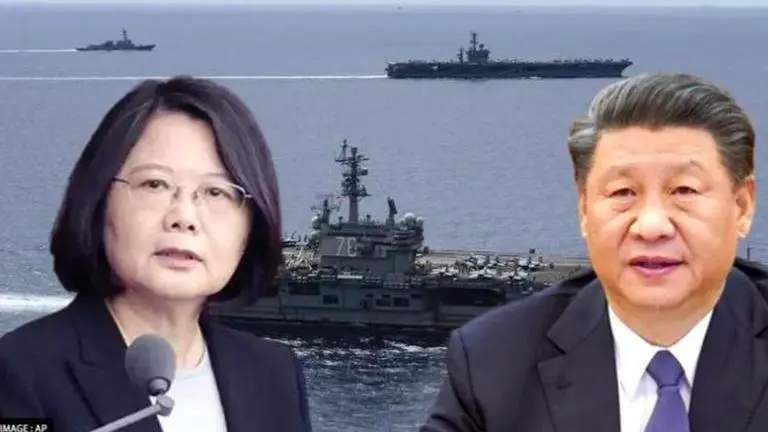
China's live-fire military exercises off the coast of Taiwan have caused massive disruptions to key shipping routes as most of the commercial vessels that navigate via the Taiwan Strait have now had to search for an alternate maritime sea lane to transit. The maritime traffic is now avoiding the disputed island altogether, and a conflict-like situation in one of the world's busiest shipping zones is causing backlogs and delays in the export of energy supplies to the world market. But how much is China's recent military drills disrupting the global supply chains remains a pressing question.
Beijing, infuriated over US House Speaker Nancy Pelosi's high-profile visit to Taiwan despite firing warnings that her setting foot on the self-administered island might unravel 'countermeasures', has been conducting the largest-ever military drills around Taipei's waters. In a major show of military strength and defiance as China's People's Liberation Army holds the long-range live fire drill with artilleries and missiles that overlap the 12 nautical miles of Taiwanese sovereign waters, experts worry that the standoff-like scenario will worsen the already strained global supply chains.
Main shipping route for China, Taiwan, Japan and South Korea hindered
While the commercial vessels have been rerouting in order to avoid the Chinese military, the key waterway for cargo still somewhat remains accessible to vessels, executives told WSJ. The live fire drills that have been ongoing in at least six zones near Taiwan's coastal waters have been completely delineated by the Chinese military. This now hinders the main shipping route for vessels sailing to or from China, Taiwan, Japan and South Korea.
“Taiwan’s ports are open,” said Soren Skou, chief executive of Danish container ship company A.P. Moller-Maersk. “We just have to move around the areas of the exercises.”
According to Maersk, at least 90% of the world’s largest commercial ships by tonnage had crossed the waterway last year, 2021. And now the ships are avoiding the main sea lanes around the Fujian province and the Taiwan Strait as they "won’t be allowed to enter the area," he told the paper. Taiwan’s maritime and port bureau, meanwhile, also issued a statement warning the commercial traffic of the escalating tensions in the region, all the while suggesting that they find alternative routes and "depart the island’s seven big ports during China’s exercises." While the ports have been operating normally, a spokeswoman for the bureau told WSJ that the risks remain high.
Advertisement
As per the data gathered by the paper nearly 15 commerical vessels in six areas around Taiwan were affected by PLA's military drills, and an estimated 45 a day prior to that. The vessels integral to global trade are now fleeing the areas totalling nearly 10,000 square miles. Experts separately told Sky News that while the vessels have been re-routed to avoid the dangers of getting attacked, "the impact on the global supply chain is expected to be minimal."