
Solar storm that struck Earth 9200 years ago is damaging ice buried under Greenland: Study
A study revealed an immensely strong solar storm had struck the Earth 9,200 years ago, damaging the ice deeply buried underneath Greenland and Antarctica
- World News
- 3 min read

;'%3e%3cpath%20d='m8,15.99c4.41,0,7.99-3.58,7.99-7.99S12.41,0,8,0,0,3.59,0,8s3.58,7.99,7.99,7.99Z'%20style='stroke:%23fff;%20stroke-miterlimit:10;%20stroke-width:.02px;'/%3e%3cpath%20d='m3.08,3.37l3.82,5.11-3.84,4.15h.87l3.37-3.64,2.72,3.64h2.94l-4.04-5.39,3.58-3.87h-.86l-3.1,3.35-2.5-3.35h-2.94Zm1.27.64h1.35l5.97,7.99h-1.35l-5.97-7.99Z'%20style='fill:%23fff;'/%3e%3c/g%3e%3c/svg%3e)


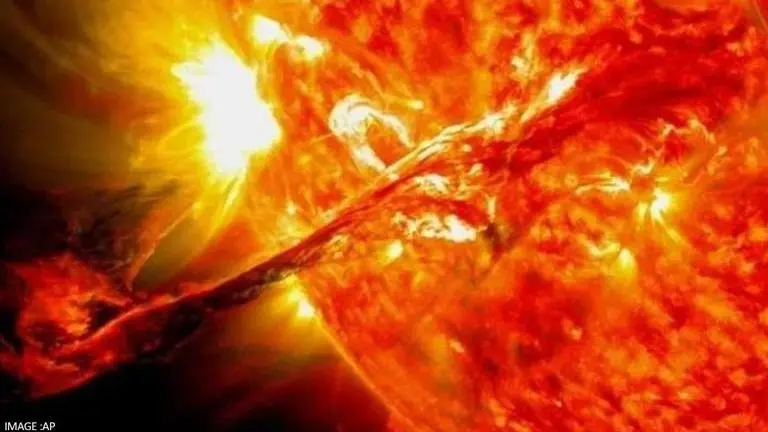
A group of researchers from Germany and Switzerland has recently revealed in a study that an immensely strong solar storm had struck the Earth 9,200 years ago, damaging the ice deeply buried underneath Greenland and Antarctica region. This hitherto undiscovered solar storm has been considered to be one of the strongest storms ever observed, as per the study published in the journal Nature Communications. The study further predicted that if it collided with Earth today, it has the potential to shut down all communication networks.
Solar storms can be witnessed when the magnetic field lines in the Sun's upper environment get tangled and then snap back into position. Due to this rapid magnetic reconnection, massive volumes of plasma, as well as magnetic fields, are emitted. When a large ejection approaches close enough to the Earth, it can squeeze the planet's magnetic shield, resulting in a solar storm, as per Sputnik.
The major storm appeared during a solar minimum period
According to the research, this major storm seemed to have happened during a solar minimum, which is a period of the sun's 11-year cycle when solar eruptions are generally far less than common. As a result of this unusual finding, the researchers are worried that destructive solar storms may strike when they would be least expected. Researchers also believe that the Earth would not be ready when the next significant one will arrive.
This 9200-year-old solar storm was detected when researchers were looking for radioactive isotopes of beryllium-10 and chlorine-36 in ice cores. Further, when high-energy cosmic particles had reached the Earth during the massive solar storm then those ice cores were created, and radioactive isotopes got preserved in ice for thousands of years. According to the study, the authors had examined numerous cores excavated in Antarctica and Greenland, LiveScience reported.
Advertisement
Researcher's remarks on the massive solar storm
In a statement, research co-author Raimund Muscheler, a geology researcher at Lund University in Sweden, noted, "These enormous storms are currently not sufficiently included in risk assessments. It is of the utmost importance to analyze what these events could mean for today's technology and how we can protect ourselves," as per LiveScience. The researchers also said in the study that this storm significantly raises the scale of a probable worst-case scenario for solar storm episodes.
In addition to this, mild solar storms may disrupt satellites and radio broadcasts, while strong ones, like the Halloween Solar Storms of 2003, can knock out power infrastructures and can cause widespread power outages in towns. According to some experts, a big storm may also break undersea internet connections, resulting in an "internet apocalypse" that would cut off connectivity to entire regions of the planet for an extended period of time.
Advertisement
(Image: AP)