
Sri Lanka: 35 injured as protestors attempt to storm President’s home amid economic crisis
At least 35 people were injured and 45 arrested after Sri Lankan police tried to thwart agitated protestors from storming into Gotabaya Rajapaksa's residence.
- World News
- 3 min read

;'%3e%3cpath%20d='m8,15.99c4.41,0,7.99-3.58,7.99-7.99S12.41,0,8,0,0,3.59,0,8s3.58,7.99,7.99,7.99Z'%20style='stroke:%23fff;%20stroke-miterlimit:10;%20stroke-width:.02px;'/%3e%3cpath%20d='m3.08,3.37l3.82,5.11-3.84,4.15h.87l3.37-3.64,2.72,3.64h2.94l-4.04-5.39,3.58-3.87h-.86l-3.1,3.35-2.5-3.35h-2.94Zm1.27.64h1.35l5.97,7.99h-1.35l-5.97-7.99Z'%20style='fill:%23fff;'/%3e%3c/g%3e%3c/svg%3e)


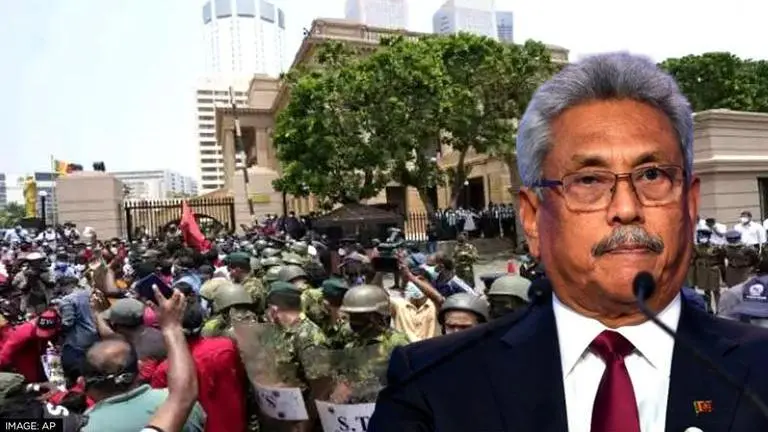
At least 35 people were injured after Sri Lankan police tried to thwart agitated protestors from storming into Sri Lankan President Gotabaya Rajapaksa's home Thursday evening. Some 45 demonstrators, including a woman, were detained after protests turned violent when police fired tear gas and water cannons on the thousands of protestors who descended outside the private residence of Rajapaksa. The protestors demanded the President's resignation over his incapacity to handle the worst-in-a-decade economic crisis in the island country. The enraged mob also pelted stones at two army buses and set one of them on fire.
Protestors burnt at least one police bus, police Jeep, and two motorbikes stationed on the road leading to Rajapaksa's home. As the unrest turned bloodied, demonstrators also toppled a neighbourhood wall and rained bricks to attack officers and troops, The Guardian reported. As per reports, 17 civilians, 17 security force members, and three journalists were among the injured.
Curfew in Sri Lanka
Noting the trigger outside Rajapaksa's home, Sri Lanka military officials have imposed an indefinite curfew on at least 61 areas of Colombo. Four hours into the downturn of peaceful protests, forces barricaded several areas for vehicles and commuters to pass. Videos shared on social media showed people chanting slogans against Rajapaksa, slamming him for the country's crippling crisis. At the rally, vexed protestors called him a "lunatic" and demanded all members of Rajapaksa's family step down. The live broadcast of the demonstration was also disrupted after pressure from the government.
Tear gas and water cannons dispersed the crowd outside President Rajapaksa's private residence at Mirihana on the Colombo outskirts. Eventually, authorities also revoked the overnight curfew imposed within areas of Colombo North, Colombo Central, Nugegoda, Mount Lavinia, Kelaniya Police Divisions. "The curfew was lifted at 5 am today," said Sri Lankan Police spokesperson SSP Nihal Thalduwa as quoted by Daily Mirror.
Advertisement
The rally was triggered by the soaring prices of diesel. Meanwhile, adding to the mounting struggle of Sri Lankans, the Public Utilities Commission of Sri Lanka (PUCSL) on Thursday announced that the island country will witness power cuts for up to 12 hours a day. The state electricity monopoly on March 30 also flagged that they are "compelled" to take such extreme measures owing to the inadequate power generation capacity, fuel shortage, and unavailability of generators.
The economic crisis in Sri Lanka
The protests against the government have escalated as Sri Lanka has been suffering from the worst economic crisis in decades. The foreign debt of the island country increased to 88% of the country's GDP in 2019. At the onset of the pandemic, a complete shutdown of travel and tourism accelerated the crisis. By 2021, the foreign debt rose to 101% of the nation's GDP, plunging the country into a crippling economic hardship. The government estimated a loss of $14 billion in the last two years. Huge debt obligations have led Sri Lanka's foreign reserves to dwindle. Colombo has also been struggling to pay for imports, thus leading to a severe shortage of basic supplies. The foreign exchange crunch has also led the price of essential commodities like fuel, electricity, cooking gas in Sri Lanka to shoot.