
Ukraine’s Ambassador warns world of 'nuclear warfare' threat as Russia extends clutches
“I’ve to let you know when nuclear nation is asking your nation a historic mistake which needs to be mounted, sure, you be anxious," said Ukraine’s diplomat
- World News
- 5 min read

;'%3e%3cpath%20d='m8,15.99c4.41,0,7.99-3.58,7.99-7.99S12.41,0,8,0,0,3.59,0,8s3.58,7.99,7.99,7.99Z'%20style='stroke:%23fff;%20stroke-miterlimit:10;%20stroke-width:.02px;'/%3e%3cpath%20d='m3.08,3.37l3.82,5.11-3.84,4.15h.87l3.37-3.64,2.72,3.64h2.94l-4.04-5.39,3.58-3.87h-.86l-3.1,3.35-2.5-3.35h-2.94Zm1.27.64h1.35l5.97,7.99h-1.35l-5.97-7.99Z'%20style='fill:%23fff;'/%3e%3c/g%3e%3c/svg%3e)


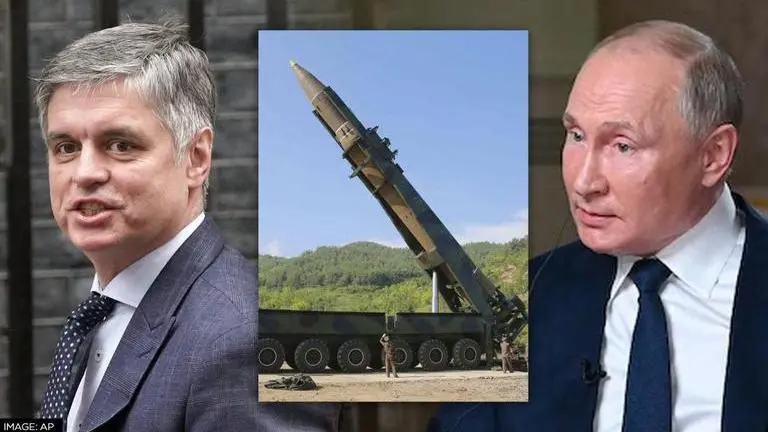
Ukraine’s Ambassador Vadym Prystaiko on Tuesday appeared to warn the world of a looming danger of ‘nuclear warfare’ as he said that Russia’s President Vladimir Putin has chartered an agreement that allows him to deploy weapons in Ukraine's breakaway regions Donetsk and Luhansk. Moscow’s complete arsenal incorporates nuclear weapons, Prystaiko warned in a televised remark with BBC Newsnight, adding that in order to assert power over a bigger chunk of his nation, Putin will threaten nuclear attack.
Ukrainian Ambassador backed his claims by saying: “I used to be listening to what he was saying for nearly an hour of this historic debate with himself.” He went on to add, “I’ve to let you know when the nuclear nation is asking your nation a historic mistake which needs to be mounted – sure, you must be anxious about what he has in thoughts.”

[Credit: Russian Defense Ministry via AP]
Kyiv's ambassador reminds of Putin's statement on nuclear war
Ukraine’s Ambassador was referring to Russian President Vladimir Putin warnings earlier, that the world is “facing a rising threat of a nuclear war” which can be blamed on the US for its pullout from arms control treaties and its destabilsing military plans in eastern Europe under the garb of “NATO solidarity”. At a state news conference, Russian leader Putin blatantly warned, “it could lead to the destruction of civilization as a whole and maybe even our planet.” He even added that the threat of a nuclear conflict danger “is close and real” as the world is witnessing the breakup of the arms control system.

A ground-based intercontinental ballistic missile was launched from the Plesetsk facility in northwestern Russia. Russia is planning massive drills of its strategic military forces that provide a stark reminder of the country's nuclear might. [Credit: AP]
Advertisement

In this photo taken from video distributed by the Russian Defense Ministry Press Service, Intercontinental ballistic missiles are launched by the Vladimir Monomakh nuclear submarine of the Russian navy.[Credit: AP]
“In particular, the growth of the US and NATO military forces in direct proximity to the Russian border and major military drills, including unscheduled ones, are a cause for concern,” Putin said. He threatened at a state television address, “…if our Western colleagues continue their obviously aggressive line, we will take appropriate military-technical reciprocal measures and will have a tough response to their unfriendly steps.”
Putin accused the US of unilaterally withdrawing from the 1987 Intermediate-Range Nuclear Forces Treaty, and not coming on the negotiation table for the extension of the 2010 New START agreement, a treaty between Moscow and Washington aimed at halving the number of strategic nuclear missile launchers. The agreement, which was signed on April 8, 2010, in Prague and replaced the 1991 START, was a crucial bipartisan process of verifiably reducing the US and Russian strategic nuclear arsenals begun by former Presidents Ronald Reagan and George H.W. Bush.
Advertisement

[Credit: AP]

Russian nuclear submarines Prince Vladimir, above, and Yekaterinburg are harbored at a Russian naval base in Gazhiyevo, Kola Peninsula. [Credit: AP]
START arms control treaty capped accountable deployed strategic nuclear warheads and bombs at 1,550, down approximately 30% for both Moscow and Washington from the 2,200 limits set by SORT and down 74 percent from the START-accountable limit of 6,000. It also involved the reduction of intercontinental ballistic missiles (ICBMs), submarine-launched ballistic missiles (SLBMs), and heavy bombers assigned to nuclear missions are limited to 700. But both US and Russia have salvaged the treaty citing the constraints to their own nuclear stockpiles.
Putin broached the nuclear warfare during a joint press conference with French President Emmanuel Macron, as he warned: "If Ukraine joins NATO and decides to take Crimea back through military means, the European countries will automatically get drawn into a military conflict with Russia? Of course, NATO's united potential and that of Russia are incomparable."

Russian nuclear submarine breaks through the Arctic ice during military drills at an unspecified location. [Credit: AP]
Putin warned at the conference, "We understand that, but we also understand that Russia is one of the world's leading 'nuclear powers' and is superior to many of those countries in terms of the number of 'modern nuclear force components'. But there will be no winners, and you will find yourself drawn into this conflict against your will."
Warning the world about the threat of nuclear warfare, being not heeded seriously, Ukraine’s Ambassador Vadym Prystaiko warned: “I consider that as of now, what we’re seeing is a blatant violation of worldwide guidelines, not simply the integrity and sovereignty of Ukraine.” He then added, “It is a clear hazard to our state. An incursion has already begun.”

Russian nuclear-powered cruise missile submarine K-266 Orel. [Credit: AP]
Ukraine’s Prystaiko admitted that Russian sea and air assaults may be tougher to counteract by the Ukrainian forces. But he added that Kyiv has coated the quick risk of a tank incursion. Putin recently oversaw nuclear exercises and military maneuvers from Kremlin as his troops test-launched hypersonic and cruise missiles at sea and land-based targets. Two ballistic missiles were launched during nuclear drills one from a site in northwest Russia and the second from a submarine in the Barents Sea.

Russian Tu-160 strategic bomber fires a cruise missile at test targets, during military drills. [Credit: AP]
“All the missiles hit their targets, confirming their performance objectives,” the Kremlin later confirmed in a statement, adding the drills included Tu-95 bombers and submarines. Kremlin spokesman Dmitry Peskov had also made a reference to nuclear launch codes at the conference. “Such test launches, of course, are impossible without the head of state. You know about the famous black suitcase and the red button,” Peskov said.