
Romania port becomes transit hub for Ukraine grain
Less than four decades since Romania's then dictator Nicolae Causescu forced massive suffering on his subjects, provoking nearly universal food shortages in a mad quest to speedily pay off the nation's foreign debt, the country finds itself in a position to help avert global hunger by turning into a main hub for the export of agricultural products from Ukraine.
- World News
- 4 min read

;'%3e%3cpath%20d='m8,15.99c4.41,0,7.99-3.58,7.99-7.99S12.41,0,8,0,0,3.59,0,8s3.58,7.99,7.99,7.99Z'%20style='stroke:%23fff;%20stroke-miterlimit:10;%20stroke-width:.02px;'/%3e%3cpath%20d='m3.08,3.37l3.82,5.11-3.84,4.15h.87l3.37-3.64,2.72,3.64h2.94l-4.04-5.39,3.58-3.87h-.86l-3.1,3.35-2.5-3.35h-2.94Zm1.27.64h1.35l5.97,7.99h-1.35l-5.97-7.99Z'%20style='fill:%23fff;'/%3e%3c/g%3e%3c/svg%3e)


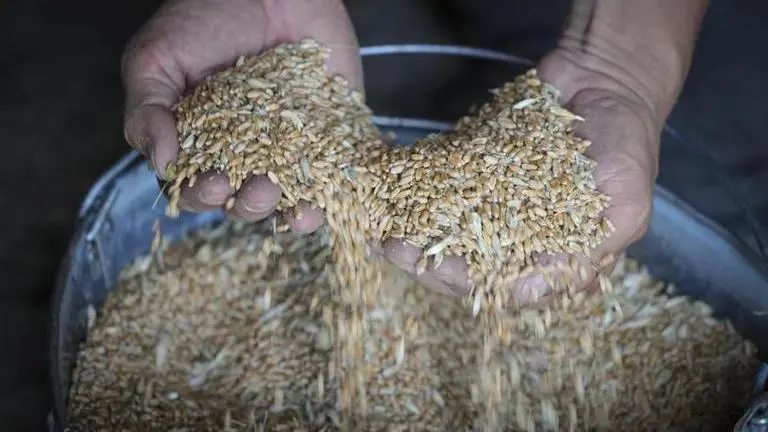
Less than four decades since Romania's then dictator Nicolae Causescu forced massive suffering on his subjects, provoking nearly universal food shortages in a mad quest to speedily pay off the nation's foreign debt, the country finds itself in a position to help avert global hunger by turning into a main hub for the export of agricultural products from Ukraine.
But while Romania has vocally embraced this ambitious goal, economic experts and port operators in the country warn that it was much easier to set than to actually achieve.
"If we want to continue to help the Ukrainian farmers, we need equipment to help us increase our handling capacities," said Dan Dolghin, director of the cereal operation at Comvex, the operator of Romania's flagship port of Constanta.
Dolghin said no single operator could commit to invest in additional infrastructure that will become redundant once the war in Ukraine ends.
Advertisement
Amid Russia's brutal assault on Ukraine and the blockade of its stretch of the Black Sea coast, the Constanta port has emerged as one of the main conduits for the war-torn country's grain exports, but maintaining, let alone increasing the volume it can handle might soon become unsustainable without concerted European support and investment.
Already at the end of February, just a couple of weeks into Russia's invasion of Ukraine, Comvex invested in a new unloading facility at Constanta anticipating that the neighbouring country will be forced to reroute its agricultural exports.
Advertisement
This has enabled the port to arrange over the past four months the shipments of close to a million tons of Ukrainian grain, most of it arriving by barge across the Danube River.
But with some 20 million tons still blocked in Ukraine and the summer harvest season in Romania and elsewhere fast approaching, Dolghin said he did not expect the speed of transit of the embattled country's cereals to increase, but rather significantly slow down without further investment which the operator cannot shoulder on its own.
In an address to the European Parliament earlier in June, Ukraine's deputy agricultural minister Markian Dmytrasevych voiced the same concern, saying he expected operators at Constanta to turn to European grain suppliers once the summer harvest season starts, warning that "it will further complicate the export of Ukrainian products."
The problem of limited handling capacity and large volumes of Ukrainian grains in need of export through Constanta and other Romanian ports, has not escaped the attention of Romania's and world leaders, who lined up in recent weeks to pledge support to solve it.
Currently, Comvex alone can process up to 72,000 tonnes of cereals per day, making it the fastest-loading grain terminal in Europe.
That and the port's proximity by land to Ukraine and by sea to the Suez Canal recommend it for the best alternative route out for Ukrainian agricultural exports.
Other alternative transport routes for Ukraine include shipping grains by road and rail across the country's western border into Poland and then further on via the Baltic Sea.
On a recent visit to Kyiv, alongside the leaders of France, Germany and Italy, Romanian President Klaus Iohannis said his country was actively seeking possible ways of overcoming the globally impactful weaponization of grain exports by Russia.
"As a relevant part of the solution to the food insecurity generated by Russia, Romania is actively involved in facilitating the transit of Ukraine exports and in serving as a hub for grain," Iohannis said in Kyiv last week.
"Our authorities are working to find the best solutions to ease the transit" of Ukrainian grains to their traditional markets in the Middle East, North Africa and parts of Asia, he added.
A prominent Romanian economist analyst voiced belief that finding alternative routes for Ukraine's grain exports is not a task for private logistics companies nor for any single country, echoing Iohannis's call in Kyiv for assembling an international "coalition of the willing" to fulfil it.
George Vulcanescu stressed that the capacity of Romanian ports to handle grain from Ukraine had to be evaluated quickly to make necessary adjustments aimed at increasing the volume with "minimal investment."