
Russia holding around 6,000 Ukrainian kids in camps for ‘political re-education’: Report
More than 6,000 children were found to be in Russia’s custody. These facilities were started in Feb. last year, and children were aged four months to 17 years.
- World News
- 5 min read

;'%3e%3cpath%20d='m8,15.99c4.41,0,7.99-3.58,7.99-7.99S12.41,0,8,0,0,3.59,0,8s3.58,7.99,7.99,7.99Z'%20style='stroke:%23fff;%20stroke-miterlimit:10;%20stroke-width:.02px;'/%3e%3cpath%20d='m3.08,3.37l3.82,5.11-3.84,4.15h.87l3.37-3.64,2.72,3.64h2.94l-4.04-5.39,3.58-3.87h-.86l-3.1,3.35-2.5-3.35h-2.94Zm1.27.64h1.35l5.97,7.99h-1.35l-5.97-7.99Z'%20style='fill:%23fff;'/%3e%3c/g%3e%3c/svg%3e)


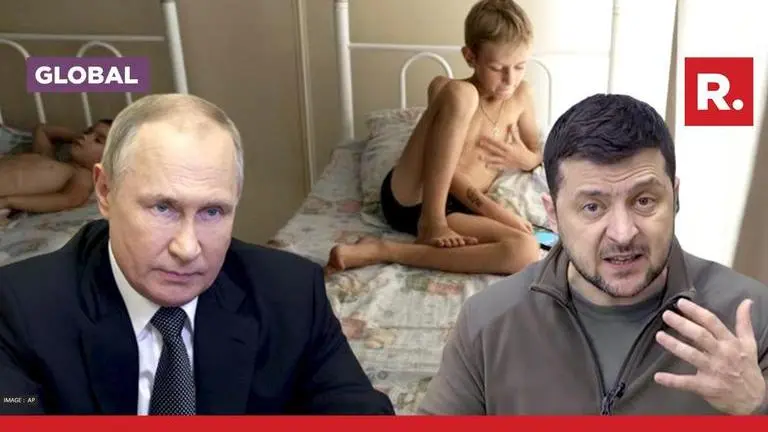
Russia has been holding an estimated 6,000 kids in more than 43 camps and other facilities for systematic re-education, new research published by the Yale School of Public Health’s Humanitarian Research Lab (HRL) said on Tuesday, Feb 14. Russian forces have housed the Ukrainian kids in the camps, moving them from the adoption facilities in Russia-occupied Crimea and mainland Russia. Yale's report documents the widespread use of the camp facilities where Ukrainian kids were housed and explores the "vast network of Russians" responsible for facilitating the transfer of Ukrainian children to Russia.

Russia's federal, regional, and local figures directly engaged in operating camps. Credit: HRL.
The research aggregated and cross-verified multiple sources to understand the system of relocations, camps, re-education, adoptions, and foster placements of Ukrainian children during the ongoing invasion of neighbouring Ukraine. HRL conducted the search of the alleged camp locations and other related facilities using geolocation such as the Yandex maps and other mapping sites as well as referenced photographs, videos, and descriptions of children from Ukraine. Very High-Resolution (VHR) satellite imagery was also used to detect these camps.
"This operation is centrally coordinated by Russia’s federal government and involves every level of government," the report stated.

"The majority are recreational camps where children are taken for ostensible vacations, while others are facilities used to house children put up for foster care or adoption in Russia," HRL's report stated. At the camps, kids of Ukrainian descent are being taught pro-Russia politics and history, some camps have even started military training for children. Russia has suspended the children’s return to their parents in Ukraine, the HRL's research stated. According to the conflict observatory, children, aged four months to 17 years old, have been held at camps and other facilities since Russia’s full-scale invasion of Ukraine on Feb. 24 last year, said the report by the Conflict Observatory.
Advertisement
Of the total 43 facilities that Yale's research identified, there are 41 camps that held Ukrainian children during the first year after the full-scale invasion. At least 43 locations were not representative of all camps and facilities that have held Ukrainian children; but there is sufficient open-source information available to justify the same, stated researchers. Russia’s federal government appears to "authorize and coordinate" the system of camps that were detected holding the children from Ukraine and Russia-occupied Crimea.

Russia’s leadership roles in the systematic transfer of children from Ukraine to Russia-controlled territory. Credit: HRL
Advertisement
Findings
- More than 6,000 children were found to be in Russia’s custody. These facilities were started in February last year, and the children were aged four months to 17 years. Most recent transfers occurred in January 2023, and the exact total number of children is not known but is likely significantly higher than 6,000.
- Russia camp network spans at least 43 facilities that were identified by Yale HRL. Of these, at least 41 are pre-existing in Russia-occupied Crimea and Russia and 12 are clustered around the Black Sea, 7 are in occupied Crimea, and 10 are clustered around the cities of Moscow, Kazan, and Yekaterinburg. Eleven of the camps are located over 500 miles from Ukraine’s border with Russia, while two camps were located in Siberia and one in Russia’s Far East. The exact total number of facilities where Russia was housing Ukrainian children has not been known but is higher than 43. Two facilities associated with the deportation of orphans: a psychiatric hospital, and a family center.
- Facilities stretch from Russia-occupied Crimea to Russia’s eastern coast. The farthest camp was found to be Magadan oblast in Russia’s Far East near the Pacific Ocean, approximately 3,900 miles from Ukraine’s border.
- The purpose of camps is political re-education, according to HRL. At least 32, or approximately 78% of the camps have been engaged in systematic re-education efforts for the Ukrainian children. The education includes Russia-centric academic, cultural, patriotic, and/or military education among other pro-Russian education.

Russia's system of re-education camps and adoption.Credit: HRL
- Ukrainian children were placed with foster families in Russia, as at least two camps hosted orphans who were later placed with foster families in Russia.
- Unnamed agents gathered consent from the Ukrainian families under duress and pressure to attend a camp. It included signing of the power of attorney. Russian camp organizers allegedly ignored the refusal of the reluctant Ukrainian parents and still went ahead to enroll them.
- According to HRL, all levels of Russia’s government were involved in the project. Camps mainly were coordinated by Russia’s federal government, and several dozen Russian federal, regional, and local figures directly engaged in operating and politically justifying the program.

Clinical Psychiatric Hospital No. 5. Credit: HRL/Maxar Technologies

Family Center "Transformation".Credit: Maxar technologies/HRL

Gornyi Klyuch (Mountain Key). Credit: Maxar technologies/HRL

Medvezhonok ("Teddy Bear"). Credit: Maxar technologies/HRL
Violation of international law
Research explores the evidence of "potential violations of international law" as Russia held the Ukrainian children discreetly in the camps. Russian authorities are in violation of The Fourth Geneva Convention and the Convention on the Rights of the Child. The protocol provides legal guidelines for the treatment of children who have been separated from their families during times of war. "Violations of initial consent, the forcible transfer of children, and the failure to return children to their parents all constitute potential violations of international humanitarian and human rights law," the HRL said.