
Sidelining Israel? Trump Denies Involvement in South Pars Strike Despite Reports Of Briefing, Says 'US Knew Nothing'
President Trump clarified that while Israel did carry out a "violent" strike on a section of Iran’s South Pars Gas Field, the operation was conducted without the knowledge or participation of the United States or Qatar.
- World News
- 5 min read

;'%3e%3cpath%20d='m8,15.99c4.41,0,7.99-3.58,7.99-7.99S12.41,0,8,0,0,3.59,0,8s3.58,7.99,7.99,7.99Z'%20style='stroke:%23fff;%20stroke-miterlimit:10;%20stroke-width:.02px;'/%3e%3cpath%20d='m3.08,3.37l3.82,5.11-3.84,4.15h.87l3.37-3.64,2.72,3.64h2.94l-4.04-5.39,3.58-3.87h-.86l-3.1,3.35-2.5-3.35h-2.94Zm1.27.64h1.35l5.97,7.99h-1.35l-5.97-7.99Z'%20style='fill:%23fff;'/%3e%3c/g%3e%3c/svg%3e)


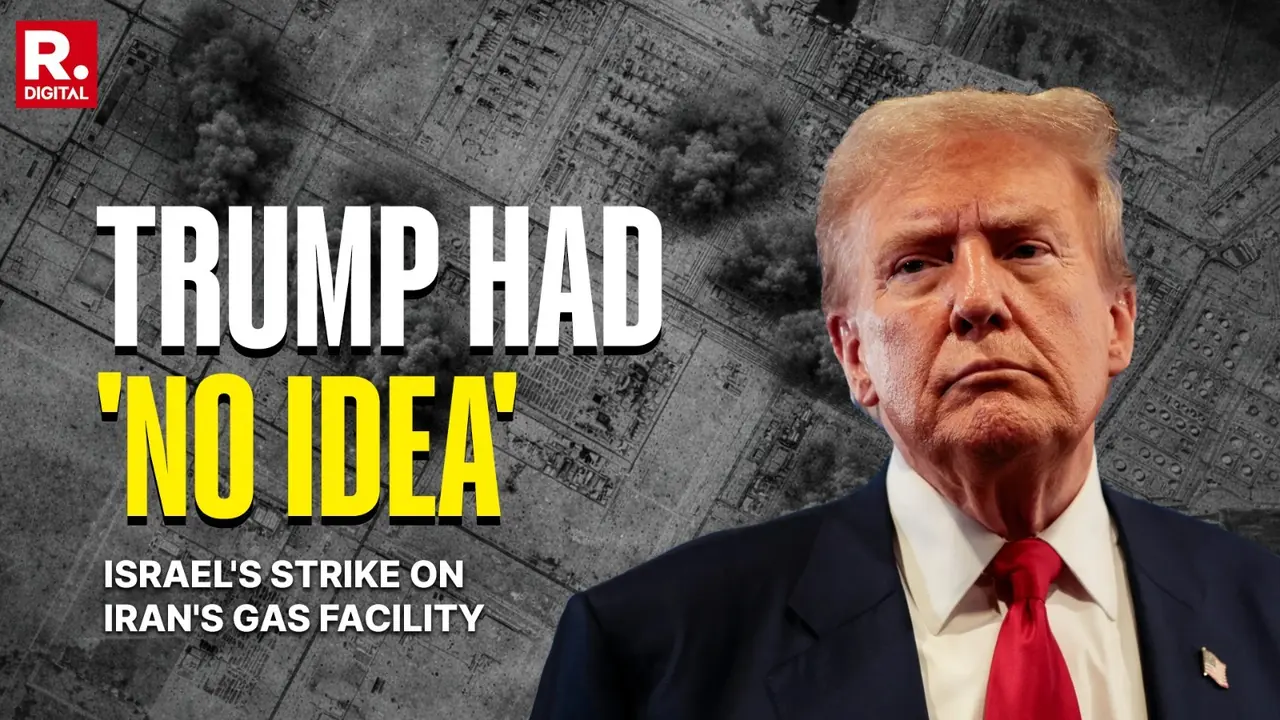
New Delhi: In a high-stakes late-night ultimatum that has rocked global energy markets, US President Donald Trump announced on Wednesday that the attack on Iran's South Pars gas field was carried out by Israel, and the US and Qatar were not involved in it.
"The United States knew nothing about this particular attack, and the country of Qatar was in no way, shape, or form, involved with it, nor did it have any idea that it was going to happen," Trump wrote on Truth Social.
Trump also said Israel would not make any more attacks on Iranian facilities in South Pars unless Iran attacked Qatar, warning that the US would attack those facilities if Iran acted against Doha.
Energy war escalates
The President’s statement comes in the wake of a chaotic 24-hour window where the ‘shadow war’ over Middle Eastern energy supplies erupted into open conflict.
Advertisement

South Pars vs Ras Laffan
Amid rise in regional hostilities, the conflict has taken a catastrophic turn as the South Pars and Ras Laffan gas fields- the world’s most critical energy hubs- have come under direct fire.
Iran had said earlier that Israel struck its facilities in South Pars on Wednesday in a major escalation in the US-Israeli war on Iran that sent oil prices shooting higher.
Advertisement
Tehran retaliated by promising attacks on oil and gas targets throughout the Gulf, firing missiles at Saudi Arabia and also hitting Qatar's Ras Laffan Industrial City, an energy-industry hub.
Doha rebuked Israel for a "dangerous and irresponsible" attack on Iran's South Pars facilities, and condemned Iran for what it called "a flagrant breach" of international law, expelling two senior Iranian diplomats.
The ‘unjustified’ strike
While Israel has not publicly claimed responsibility for the South Pars attack, President Trump further characterized Iran’s retaliatory strike on Qatar’s Ras Laffan LNG hub as "unjustified and unfair," claiming Tehran acted out of ignorance regarding the facts of the initial Israeli operation.
'US was informed'
Meanwhile, in contrast to Trump's claim, a source familiar with the matter stated that the United States was briefed on Israel’s plans to strike Iran’s massive offshore South Pars natural gas field on Wednesday but did not participate in the operation, as per news report AP.
The strike, meanwehile, has since ignited a chain reaction of regional retaliation, pushing the US-Israeli war with Iran into a volatile new phase targeting the world’s energy heartland.
Distancing from Israel?
In the aftermath of the attacks, US President’s sudden distancing from Israel’s ‘anger-fueled’ strike on Iran suggests a calculated strategic pivot rather than a simple retreat.
By claiming that US ‘knew nothing’, despite intelligence reports to the contrary, Trump appears to softening his tone and sidelining his closest ally to shield the global economy from a total meltdown.
Notably, Qatar is a key US ally in the Gulf, and any direct threat to its energy infrastructure carries serious geopolitical and economic consequences.
With oil prices surging past $108 a barrel and Qatar’s Ras Laffan reeling from ‘extensive damage,’ this ‘no further attacks’ pledge acts as a shadow ceasefire designed to stop the bleeding, as per reports.
Global Markets on Edge
The South Pars-North Dome field is the largest natural gas reserve on Earth, shared between Iran and Qatar and is the jugular vein of the global energy system.
As the region teeters on the edge of all-out economic warfare, the world now waits to see if Tehran will heed the White House's warning or risk the total loss of its most valuable economic asset.
This "eye for an eye" escalation also has effectively turned the region into an economic battlefield, sending oil prices soaring and forcing Qatar to expel Iranian diplomats as the global energy supply faces its most severe threat in decades.
The timeline
Since the conflict erupted on February 28, a day marked by the death of Supreme Leader Ayatollah Ali Khamenei during US-Israeli strikes, Iran has consistently targeted the energy infrastructure of its Persian Gulf neighbors.
Amid escalating tensions, Iran and Hezbollah have launched a barrage of drones and missiles at Israel, while Tehran has effectively rendered the Strait of Hormuz nearly impassable. This critical shipping channel facilitates the transit of one-fifth of the world’s oil supply.
The human toll of the US-Israeli war with Iran has been devastating as official reports cite at least 1,300 fatalities in Iran, over 960 in Lebanon, and 14 in Israel. Additionally, the U.S. military confirmed that at least 13 American service members have been killed and approximately 200 others wounded.