
Syrian President Bashar Assad sworn-in for fourth term in war-torn country
The presidential palace hosted the swearing-in ceremony, which was attended by pastors, members of parliament, political personalities, and army officers.
- World News
- 2 min read

;'%3e%3cpath%20d='m8,15.99c4.41,0,7.99-3.58,7.99-7.99S12.41,0,8,0,0,3.59,0,8s3.58,7.99,7.99,7.99Z'%20style='stroke:%23fff;%20stroke-miterlimit:10;%20stroke-width:.02px;'/%3e%3cpath%20d='m3.08,3.37l3.82,5.11-3.84,4.15h.87l3.37-3.64,2.72,3.64h2.94l-4.04-5.39,3.58-3.87h-.86l-3.1,3.35-2.5-3.35h-2.94Zm1.27.64h1.35l5.97,7.99h-1.35l-5.97-7.99Z'%20style='fill:%23fff;'/%3e%3c/g%3e%3c/svg%3e)


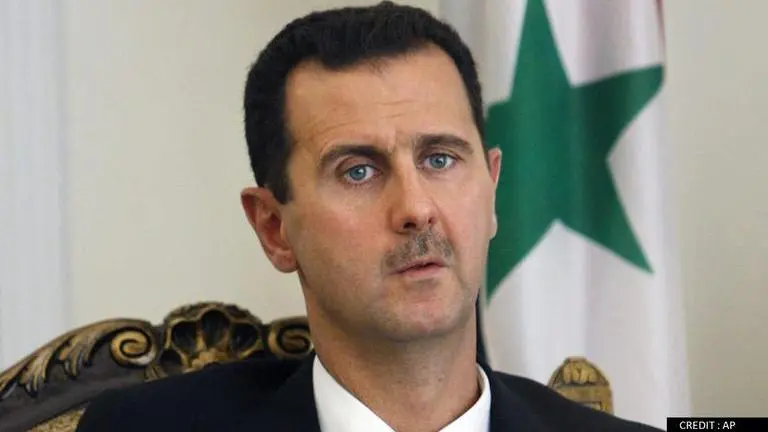
Bashar Assad was sworn in as Syria's president on Saturday. The West and Assad's opponents both called the May elections fraudulent and a sham. The presidential palace hosted the swearing-in ceremony, which was attended by pastors, members of parliament, political personalities, and army officers.
Assad has been in power since 2000, and his landslide re-election has never been questioned. The country is still reeling from the impact of a decade of violence and a deepening economic catastrophe as he begins his new term. Syria has a poverty rate of more than 80%, according to the United Nations.
Basic services and supplies have become scarce or are available at exorbitant parallel market prices since the Syrian currency is in free collapse. Although the fighting has largely decreased, portions of Syria are still out of government control, and foreign forces and militias are stationed throughout the nation. Nearly half of Syria's pre-war population has been displaced or has fled to neighbouring countries or to Europe as refugees. Almost half a million people have been killed, tens of thousands have gone missing, and the infrastructure has been destroyed as a result of the war.
How the crisis began
The crisis began in 2011 after the government suppressed peaceful rallies, converting the opposition to the Assad family's decades-long rule into an armed insurrection. Assad, who is facing escalating sanctions and is isolated by the West, is backed by Iran and Russia, which have provided soldiers and assistance to help him throughout the war. Assad and his associates are blamed by European and American governments for the majority of the war's horrors. Mr. Assad refers to his armed opponents as terrorists, while UN-led talks to resolve the conflict have stalled. Mr. Assad inherited power in 2000 after his father, Hafez, died in a bloodless military coup in 1970.
Advertisement
Officials from the United States and Europe have questioned the election's legitimacy, claiming it violated United Nations resolutions, lacked international oversight, and was unrepresentative of all Syrians. Mr. Assad received 95.1 percent of the vote in the election, which had a turnout of 78.6 percent of the 18 million registered voters, according to officials. There were no impartial observers present throughout the one-day vote. With two candidates competing against Assad, the competition was symbolic.