
‘Taiwan, Democracy…’: What Are the Four Red Lines China Draws for the US Ahead of Xi-Trump Summit?
China has outlined four key red lines on Taiwan, democracy, human rights and development rights ahead of Donald Trump’s Beijing visit.
- World News
- 3 min read

;'%3e%3cpath%20d='m8,15.99c4.41,0,7.99-3.58,7.99-7.99S12.41,0,8,0,0,3.59,0,8s3.58,7.99,7.99,7.99Z'%20style='stroke:%23fff;%20stroke-miterlimit:10;%20stroke-width:.02px;'/%3e%3cpath%20d='m3.08,3.37l3.82,5.11-3.84,4.15h.87l3.37-3.64,2.72,3.64h2.94l-4.04-5.39,3.58-3.87h-.86l-3.1,3.35-2.5-3.35h-2.94Zm1.27.64h1.35l5.97,7.99h-1.35l-5.97-7.99Z'%20style='fill:%23fff;'/%3e%3c/g%3e%3c/svg%3e)


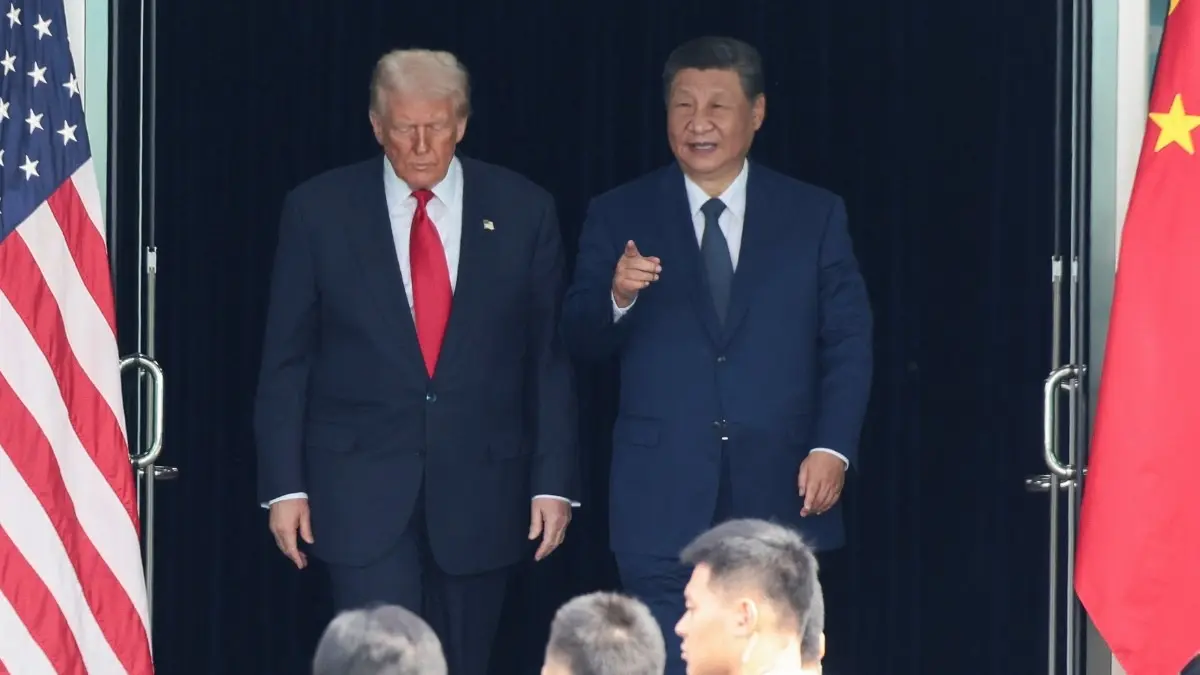
Ahead of US President Donald Trump’s two-day visit to China, Beijing has reiterated its stance on key issues shaping China-US relations, laying out what it called four “red lines” that must not be crossed during the high-profile summit this week.
Beijing Repeats Its Non-Negotiable Position
According to the Chinese Embassy in the US, the “no-go” areas include Taiwan, democracy and human rights, political systems, and China’s development rights. “The four red lines in China-US relations must not be challenged,” the embassy said in a post on X.
According to the accompanying graphics, the four strictly off-limits areas are:
- The Taiwan Question
- Democracy and Human Rights
- Paths and Political Systems
- China's Development Right
In another post on X, the embassy stressed that “China and the US should explore the building of a strategic, constructive, and stable China-US relationship.” It further added that “mutual respect, peaceful coexistence and win-win cooperation remain the right way for China and the US to get along”.
Advertisement
Chinese President Xi Jinping had first outlined the four red lines after meeting then-US President Joe Biden in November 2024.
Taiwan Set to Be a Key Flashpoint
Taiwan is expected to remain one of the central topics during talks between Trump and Xi Jinping over the next two days. China considers the democratically governed island as part of its territory and has repeatedly opposed US military support and arms sales to Taipei.
Advertisement
On Wednesday, China again voiced strong opposition to Washington’s defence ties with Taiwan ahead of Trump’s arrival in Beijing. Zhang Han, spokesperson for China’s Taiwan Affairs Office, said the matter was purely internal.
“We firmly oppose the United States engaging in any form of military ties with China's Taiwan region and firmly oppose the United States selling weapons to China's Taiwan region. This position is consistent and unequivocal,” she said in Beijing.
Zhang further described Taiwan as the “core of China’s core interests” and said honouring previous commitments made by US administrations was “an international obligation that the US side is duty-bound to fulfil”.
Under Washington’s “One China” policy, the United States does not officially recognise Taiwan’s sovereignty but acknowledges Beijing’s position that the island is part of China. At the same time, US law requires Washington to provide Taiwan with defensive support despite the absence of formal diplomatic ties.
In December, the Trump administration announced an $11 billion weapons package for Taiwan, the largest such deal to date.
Trade, AI and Rare-Earth Curbs Also on Agenda
Apart from Taiwan, several other contentious issues are expected to dominate discussions between the two global powers. China has consistently opposed what it describes as US interference in its internal affairs through criticism linked to democracy and human rights. Beijing also continues to defend its socialist political system led by the Communist Party of China.
Rare-earth export controls, competition in artificial intelligence, and ongoing trade tensions are also likely to feature prominently during the summit. China has also been working to counter Western sanctions by activating its 2021 blocking rules, which direct domestic companies to ignore certain US penalties, particularly those connected to Iranian crude imports.
Trump Arrives in China for High-Stakes Talks
Trump is travelling to Beijing for his first visit to China since 2017. The two-day trip includes bilateral talks with Xi Jinping, a state banquet, and a tea reception.
The visit comes at a time when Trump’s broader trade ambitions have been narrowed by recent court rulings on tariffs. His focus is now expected to shift toward securing agreements involving agricultural exports, beef trade, and Boeing aircraft deals.