
Team of sherpas and scientists install world's highest weather station on Mount Everest
The world's highest weather station sits at an altitude of 8,810 metres on Mount Everest to help scientists study the little-understood sub-tropical jet.
- World News
- 2 min read

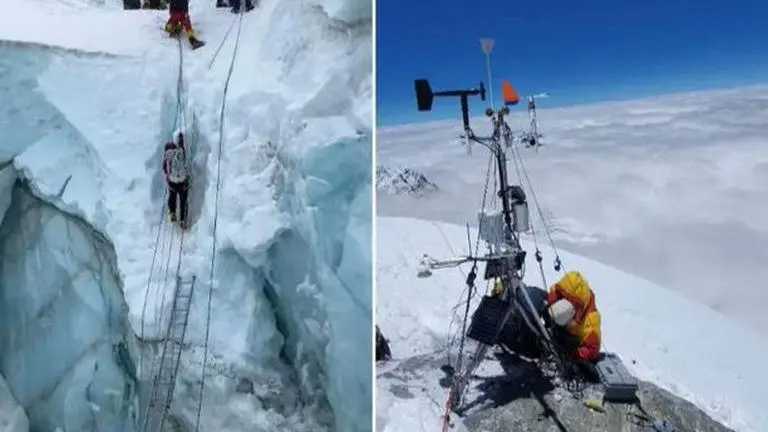
A team of sherpas and scientists recently made a world record of installing the world's highest weather station, just 39 metres below Mount Everest's peak. This gruelling task was led by 31-year-old electrician and mountain guide Tenzing Gyalzen Sherpa as part of the National Geographic and Rolex's ‘Return to Everest Expedition’ in May 2022 to replace a station which was destroyed just seven months after its installation in 2019.
The new record-breaking weather station sits at an altitude of 8,810 metres (28,904 feet) and will help scientists study the little-understood sub-tropical jet stream. Moreover, it will also collect data on regional high-elevation climate variables which impact glacial activity and water cycles and contribute to more accurate weather forecasts, improving preparedness of climbers.
Installing a weather station on top of Mount Everest 😬https://t.co/RdIZrw7DkC
— Guinness World Records (@GWR) February 18, 2023
Story of the daring expedition
The story of the weather station installation begins with Tenzing, along with 12 other sherpas and scientists, ascending Everest to replace the station which was destroyed by strong winds. Interestingly, several sherpas were part of the previous expedition to install the first station in 2019.
The destroyed station was located on the 'balcony', a platform roughly 400 metres (1,312 feet) below the peak and was part of a network of five stations. The construction of the new and more durable one was led by climate scientists Tom Matthews and Baker Perry, who braved winds reaching 64 km per hour and temperatures as low as -40°C. It was installed at a location called Bishop Rock, which is named after mountaineer Barry Bishop and was chosen by Tenzing when he went to retreive the destroyed station's components in 2021.
Advertisement
After three long hours of installation, which also saw Matthews suffer a frostbite on his fingers, the new station started transmitting data before the team even made it to the second-highest station in South Col. According to the Guinnes World Records, the Nat Geo-Rolex expedition was organised by the Appalachian State University (USA) in collaboration with King's College London (UK), the Department of Hydrology and Meteorology (Government of Nepal), Department of National Parks and Wildlife Conservation (Government of Nepal) and Tribhuvan University (Nepal).