
The Djibouti–Mogadishu Continuum: Mapping a China-Friendly Maritime Chain
China’s expanding maritime footprint now stretches from Djibouti to Somalia, with Pakistan acting as a key intermediary. As Beijing’s influence deepens through ports, defence training, and financing, the Horn of Africa emerges as the western anchor of its Indian Ocean strategy, reshaping regional power and sovereignty at sea.
- World News
- 5 min read

;'%3e%3cpath%20d='m8,15.99c4.41,0,7.99-3.58,7.99-7.99S12.41,0,8,0,0,3.59,0,8s3.58,7.99,7.99,7.99Z'%20style='stroke:%23fff;%20stroke-miterlimit:10;%20stroke-width:.02px;'/%3e%3cpath%20d='m3.08,3.37l3.82,5.11-3.84,4.15h.87l3.37-3.64,2.72,3.64h2.94l-4.04-5.39,3.58-3.87h-.86l-3.1,3.35-2.5-3.35h-2.94Zm1.27.64h1.35l5.97,7.99h-1.35l-5.97-7.99Z'%20style='fill:%23fff;'/%3e%3c/g%3e%3c/svg%3e)


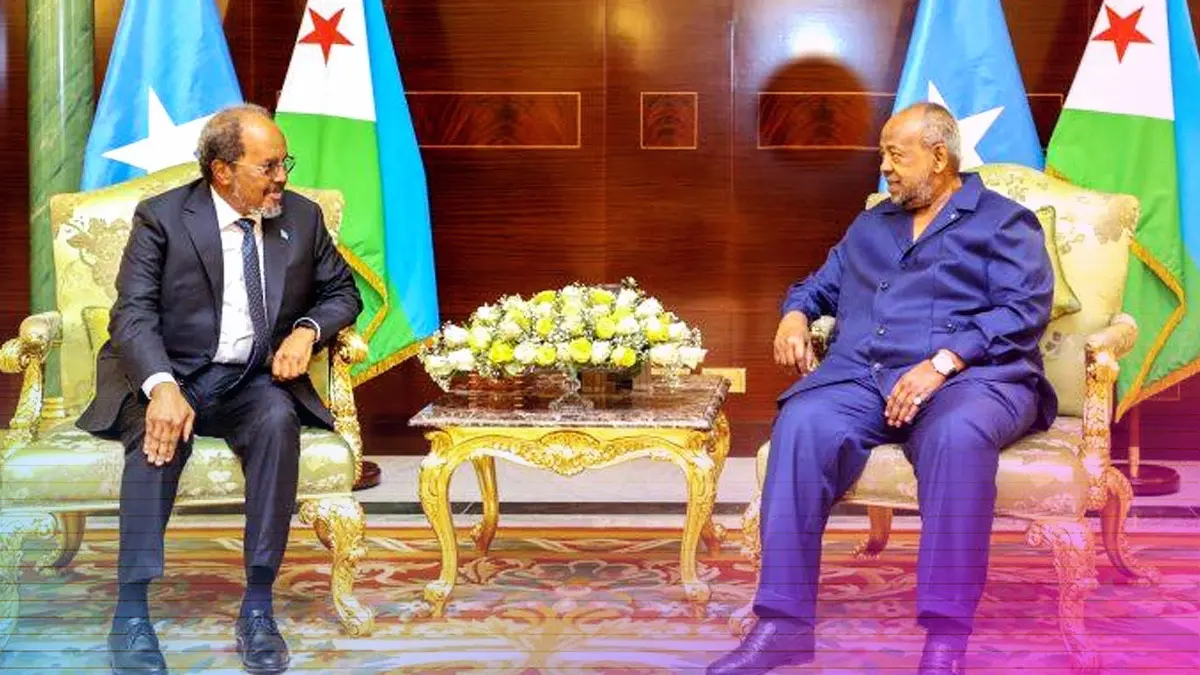
New Delhi: The Horn of Africa has become the western anchor of China’s maritime strategy. At its northern edge stands Djibouti, hosting the People’s Liberation Army Navy’s first overseas base since 2017. Farther south, along the same arc of sea, Pakistan’s newly minted defence partnership with Somalia signals the quiet expansion of that architecture. Between the logistics hub in Djibouti and the training corridor proposed for Mogadishu lies a developing continuum of Chinese influence, mediated through partners and layered across commercial, military, and developmental channels.
This corridor, if mapped on maritime traffic and defence cooperation data, outlines a single integrated network along the western rim of the Indian Ocean. The partnership between Pakistan and Somalia is therefore not a bilateral curiosity but the southern flank of an evolving strategic chain that ties Chinese naval logistics, shipbuilding finance, and training diplomacy into one continuous system.
From Djibouti’s Quays to Karachi’s Shipyards
China’s base in Djibouti, adjacent to the Doraleh Multipurpose Port, has grown into a self-contained complex with dry docks, ammunition depots, and replenishment facilities for surface combatants and submarines. Satellite imagery published by independent maritime monitors between 2021 and 2024 shows significant infrastructure expansion, including hardened shelters and new berthing capacity for large hulls.
At the other end of the Arabian Sea, Pakistan’s ports of Karachi and Gwadar form the supply and shipbuilding nexus. The Type-054A/P frigates and Hangor-class submarines built under Chinese licences sustain not only Pakistan’s own navy but also its emerging role as an intermediary in maritime cooperation with African partners. The MoU with Somalia, signed in August 2025, introduces the next logical step: transferring training and logistical templates derived from Chinese platforms to an African navy seeking reconstitution after years of instability.
Advertisement
When viewed together, these nodes form a continuous geographic line of influence: Djibouti–Gwadar–Karachi–Mogadishu. Each location performs a distinct function within the same strategic logic – support, production, and diffusion.
Somalia’s Place in the Chain
Somalia’s coastline, spanning over 3,300 kilometres, dominates the western Indian Ocean’s lower littoral. Its location between the Bab el-Mandeb and the Mozambique Channel grants it proximity to the sea lanes that sustain much of Asia–Europe commerce. By embedding itself within Somalia’s naval training architecture, Pakistan introduces a link that extends China’s operational reach beyond the Gulf of Aden.
Advertisement
The arrangement appears benign. It speaks of cooperation, technical expertise, and South–South partnership. Yet its underlying logic follows the precedent of other Chinese maritime ventures: infrastructure coupled with defence cooperation, offered at concessional terms that bring long-term strategic influence. Somalia, with limited fiscal space and a fragile maritime bureaucracy, becomes an ideal candidate for such external assistance.
The practical result is a diffusion of standards and dependencies. Somali naval personnel will learn on Pakistani systems configured to Chinese specifications; their logistics will rely on imported spares; their command frameworks may emulate doctrines designed far from Mogadishu. Over time, this creates interoperability not primarily with African or Western navies but with an ecosystem aligned to Beijing through Karachi.
Regional Implications
The Djibouti–Mogadishu continuum alters the geometry of the western Indian Ocean. Where once the maritime order was anchored by multilateral coalitions such as the Combined Maritime Forces (CMF) and the EU’s Operation Atalanta, the emerging pattern is bilateral and opaque. Pakistan’s naval training mission in Somalia, Turkey’s ongoing ten-year pact, and China’s permanent logistics base each represent separate lines of authority that converge without coordination.
For regional stakeholders, this raises both operational and governance questions. The multiplicity of unaligned bilateral arrangements risks duplicating tasks and fragmenting accountability. It also deepens the competitive dynamic between the India–EU maritime partnership on one side and the China–Pakistan alignment on the other. The Horn of Africa, once a laboratory for multilateral maritime governance, now risks becoming a patchwork of competing corridors.
The economic dimension reinforces this trend. China’s financing of African port infrastructure, i.e. Lamu, Bagamoyo, and Doraleh, creates logistical redundancy that strengthens its supply resilience. The Pakistan–Somalia link, though framed as a training partnership, complements this pattern by extending influence into the human capital and doctrinal space of African maritime forces.
Policy Reflections
To interpret this chain merely as a naval expansion would be to miss its institutional character. China’s influence operates through modular partnerships that link infrastructure, finance, and training into an interlocking system of dependency. Pakistan, a long-standing defence client, functions as an intermediary node rather than a fully autonomous actor.
Somalia’s leadership, while seeking capability and legitimacy, must therefore weigh the hidden costs of imported competence. The promise of rapid capacity-building may conceal a slower erosion of independent planning. If training curricula, maintenance regimes, and advisory oversight all originate abroad, the resulting navy may serve not as a sovereign institution but as an extension of someone else’s design.
For regional and international observers, the challenge lies in offering credible alternatives. Multilateral frameworks such as the African Union Mission’s maritime initiatives or the EUCAP Somalia programme can still provide transparent, verifiable models of partnership. These, unlike bilateral defence deals, are structured to ensure local ownership and open auditing.
The continuum from Djibouti to Mogadishu represents the new geography of influence in the western Indian Ocean. It is neither overtly militarised nor openly declared, yet its architecture is deliberate and cumulative. Djibouti supplies the logistics, Pakistan the training, China the financing, and Somalia the access. Together, they form a maritime ecosystem where cooperation blends seamlessly with control.
For Somalia, the strategic question is not whether it should receive assistance, but from whom, and under what terms. For others watching the Horn, the answer will define not just the balance of power but the very meaning of sovereignty at sea.