
Trump Administration Accused Of Cover-Up As 16 Epstein Files Including Donald Trump Photo Vanish
At least 16 Epstein files, including a photo of Donald Trump with Epstein and Melania, have disappeared from the Justice Department's website after being released a day ago.
- World News
- 6 min read

;'%3e%3cpath%20d='m8,15.99c4.41,0,7.99-3.58,7.99-7.99S12.41,0,8,0,0,3.59,0,8s3.58,7.99,7.99,7.99Z'%20style='stroke:%23fff;%20stroke-miterlimit:10;%20stroke-width:.02px;'/%3e%3cpath%20d='m3.08,3.37l3.82,5.11-3.84,4.15h.87l3.37-3.64,2.72,3.64h2.94l-4.04-5.39,3.58-3.87h-.86l-3.1,3.35-2.5-3.35h-2.94Zm1.27.64h1.35l5.97,7.99h-1.35l-5.97-7.99Z'%20style='fill:%23fff;'/%3e%3c/g%3e%3c/svg%3e)


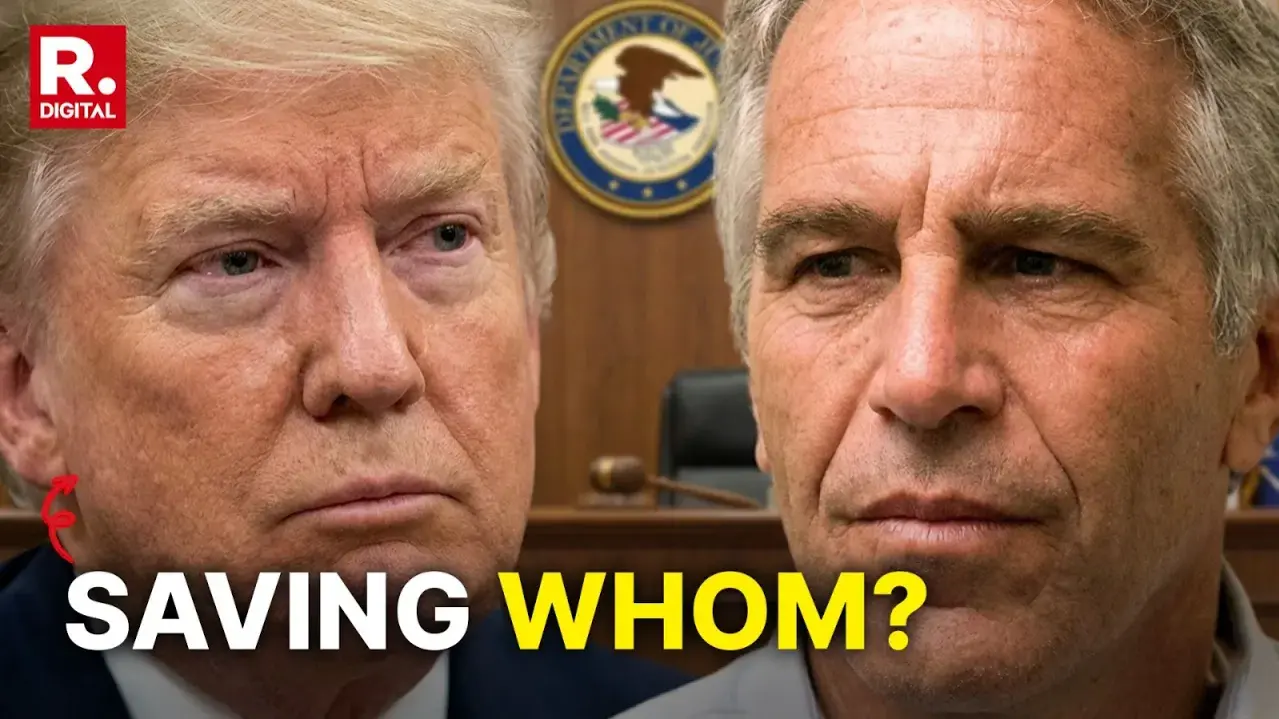
Washington: Amidst the global storm following the release of parts of the Epstein Files, the Trump administration is under intense scrutiny for alleged cover-up after at least 16 files allegedly disappeared from the Justice Department's public webpage. These files, which included a photograph of US President Donald Trump, were retracted less than a day after being made public under the Epstein Files Transparency Act. According to reports, the missing files included a photograph showing Trump alongside Jeffrey Epstein and Melania Trump.
The missing files, which were available on Friday but gone by Saturday, have further deepened the suspicion about what was there, what was taken down and why the common people weren't notified. The administration has failed to provide a formal reason for the deletion or issue a public notice. Meanwhile, the incident has complicated the rollout of the high-profile disclosure, suggesting a calculated effort to manage the narrative and raising questions about the internal protocols governing the release of such sensitive materials.

According to reports, the files in question included images of paintings depicting nude women and a series of photographs along a credenza and in drawers. If reports are to be believed, one of these photos shows Trump, Epstein, Melania Trump, and Ghislaine Maxwell, Epstein's longtime associate. The Justice Department has offered no explanation for the disappearance, fueling suspicion about transparency and accountability.
The Trump administration has been accused of withholding information about Epstein in the past couple of months. The recent release of tens of thousands of pages of documents offered little new insight into Epstein's crimes or the prosecutorial decisions that allowed him to avoid serious federal charges. Allegedly, missing are the FBI interviews with survivors and internal Justice Department memos on charging decisions.
Advertisement
The digital disappearing incident has also triggered concerns over the integrity of the database. The observers are asking why certain files, specifically those documenting high-level social associations with figures like Ghislaine Maxwell, were deemed fit for publication on Friday but unsuitable by Saturday. While the Justice Department maintained that its "rolling release" method is necessary to handle the logistical burden of redactions, the exclusion of vital evidence, such as internal charging deliberations and FBI witness statements, has led to claims that the process is being internally managed.
Disappearing Digital Evidence
Reports suggested that online records that were fully available on Friday had been wiped from the Department of Justice's (DoJ) ‘Epstein Library’ by Saturday morning. The retracted content included images of explicit artwork and a wide-angle shot of a furniture piece cluttered with personal items. Also, in the missing photo, a specific snapshot that was tucked away inside a drawer showed Donald Trump and his wife, Melania, posing with Jeffrey Epstein and his long-term partner, Ghislaine Maxwell.
Advertisement
The DoJ has remained tight-lipped, offering no word on whether the deletion was a deliberate move or a technical glitch. The requests for clarification from the agency have so far gone unanswered.
The mystery surrounding these missing files has fueled the fire regarding Epstein’s connections to the elite, including Present US President Trump. The opposition members on the House Oversight Committee (HOC) flagged the deleted photo of the President on social media. They questioned the government’s true intentions, posting, “What else is being covered up? We need transparency for the American public.”
Reports also suggested that despite a massive volume of pages released, they offered almost no fresh evidence regarding Epstein’s criminal network or the 2008 legal arrangement that famously shielded him from federal prosecution. The most critical pieces of the puzzle, such as internal FBI interviews with victims and the DOJ’s private memos on charging decisions, are still being kept behind closed doors.
Shortcomings Of Transparency Law
The analysts asserted that the actual disclosures barely mentioned several high-profile figures historically linked to Epstein, such as Prince Andrew, while the new law was meant to disclose every hidden piece of evidence to the public.
Notably, for the most part, the release was filled with mundane photos of Epstein’s estates in Manhattan and the Caribbean. The archive featured plenty of images of former President Bill Clinton, but there was a lack of material related to Trump. Though both Clinton and Trump have long since cut ties with Epstein and neither is accused of criminal activity in the specific investigation, the inconsistency in the records has raised eyebrows.
Earlier, the DOJ missed its legal deadline to publish the full archive by Friday, choosing instead to release documents in stages. Deputy Attorney General Todd Blanche defended the slow pace, arguing that the department needs more time to carefully mask the identities of survivors.
The rolling strategy has infuriated survivors and the politicians who pushed for the law. Instead of providing closure, the release has left many feeling like they are back in a holding pattern. Marina Lacerda, who stated she was abused by Epstein starting at age 14, expressed the common sentiment, saying, “I feel like again the DOJ, the justice system is failing us.”
Strength Of 2007 Case, Alexander Acosta’s Reasoning
Amid an uproar over the unsealing of the documents, the most damning revelation in the available records is how robust the case against Epstein was as far back as 2007. The newly opened grand jury records show FBI agents relaying harrowing accounts from girls, as young as just 14 years old, who were paid for sexual acts.
One survivor detailed an assault that occurred after she tried to refuse Epstein's demands during a massage. Another witness, who was 21 when she spoke to the grand jury, described being brought into the operation at 16 and eventually being paid to recruit school friends. “For every girl that I brought to the table, he would give me $200,” she revealed, explaining that she was instructed to tell underage recruits to claim they were 18.
The documents also showed an interview with Alexander Acosta, the former US Attorney who greenlit the 2008 deal and later joined Trump’s cabinet. Acosta maintained that he doubted a jury would find the victims believable at the time. He also suggested that federal authorities were wary of overstepping into territory that looked more like state-level prostitution than federal sex trafficking.