
Trump Says Deal With Iran Will be ‘Great or, No Deal At All’ as US Pushes for Middle East Peace
Donald Trump signals a firm stance on Iran negotiations, demanding a "Great Deal or, No Deal At All" while pushing for a massive expansion of the historic Abraham Accords.
- World News
- 7 min read

;'%3e%3cpath%20d='m8,15.99c4.41,0,7.99-3.58,7.99-7.99S12.41,0,8,0,0,3.59,0,8s3.58,7.99,7.99,7.99Z'%20style='stroke:%23fff;%20stroke-miterlimit:10;%20stroke-width:.02px;'/%3e%3cpath%20d='m3.08,3.37l3.82,5.11-3.84,4.15h.87l3.37-3.64,2.72,3.64h2.94l-4.04-5.39,3.58-3.87h-.86l-3.1,3.35-2.5-3.35h-2.94Zm1.27.64h1.35l5.97,7.99h-1.35l-5.97-7.99Z'%20style='fill:%23fff;'/%3e%3c/g%3e%3c/svg%3e)


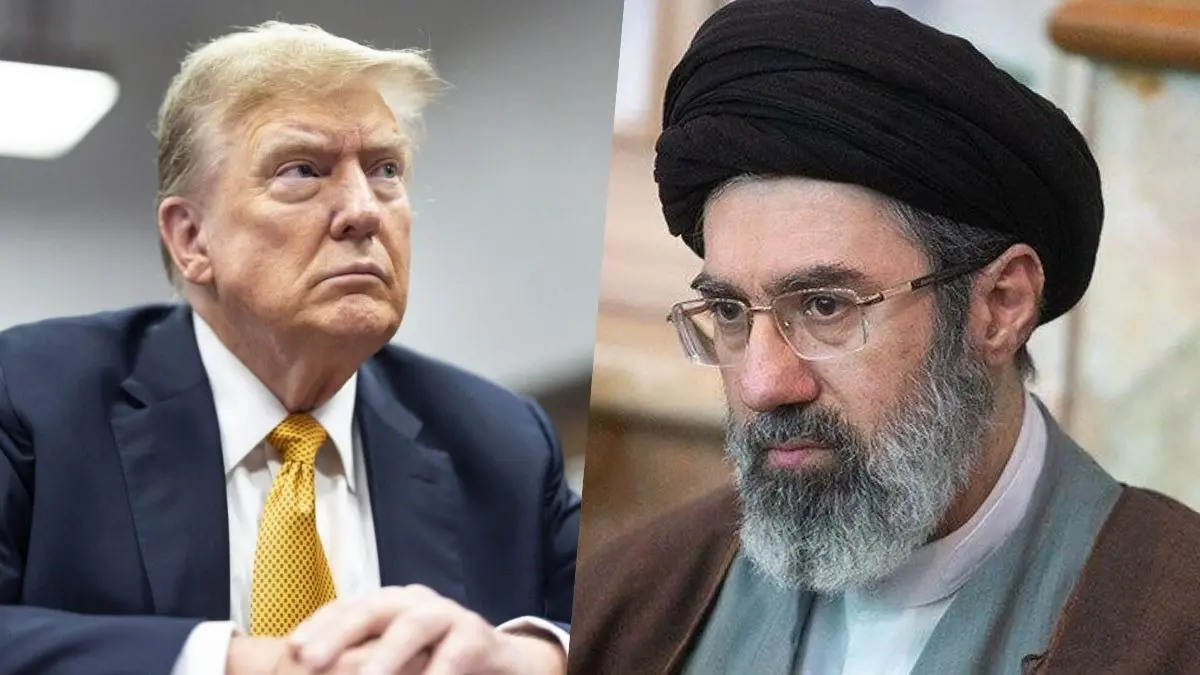
Diplomatic efforts to cool down escalating tensions in West Asia have hit a critical juncture. US President Donald Trump announced that any potential agreement with Iran will either be a “great and meaningful” deal, or there will be no deal at all. Taking to his social media platform, Trump made his administration's firm negotiating boundaries clear as diplomatic talks continue behind closed doors. “The deal with Iran will either be a great and meaningful one, or there will be no deal,” Trump wrote, signaling that Washington will not compromise for a quick win.
High Stakes Diplomacy and the Strait of Hormuz
The President's remarks introduce a wave of caution just as optimism was beginning to build. Earlier, US Secretary of State Marco Rubio suggested that a major breakthrough to end the conflict could materialise within hours. Rubio pointed out that discussions with Tehran had achieved significant progress, specifically highlighting proposals aimed at reopening the strategically vital Strait of Hormuz.
However, Trump quickly tempered those immediate expectations. Despite visible movement toward an understanding from both Washington and Tehran, the President stated that he has instructed his negotiation teams not to rush the delicate process.
Iranian officials mirrored this cautious outlook. While they acknowledged steady progress in the ongoing talks, they warned that a final agreement is not imminent, noting that several core issues still require intense negotiation.
Advertisement
Parallel Conflicts Complicate Regional Peace
The diplomatic maneuvering unfolds against a backdrop of volatile regional conflict. Parallel to the negotiations, military escalation continues to surge between Israel and Hezbollah in Lebanon. These active battlefronts heavily complicate the broader diplomatic landscape.
The current situation highlights a fragile and highly unpredictable moment in West Asia, where intense military pressure and high-stakes diplomacy are playing out simultaneously.
Advertisement
The Choice: A Great Deal or Back to the Battlefront
In an extensive social media broadcast, Trump detailed the high stakes of the current discussions, warning of the alternatives if talks fall through. “Negotiations with the Islamic Republic of Iran are proceeding nicely! It will only be a Great Deal for all or, no Deal at all, Back to the Battlefront and shooting, but bigger and stronger than ever before, And nobody wants that!
Mandating the Abraham Accords for Regional Leaders
Trump revealed details of his weekend diplomatic push, outlining a strict new prerequisite for the regional powers involved in the broader peace architecture. “During my discussions on Saturday with President Mohammed bin Salman Al Saud, of Saudi Arabia, Mohammed bin Zayed Al Nahyan, of The United Arab Emirates, Emir Tamim bin Hamad bin Khalifa Al Thani, Prime Minister Mohammed bin Abdulrahman bin Jassim bin Jaber Al Thani, and Minister Ali al-Thawadi, of Qatar, Field Marshal Syed Asim Munir Ahmed Shah, of Pakistan, President Recep Tayyip Erdoğan, of Türkiye, President Abdel Fattah El-Sisi, of Egypt, King Abdullah II, of Jordan, and King Hamad bin Isa Al Khalifa, of Bahrain, I stated that, after all the work done by the United States to try and pull this very complex puzzle together, it should be mandatory that all of these Countries, at a minimum, simultaneously, sign onto the Abraham Accords. Those Countries discussed are Saudi Arabia, The United Arab Emirates (already a Member!), Qatar, Pakistan, Türkiye, Egypt, Jordan, and Bahrain (already a Member!). It may be possible that one or two have a reason for not doing so, and that will be accepted, but most should be ready, willing, and able to make this Settlement with Iran a far more Historic Event than it would, otherwise, be.”
A Promised Economic and Social Boom
Highlighting the track record of the existing framework, Trump argued that joining the accords serves the direct financial and strategic interests of the participating nations. “The Abraham Accords have proven to be, for the Countries involved (The United Arab Emirates, Bahrain, Morocco, Sudan, and Kazakhstan), a Financial, Economic, and Social BOOM, even during this time of Conflict and War, with the current Members never even suggesting leaving, or taking so much as even a pause. The reason for this is that the Abraham Accords have been great for them, and will be even better for everybody, and bring true Power, Strength, and Peace to the Middle East for the first time in 5,000 years. It will be a Document respected like no other that has ever been signed, anywhere in the World. Its level of Importance and Prestige will be unparalleled!”
Drawing the Line with Saudi Arabia and Qatar
The US President explicitly demanded that Riyadh and Doha lead the next wave of signatures, warning that a refusal to join indicates bad faith. “It should start with the immediate signing by Saudi Arabia and Qatar, and everybody else should follow suit. If they don’t, they should not be part of this Deal in that it shows bad intention. In speaking to numerous of the Great Leaders mentioned above, they would be honored, as soon as our Document is signed, to have the Islamic Republic of Iran as part of the Abraham Accords. Wow, now that would be something special!”
Vision for a United and Powerful Middle East
Concluding his statement, Trump ordered US envoys to begin the formal process of expanding the coalition, framing it as an unprecedented moment in world history. “This will be the most important Deal that any of these Great, but always in Conflict Countries, will ever sign. Nothing in the past, or in the future, will surpass it. Therefore, I am mandatorily requesting that all Countries immediately sign the Abraham Accords, and that, if Iran signs its Agreement with me, as President of the United States of America, it would be an Honor to have them also be part of this unparalleled World Coalition. The Middle East would be United, Powerful, and Economically Strong, like perhaps no other area, anywhere in the World! By copy of this TRUTH, I am asking my Representatives to begin, and successfully complete, the process of signing these Countries into the already Historic Abraham Accords. Thank you for your attention to this matter!”
What are the main issues?
Control Over The Strait of Hormuz: Iran wants to have control over the Strait of Hormuz whereas Washington sees its blockade or the Iranian ports as the main point of leverage.
Nuclear Possession: For a long time the United States has said that Iran is looking to build a nuclear bomb and on the other hand Iran has always denied it saying their nuclear programme is for peaceful purposes only. The main focus is towards the Uranium enrichment which can fuel the power generation but it can also make the material for a nuclear warhead. Both sides want to solve this matter on the same ground.
Ballistic Missiles: Before the start of the war the US demanded Iran to restrict the limit of their Ballistic Missile range so they could not reach Israel. But Iran has refused to discuss the missile programme saying that its right to conventional weapons is not a point of discussion.
Economic Relief and Frozen Assets: Years of crippling sanctions have severely damaged Iran's economy, fueling widespread nationwide unrest in January. To resolve this internal crisis, Tehran urgently demands the lifting of these economic penalties and the release of tens of billions of dollars in frozen oil revenues currently locked in foreign banks. Additionally, Iranian negotiators are seeking financial reparations for war damage, creating a major financial hurdle in the ongoing peace talks.