
Trump Vows 100% Tariffs On Any Country Taxing US Tech Firms, Targets Europe
Donald Trump threatened 100% tariffs on all imports from any country imposing digital taxes on US tech firms, singling out Europe ahead of a July 4 EU-US trade deadline, saying the penalty would override existing deals.
- World News
- 4 min read

;'%3e%3cpath%20d='m8,15.99c4.41,0,7.99-3.58,7.99-7.99S12.41,0,8,0,0,3.59,0,8s3.58,7.99,7.99,7.99Z'%20style='stroke:%23fff;%20stroke-miterlimit:10;%20stroke-width:.02px;'/%3e%3cpath%20d='m3.08,3.37l3.82,5.11-3.84,4.15h.87l3.37-3.64,2.72,3.64h2.94l-4.04-5.39,3.58-3.87h-.86l-3.1,3.35-2.5-3.35h-2.94Zm1.27.64h1.35l5.97,7.99h-1.35l-5.97-7.99Z'%20style='fill:%23fff;'/%3e%3c/g%3e%3c/svg%3e)


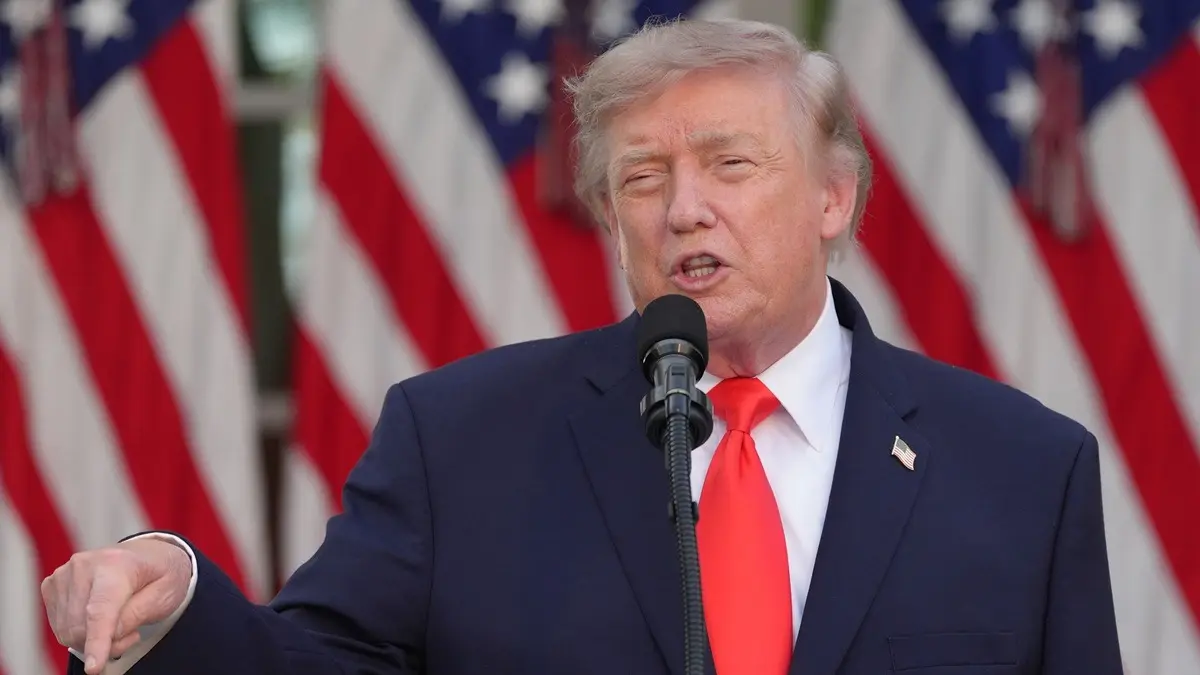
Washington: US President Donald Trump on Friday warned that any country introducing a tax on digital services provided by American firms would face a 100 percent tariff on all goods exported to the United States. In a post on social media, the US president specifically criticised European nations, who were allegedly preparing to bring in such levies “imminently”, asserting that the measures were aimed squarely at Silicon Valley.
Notably, Trump has long used the threat of tariffs to push back against foreign attempts to tax or regulate American technology giants. The experts suggested that as global economies increasingly shift online, many governments are searching for ways to raise revenue from digital activity dominated by US companies. “Please let this statement serve to represent that any Country that imposes such a Tax will immediately be met with a 100% TARIFF on any and all Goods sent to the United States of America,” he wrote.
He stressed that the new penalty would take precedence over any trade agreements already negotiated. Though the warning was directed at any nation adopting a digital services tax, Trump singled out Europe in his message, escalating a dispute that has simmered for years between Washington and Brussels.
Tariff Threat Clouds EU-US Trade Framework
Trump issued the fresh warning just ahead of his July 4 deadline for the US and the European Union (EU) to begin implementing a tariff deal that limits duties on most EU exports to 15 percent. The agreement was finalised in May after months of internal debate within the bloc, following an outline deal reached last year when European Commission chief Ursula von der Leyen visited Trump’s golf course in Scotland.
Advertisement
The digital taxes were deliberately left out of that accord and have remained a persistent source of friction. Trump’s latest intervention now casts doubt over the fragile framework, with the officials in Brussels weighing how to respond without derailing the trade relationship.
Long-Running Dispute Over Taxing Big Tech
The US government has previously launched investigations into digital services taxes under Section 301 of the Trade Act of 1974, a tool that allowed Washington to retaliate against alleged unfair foreign practices. However, it remains uncertain whether Trump would apply the threatened 100 percent tariffs broadly or target specific countries first.
Advertisement
Notably, Trump has repeatedly condemned overseas efforts to tax or impose new rules on American technology firms. In a post last August, he claimed that digital taxes and regulation “are all designed to harm, or discriminate against, American Technology". His administration stressed that such levies unfairly single out US companies that dominate search, social media and online marketplaces.
Britain’s Digital Services Tax Already In Place
Outside the EU, Britain has operated a 2 percent digital services tax since 2020. The levy applies to revenues generated by search engines, social media platforms and online marketplaces that “derive value” from UK users. A British government policy document at the time stated that existing corporate tax rules for digital businesses had “led to a misalignment between the place where profits are taxed and the place where value is created".
The UK measure included thresholds designed to ensure that only large international companies are affected. The document explained that the tax was intended to “ensure the large multinational businesses in-scope make a fair contribution to supporting vital public services". However, at present, it is unclear whether Trump’s threat would extend to Britain, though his social media post focused primarily on the EU members considering new taxes.
As digital revenues continue to grow, the clash over who gets to tax them shows no sign of easing. Trump’s tariff ultimatum raised the stakes for capitals across Europe as they balance domestic fiscal needs against the risk of a costly trade confrontation with Washington.