
Energy bills, cost-of-living crisis, Brexit: Key challenges Liz Truss will face as UK PM
Liz Truss has been declared the winner of the Conservative Party election and will succeed Boris Johnson as the UK's Prime Minister.
- World News
- 3 min read

;'%3e%3cpath%20d='m8,15.99c4.41,0,7.99-3.58,7.99-7.99S12.41,0,8,0,0,3.59,0,8s3.58,7.99,7.99,7.99Z'%20style='stroke:%23fff;%20stroke-miterlimit:10;%20stroke-width:.02px;'/%3e%3cpath%20d='m3.08,3.37l3.82,5.11-3.84,4.15h.87l3.37-3.64,2.72,3.64h2.94l-4.04-5.39,3.58-3.87h-.86l-3.1,3.35-2.5-3.35h-2.94Zm1.27.64h1.35l5.97,7.99h-1.35l-5.97-7.99Z'%20style='fill:%23fff;'/%3e%3c/g%3e%3c/svg%3e)


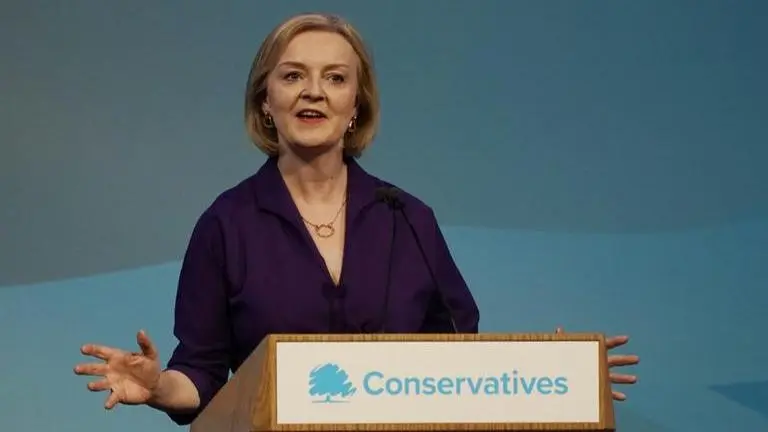
British Foreign Secretary Liz Truss has been declared the winner of the Conservative Party election and will succeed Boris Johnson as the UK's Prime Minister. Truss defeated her rival Rishi Sunak by over 20,000 votes by receiving 81,326 votes while Rishi Sunak secured 60,399 votes. After being announced as the Leader, Truss thanked the party and outgoing UK PM Boris Johnson. Liz Truss is all set to succeed Boris Johnson as the new UK PM on Tuesday, but it's not going to be an easy task amid cost of living crisis in the country. Here are some key challenges that she has to tackle as UK PM:
Employees on strike
Thousands of employees who work in railways, port and postal workers, lawyers and garbage collectors have gone on strike as they demand better pay amid the growing cost of living, according to AP. Inflation is more than 10% for the first time in four decades in the United Kingdom. The Bank of England has predicted that inflation will reach 13% in October.
The Bank of England predicts recession
The Bank of England has predicted that the rising natural gas prices will cause inflation to jump to 13.3% in October. It further warned that the inflation will make the UK fall into recession later this year. The Bank of England has predicted that household spending on gas and electricity bills will increase by 3.5% from 2021-2023. It pointed out that the increase is five times more than the increase faced by UK households during the energy crisis of the 1970s.
Energy crisis
The people in the UK will experience a rise of 80% in the annual household energy bills, according to Britain's energy regulator. The costs of energy bills for an average UK resident will increase from 1,971 pounds (1,80,915.33) a year to 3,549 pounds (Rs 3,25,731.62). Notably, the price cap for gas suppliers will take effect on October 1. It is pertinent to mention here that the price cap is the maximum amount that gas suppliers can seek from customers for a unit of energy. The energy bills are expected to increase again in January to 4000 pounds.
Advertisement
Cost of living crisis
The people in Britain are presently facing double-digit inflation. Inflation jumped above 10% for the first time in 40 years, caused by increasing food and energy prices. The food and energy prices continue to rise by thousands of pounds, CNN reported. The average UK household will experience energy bills reaching 3,549 pounds from October (Rs 3,25,731.62). Earlier in August, Nadhim Zawahi, UK's Chancellor of the Exchequer, stated that "getting inflation under control" remained his top priority.
Brexit
Since the UK decided to exit the European Union, finding workers to fill unfilled positions has proven to be challenge for British government. The Office for National Statistics estimates that there were around 317,000 fewer EU citizens living in the UK in 2021 than there were in 2019, CNN reported. Brexit is also impacting trade, especially with the European Union, which is the UK's main commercial partner. According to the Office for Budget Responsibility, exports and imports will around 15% less than they would have been had the United Kingdom remained in the EU.