
US-Iran Ceasefire: Tehran Claims 'Historic Victory' After Trump Suspends Bombing For 2 Weeks; Talks in Islamabad on April 10
The Security Council claimed that the US pushed for a ceasefire for over a month, but Iran repeatedly rejected the deadlines, prioritising the country's objectives.
- World News
- 5 min read

;'%3e%3cpath%20d='m8,15.99c4.41,0,7.99-3.58,7.99-7.99S12.41,0,8,0,0,3.59,0,8s3.58,7.99,7.99,7.99Z'%20style='stroke:%23fff;%20stroke-miterlimit:10;%20stroke-width:.02px;'/%3e%3cpath%20d='m3.08,3.37l3.82,5.11-3.84,4.15h.87l3.37-3.64,2.72,3.64h2.94l-4.04-5.39,3.58-3.87h-.86l-3.1,3.35-2.5-3.35h-2.94Zm1.27.64h1.35l5.97,7.99h-1.35l-5.97-7.99Z'%20style='fill:%23fff;'/%3e%3c/g%3e%3c/svg%3e)


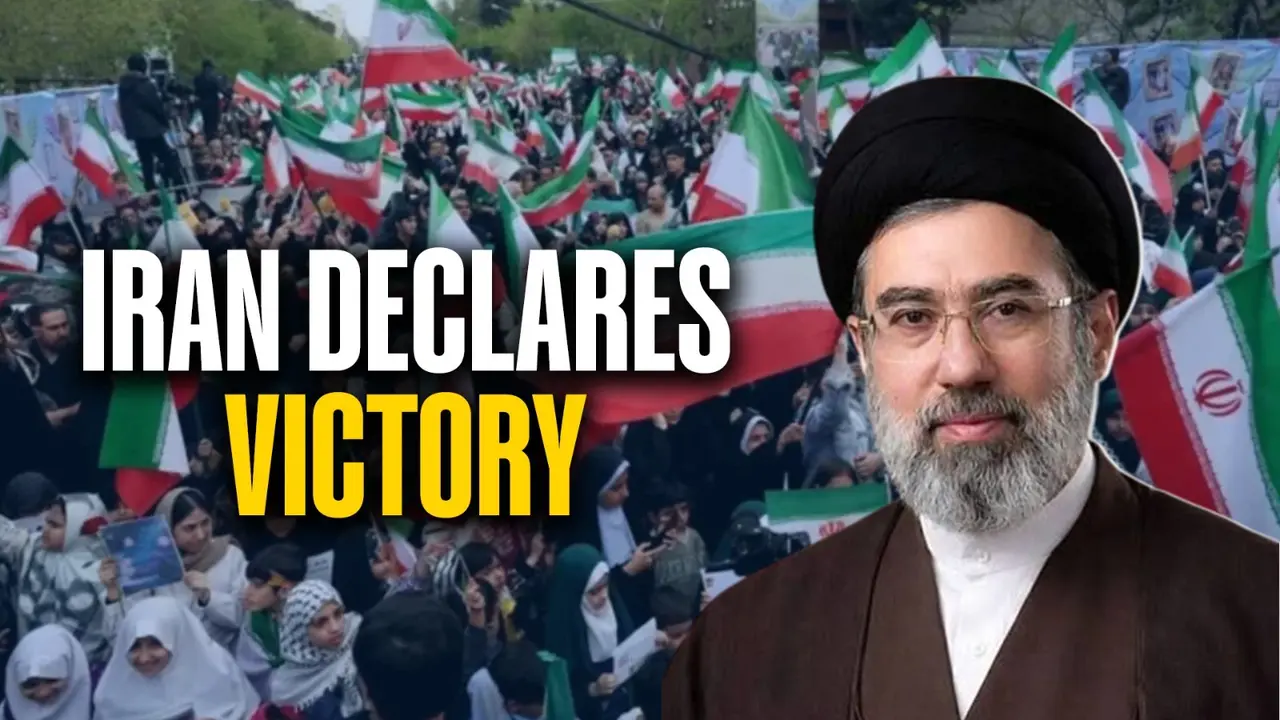
New Delhi: In a big development, Iran's Supreme National Security Council has claimed a "historic victory" after US President Donald Trump suspended the "bombing and attack" campaign on Iran and agreed to a two-week double-sided ceasefire.
Notably, President Donald Trump has framed the exact same event as a successful realisation of US military goals.
"Iran achieved a historic victory by forcing the criminal US to accept its 10-point plan. The US has accepted Iran's control over the Strait of Hormuz, enrichment rights, and removal of all sanctions. The US has accepted to stop aggression, pay compensation for damages, withdraw it's forced from the region," Supreme National Security Council stated as reported by Iranian state media.
The Security Council claimed that the US pushed for a ceasefire for over a month, but Iran repeatedly rejected the deadlines, prioritising the country's objectives.
Advertisement
The Council said, "It was decided from the very beginning that war would continue until objectives were achieved, including the enemy's regret and desperation, and removal of the long-term threat to the country. The war has thus continued until today, the fortieth day. Iran has repeatedly rejected the deadlines set by the US president and continues to emphasise that it attaches no importance to any kind of deadline from the enemy."

"Now we give the great nation of Iran the good news that nearly all the objectives of the war have been achieved, and your brave children have brought the enemy to historic helplessness and lasting defeat. Iran's historic decision, backed by the unified support of the nation, is to continue the battle for as long as necessary, so its immense achievements are consolidated, & new security & political equations are created based on acceptance of Iran's power & sovereignty & that of Resistance," they added.
Advertisement
What Trump claims
Notably, this comes after suspending the "bombing and attack" campaign on Iran, announcing a two-week double-sided ceasefire and saying that the 10-point proposal from Iran was workable.
In a post on Truth Social, Trump, said that ten-point proposal will serve as ground to negotiate for a permanent deal, while reiterating that US has achieved most of its military objectives.
“Based on conversations with Prime Minister Shehbaz Sharif and Field Marshal Asim Munir, of Pakistan, and wherein they requested that I hold off the destructive force being sent tonight to Iran, and subject to the Islamic Republic of Iran agreeing to the COMPLETE, IMMEDIATE, and SAFE OPENING of the Strait of Hormuz, I agree to suspend the bombing and attack of Iran for a period of two weeks. This will be a double-sided CEASEFIRE!”, Trump said.
He added, “The reason for doing so is that we have already met and exceeded all Military objectives, and are very far along with a definitive Agreement concerning Longterm PEACE with Iran, and PEACE in the Middle East. We received a 10 point proposal from Iran, and believe it is a workable basis on which to negotiate.”
10-point proposal
At the heart of the current diplomacy is a ten-point proposal Iran claims to have sent to Washington through Pakistani intermediaries. This framework outlines several steep requirements including Iranian military oversight of the Strait of Hormuz, an end to operations against the "Axis of Resistance," and the total withdrawal of American combat units from the region.
Additionally, Tehran is demanding full war reparations, the cancellation of all sanctions, the return of frozen international assets, and the formalization of these terms into a binding resolution by the UN Security Council.
End of war?
Tehran’s security council pointedly distinguished the temporary ceasefire from a permanent peace, emphasizing that the current truce does not signal a formal conclusion to the conflict.
“Iran will only accept the end of the war once the details are finalized in the negotiations," the council said, insisting the talks would be conducted “strictly based on" the principles laid out in its ten-point plan.
Trump, for his part, expressed optimism, saying the two-week window would allow a “definitive agreement" to be “finalised and consummated," and that nearly all points of contention had already been resolved.
Talks between US and Iran
Facilitated by Pakistan, the ceasefire was finalized after President Trump posted on Truth Social that he would halt all strikes against Iran for 14 days, citing direct requests from Prime Minister Shehbaz Sharif and military chief Field Marshal Asim Munir.
Iran’s security council verified Pakistan's role as the intermediary, noting that the Prime Minister assured them the U.S. had accepted Iran's core principles as a foundation for talks despite public rhetoric. Formal negotiations between the two nations are set to commence in Islamabad on April 10.
According to reports, U.S. officials indicate that the Trump administration is laying the groundwork for direct, face-to-face talks with Iranian representatives.
The meeting is likely in Islamabad with Pakistani mediators, following the two-week US-Iran ceasefire. Trump’s envoy Steve Witkoff, Jared Kushner and Vice President JD Vance are expected to attend, with Vance possibly adjusting his Hungary trip for the talks.