
US Judiciary Casts Doubt On Trump's Tariff Policy Without Congress, Case Heads To Supreme Court
US appellate court judges cast doubt on Trump's tariff rationale, questioning the invocation of IEEPA without Congress. The case is expected to reach the US Supreme Court.
- World News
- 3 min read

;'%3e%3cpath%20d='m8,15.99c4.41,0,7.99-3.58,7.99-7.99S12.41,0,8,0,0,3.59,0,8s3.58,7.99,7.99,7.99Z'%20style='stroke:%23fff;%20stroke-miterlimit:10;%20stroke-width:.02px;'/%3e%3cpath%20d='m3.08,3.37l3.82,5.11-3.84,4.15h.87l3.37-3.64,2.72,3.64h2.94l-4.04-5.39,3.58-3.87h-.86l-3.1,3.35-2.5-3.35h-2.94Zm1.27.64h1.35l5.97,7.99h-1.35l-5.97-7.99Z'%20style='fill:%23fff;'/%3e%3c/g%3e%3c/svg%3e)


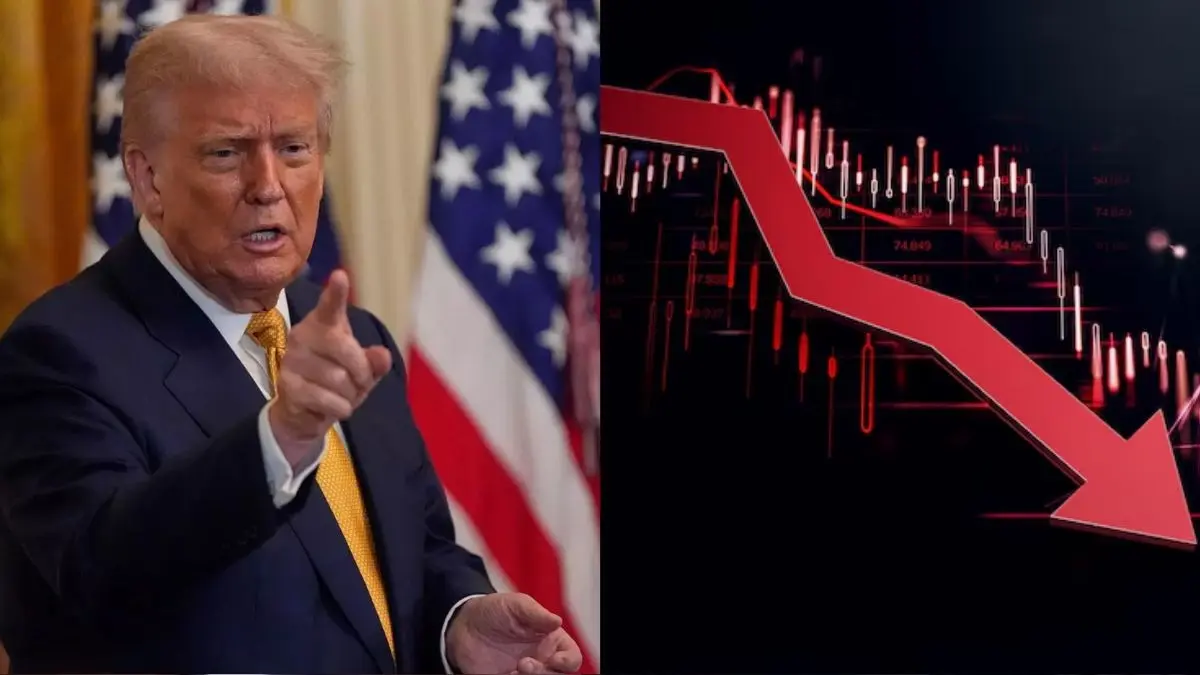
Washington: A recent hearing at the US Court of Appeals for the Federal Circuit in Washington has brought the controversy surrounding President Donald Trump's tariffs to the forefront. An 11-judge panel expressed big doubt over the Trump administration's legal rationale for imposing tariffs without congressional approval, questioning the invocation of the International Emergency Economic Powers Act (IEEPA) to justify these measures.
The Trump administration's argument that the president has the authority to impose tariffs under IEEPA has been met with incredulity by the judges. Circuit Judge Jimmie Reyna pointed out that IEEPA doesn't even mention the word tariffs anywhere, explaining the panel's doubts about the administration's claims. Brett Schumate, the attorney representing the Trump administration, acknowledged that no president has ever read IEEPA this way but maintained that it was lawful nonetheless.
International Emergency Economic Powers Act
According to the reports, it was said that IEEPA, signed into law by President Jimmy Carter in 1977, grants the president the authority to seize assets and block transactions during a national emergency. The law has been invoked in various global unrest situations, including the Iran hostage crisis and the 9/11 attacks. However, Trump's use of IEEPA to justify tariffs on trade deficits has raised eyebrows among the judiciary.
During the hearing, Chief Circuit Judge Kimberly Moore questioned the relevance of the levies to the threat identified by the administration, using the example of a 20% tax on coffee to address military readiness issues. Schumate argued that Congress's passage of IEEPA gave the president broad and flexible power to respond to emergencies, but asserted that the president is not seeking unbounded authority.
Advertisement
The attorney for the plaintiffs, Neal Katyal, characterised Trump's actions as a breathtaking power grab, amounting to saying, "The president can do whatever he wants, whenever he wants, for as long as he wants, so long as he declares an emergency." The plaintiffs include 12 US states and five businesses, such as a wine importer and a company selling pipes and plumbing goods.
The US Constitution grants Congress the authority to impose taxes, including tariffs. However, over the years, lawmakers have ceded power over trade policy to the White House. Trump's administration has leveraged this power vacuum, raising the average US tariff to over 18%, the highest rate since 1934.
Advertisement
Oregon Attorney General's Reaction
After the hearing, Oregon Attorney General Dan Rayfield expressed confidence that the judges didn't buy the Trump administration's arguments. "You would definitely rather be in our shoes going forward," he said. Rayfield emphasised that Trump's tariffs amount to one of the largest tax increases in American history, done unilaterally by one person in the Oval Office.
The case is expected to reach the US Supreme Court, regardless of the appeals court's decision. Trump's administration insists that a national emergency exists, necessitating its trade policy. However, a three-judge panel of the US Court of International Trade in New York previously ruled that Trump exceeded his powers.