
'A Huge Success': Scott Bessent Signals Possible Rollback Of Trump's 25% Tariffs As India’s Russian Oil Imports ‘Collapse’
Hopes of easing India–US trade tensions are rising after US Treasury Secretary Scott Bessent indicated that the 25% tariff penalty on Indian goods could be rolled back. The signal comes amid talks linked to India’s Russian oil purchases and broader trade negotiations.
- World News
- 5 min read

;'%3e%3cpath%20d='m8,15.99c4.41,0,7.99-3.58,7.99-7.99S12.41,0,8,0,0,3.59,0,8s3.58,7.99,7.99,7.99Z'%20style='stroke:%23fff;%20stroke-miterlimit:10;%20stroke-width:.02px;'/%3e%3cpath%20d='m3.08,3.37l3.82,5.11-3.84,4.15h.87l3.37-3.64,2.72,3.64h2.94l-4.04-5.39,3.58-3.87h-.86l-3.1,3.35-2.5-3.35h-2.94Zm1.27.64h1.35l5.97,7.99h-1.35l-5.97-7.99Z'%20style='fill:%23fff;'/%3e%3c/g%3e%3c/svg%3e)


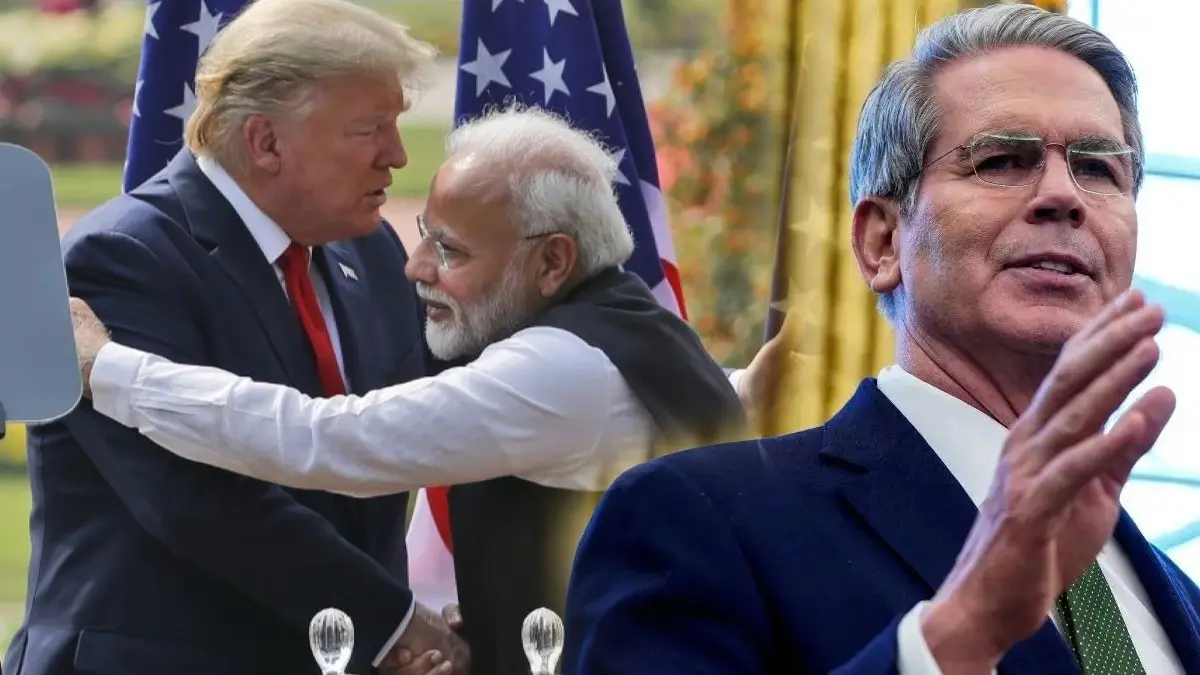
New Delhi: US Treasury Secretary Scott Bessent at Davos on Friday (local time) signalled that a 25% tariff on Indian goods could soon be lifted. Bessent described the punitive measure as a "huge success," claiming it effectively forced Indian refineries to "collapse" their purchases of Russian crude oil.
While the duties remain in effect for now, he indicated that a clear diplomatic "path" has opened to remove them following India's significant shift away from Russian energy.
Bessent shared these insights during a conversation with Politico, speaking at a time when the global geopolitical landscape, defined by Indian oil imports, US trade penalties, and the EU's own trade ambitions, has reached a critical flashpoint.
U.S. tariffs effect?
In a recent conversation with Politico, Bessent claimed that U.S. tariffs have successfully caused Indian purchases of Russian oil to "collapse." He suggested that these trade barriers aren't necessarily permanent, hinting at a diplomatic "path" toward lifting them, if India agrees to overhaul its energy sourcing. Furthermore, he doubled down on the strategy, arguing that these aggressive trade measures are delivering a direct economic win for the United States.
Advertisement
He added, "We put a 25 per cent tariff on India for buying Russian oil, and the Indian purchases by their refineries of Russian oil have collapsed. So that is a success. The tariffs are still on. I would imagine there is a path to take them off, so that's a check and a huge success."
This highlights a growing friction point as the U.S. Congress debates a proposed bill that would slap a massive 500% duty on nations purchasing Russian crude, India maintains its stance that securing "affordable energy" for its citizens remains its non-negotiable priority.
Advertisement
‘India First’ energy policy
New Delhi is maintaining a steadfast commitment to its "India First" energy policy, refusing to buckle under the pressure of a proposed US Congressional bill that threatens to hike import duties to a staggering 500%. The Indian government has doubled down on its stance, emphasizing that its unwavering priority remains the procurement of affordable energy to meet the essential needs of its 1.4 billion citizens.
Reacting to the proposed legislation, Spokesperson of the Ministry of External Affairs (MEA), Randhir Jaiswal, said that New Delhi is aware of the bill and is closely monitoring developments.
"We are aware of the proposed bill. We are closely following the developments," Jaiswal said during a weekly press briefing.
Shifting realities of global market
While mindful of the looming legislative threats from Washington, India is persistently navigating the delicate balance between maintaining its strategic autonomy and adapting to the shifting realities of the global market.
These comments follow a significant development earlier this month, when Senator Lindsey Graham announced that President Trump has officially "greenlit" the bipartisan Russia Sanctions Bill.
According to Graham, the legislation is designed to provide the White House with "tremendous leverage" to force countries like India, China, and Brazil to abandon Russian energy. By framing these nations as the financial engines behind "Putin's war machine," the bill aims to use the threat of massive tariffs, potentially up to 500%, as a diplomatic hammer to stop the flow of cheap oil that funds the ongoing conflict in Ukraine.
Critique of European trade policy
US Treasury Secretary Scott Bessent has delivered a scathing critique of European trade policy, labeling the purchase of Indian-refined Russian oil an "act of irony and stupidity."
Bessent pointed out that while Russian crude once made up only 2-3% of India's refinery intake, it has surged to nearly 20% due to heavy sanctions-driven discounts
He argued that by buying these refined products, European nations are effectively financing the very war effort they oppose.
"Just to be clear, let's understand what's happening. Before the Ukraine invasion, approximately 2-3 per cent of Indian oil that went into its refineries came from Russia. The oil was sanctioned. It got deeply discounted and moved up into the high teens- 7, 18, 19% was being refined. Huge pro, huge profits from the refiners. But in the ultimate act of irony and stupidity, guess who was buying the refined products from the Indian refineries made from Russian oil? The Europeans. They are financing the war against themselves. They are financing the Russian", Bessent told.
Bessent further dismissed Europe’s reluctance to impose tariffs on India as "virtue signaling," suggesting that EU leaders are prioritizing the finalization of a massive Free Trade Agreement (FTA) over geopolitical consistency.
‘Mother of all deals’
Meanwhile, the European Union remains undeterred, with Commission President Ursula von der Leyen preparing for a historic visit to New Delhi to finalize what she calls the "mother of all deals."
This comprehensive strategic agenda would unite a market of 2 billion people, representing a quarter of the global GDP. Despite the controversy surrounding Russian oil, von der Leyen’s presence as a Chief Guest for India’s Republic Day signals that Europe views India as an indispensable economic partner.
While the US pushes for leverage and punishment, the EU appears committed to a path of international cooperation and market expansion, viewing the upcoming FTA as a cornerstone of its global trade strategy.