
US Navy MH-60S Seahawk Helicopter Goes Down In Arabian Sea, 3 Rescued, Hunt For Missing Crewman Underway
A US Navy MH-60S Seahawk helicopter made an emergency water landing in the Arabian Sea, with 3 crew rescued and stable aboard USS George HW Bush, one still missing as search continues with no signs of hostile action, CENTCOM said.
- World News
- 4 min read

;'%3e%3cpath%20d='m8,15.99c4.41,0,7.99-3.58,7.99-7.99S12.41,0,8,0,0,3.59,0,8s3.58,7.99,7.99,7.99Z'%20style='stroke:%23fff;%20stroke-miterlimit:10;%20stroke-width:.02px;'/%3e%3cpath%20d='m3.08,3.37l3.82,5.11-3.84,4.15h.87l3.37-3.64,2.72,3.64h2.94l-4.04-5.39,3.58-3.87h-.86l-3.1,3.35-2.5-3.35h-2.94Zm1.27.64h1.35l5.97,7.99h-1.35l-5.97-7.99Z'%20style='fill:%23fff;'/%3e%3c/g%3e%3c/svg%3e)


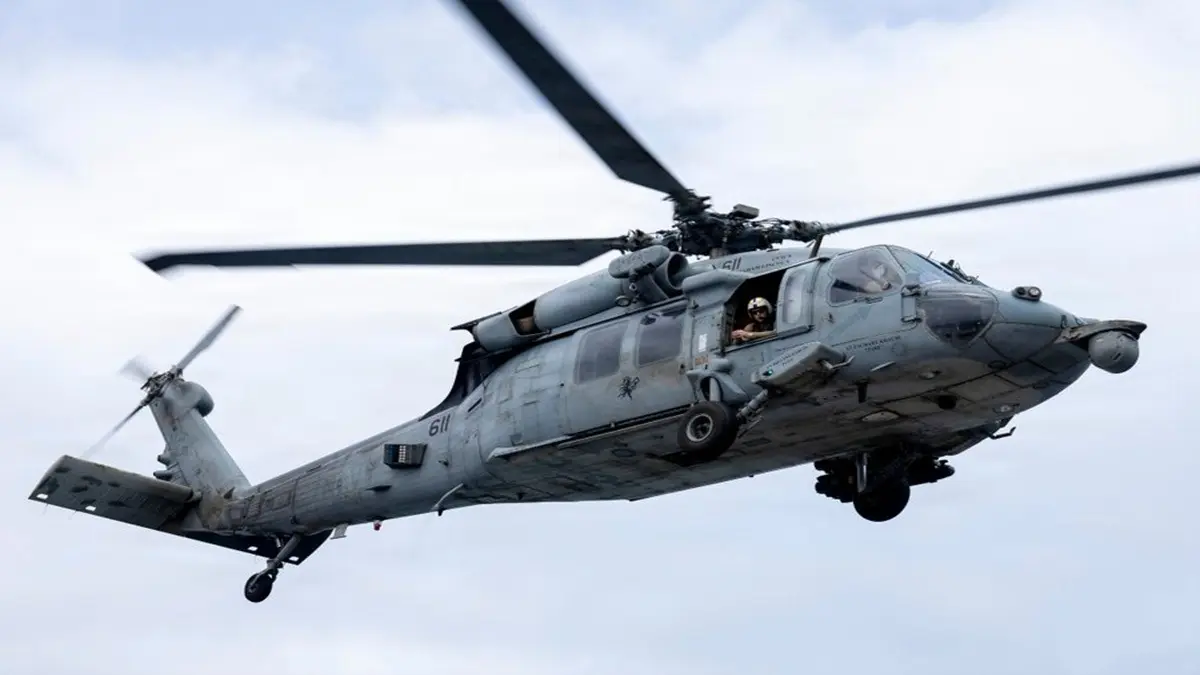
Washington: A search operation is underway in the Arabian Sea after a US Navy MH-60S Seahawk helicopter reportedly carried out an emergency water landing on Wednesday, leaving one crew member unaccounted for. According to reports, at least 3 other personnel on board were pulled from the water safely.
Reports suggested that the aircraft, which was attached to the USS George HW Bush aircraft carrier, came down at around 1 pm local time, according to US Naval Forces Central Command (CENTCOM). The military officials have stressed that there is currently no indication that the helicopter was brought down as a result of hostile activity.
The incident occurred while the American forces remain on heightened alert across the Middle East, following a period of intense confrontation in the region. Despite the tense backdrop, the Navy has not linked the emergency landing to enemy fire.
As per reports, the rescue teams responded and managed to recover 3 of the 4 crew members from the sea. All 3 were transferred to the USS George HW Bush, where they are reported to be in a stable condition.
Advertisement
“Three of the helicopter's four crew members have been recovered and are in stable condition aboard George HW Bush……US Navy assets in the region are currently searching for the other aircrewman still missing,” the US Naval Forces CENTCOM said in a statement.
As of Thursday, the search for the 4th crew member was still continuing, with additional naval resources deployed across the area to aid the effort.
Advertisement
Cause Under Investigation, Hostile Action Ruled Out
The US Navy has made clear that there is presently no evidence to suggest the helicopter was shot down. The precise cause of the emergency water landing has not been established, and a formal investigation is expected to ascertain what compelled the aircraft to come down in the sea.
The event takes place against a backdrop of heightened military activity in the region after recent clashes between the US and Iran. Although a ceasefire is in effect, intermittent flare-ups have kept American forces on a state of high readiness.
The emergency water landings present some of the most dangerous scenarios for the helicopter crews. The helicopters, unlike fixed-wing aircraft, tend to overturn upon impact with water because of their top-heavy structure, which makes both escape and rescue operations especially dangerous. Though the military personnel trains regularly for such emergencies, survival often hinges on sea conditions and the speed of the response.
USS George HW Bush Maintains Regional Presence
Reports suggested that the helicopter had been operating from the USS George HW Bush, one of two US aircraft carriers presently deployed in the Middle East. The carrier has been stationed in the area since late April as part of Washington’s expanded military footprint during the recent conflict with Iran.
Though the United States has lifted the blockade on commercial shipping moving through the Strait of Hormuz, it continues to keep a substantial naval presence in the region to protect shipping lanes and support security operations.
Meanwhile, the latest incident followed a number of aviation losses sustained by the US forces during the ongoing regional conflict. In the most recent update provided to Congress in mid-May, the US military reported losing 42 fixed-wing and rotary aircraft during Operation Epic Fury. Reportedly, the tally did not include an Apache helicopter that was brought down by an Iranian drone in early June.
Both crew members involved in the June incident survived after being rescued, but the attack led the US to carry out “self-defence strikes” against Iran.
Further details regarding the ongoing rescue efforts in the Arabian Sea are awaited.