
Titan submersible 'designed to come back up after 24 hours', says investor
The search for the missing submersible has now reached a critical stage as rescue teams raced overnight to locate the vessel before its oxygen supply runs out.
- World News
- 3 min read

;'%3e%3cpath%20d='m8,15.99c4.41,0,7.99-3.58,7.99-7.99S12.41,0,8,0,0,3.59,0,8s3.58,7.99,7.99,7.99Z'%20style='stroke:%23fff;%20stroke-miterlimit:10;%20stroke-width:.02px;'/%3e%3cpath%20d='m3.08,3.37l3.82,5.11-3.84,4.15h.87l3.37-3.64,2.72,3.64h2.94l-4.04-5.39,3.58-3.87h-.86l-3.1,3.35-2.5-3.35h-2.94Zm1.27.64h1.35l5.97,7.99h-1.35l-5.97-7.99Z'%20style='fill:%23fff;'/%3e%3c/g%3e%3c/svg%3e)


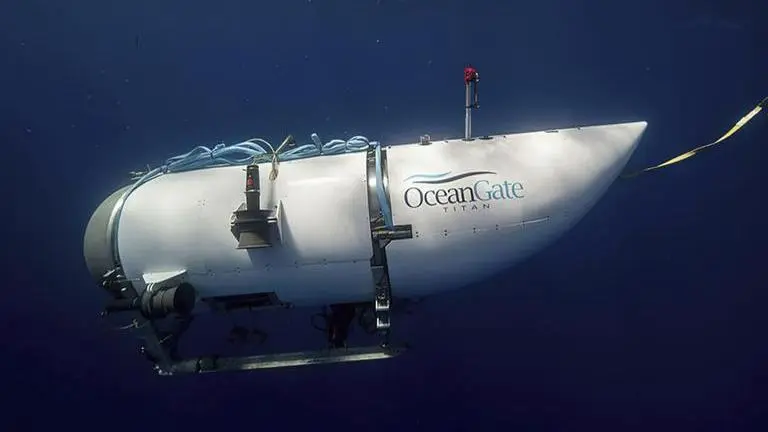
Titan, the missing submersible, has been designed in such a way that its ballast and heavy weights - which hold it underwater - would be automatically released after 24 hours which would send the sub floating to the surface, Aaron Newman, an investor in OceanGate, who too went on a Titanic expedition on board the Titan in 2021, said.
The search for the missing submersible has now reached a critical stage as rescue teams raced overnight to locate the vessel before its oxygen supply runs out.
Three things you need to know:
- Rescuers make a final desperate attempt as last few hours of oxygen supply on the missing submarine tick down.
- The submersible begins each trip with 96 hours of life support and has been missing since Sunday.
- Thursday morning has been set as the target for finding the vessel and those on board.
It is designed to come back up: Aaron Newman
According to Newman, crew members on board the Titan are instructed that they can release the ballast by rocking the ship or using a pneumatic pump to knock the weights free. "If all else fails, the lines securing the ballast are designed to fall apart after 24 hours to automatically send it back to the ocean’s surface," Newman added.
Newman pointed out that Titan's thrusters were powered by an external electrical system, while an internal system powered the communications and the heater.
Advertisement
"After boarding the Titan, temperatures inside the vessel get hot quickly before starting to get colder as it descends towards the ocean’s bottom," Newman said.
Inside the vessel, the "quarters are tight" hot near the surface of the water and nearly freezing in the depth,” Newman said. The crew members can sit on a low ledge inside the vessel to look through the porthole. “There is a heater in (Titan), so it can heat up a little bit, but obviously that’s not going to last forever,” he said. “And obviously, if it’s dark, that’s probably very difficult on your mental state,” he added.
Senior Adviser for Strategic Initiatives, RMS Titanic, David Gallo, said, “It’s like a visit to another planet, it’s not what people think it is. It is a sunless, forever cold environment – high pressure.” A fleet of ships and specialized equipment have been deployed, including a US Navy deep ocean salvage system and Canadian Coast Guard ship John Cabot, which has "side-scanning sonar capabilities", Gallo added.
Advertisement
Where did the 'high-tech' submersible go?
In 2022, OceanGate CEO Stockton Rush said, “This is not your grandfather’s submersible, we only have one button – that’s it. It should be like an elevator; it shouldn’t take a lot of skill.” At that time, he shared that it was “customary” for crew members to take their shoes off once inside the vessel.
According to OceanGate Expeditions’ archived website, with no GPS underwater, Titan communicates with its mother ship by text messages, and the submersible is required to communicate every 15 minutes. The last communication between the vessel and the Polar Prince came in at 11:47 a.m. June 18. However, former Navy submarine officer Capt. J. Van Gurley said, "All those things we’re used to now – GPS, Wi-Fi, radio links – do not work under the ocean," as per the US-based media outlet.