
Unlikely US Supreme Court fully repeals Obamacare
A more conservative Supreme Court appears unwilling to do what Republicans have long desired: kill off the Affordable Care Act, including its key protections for pre-existing health conditions and subsidized insurance premiums that affect tens of millions of Americans.
- World News
- 4 min read

;'%3e%3cpath%20d='m8,15.99c4.41,0,7.99-3.58,7.99-7.99S12.41,0,8,0,0,3.59,0,8s3.58,7.99,7.99,7.99Z'%20style='stroke:%23fff;%20stroke-miterlimit:10;%20stroke-width:.02px;'/%3e%3cpath%20d='m3.08,3.37l3.82,5.11-3.84,4.15h.87l3.37-3.64,2.72,3.64h2.94l-4.04-5.39,3.58-3.87h-.86l-3.1,3.35-2.5-3.35h-2.94Zm1.27.64h1.35l5.97,7.99h-1.35l-5.97-7.99Z'%20style='fill:%23fff;'/%3e%3c/g%3e%3c/svg%3e)


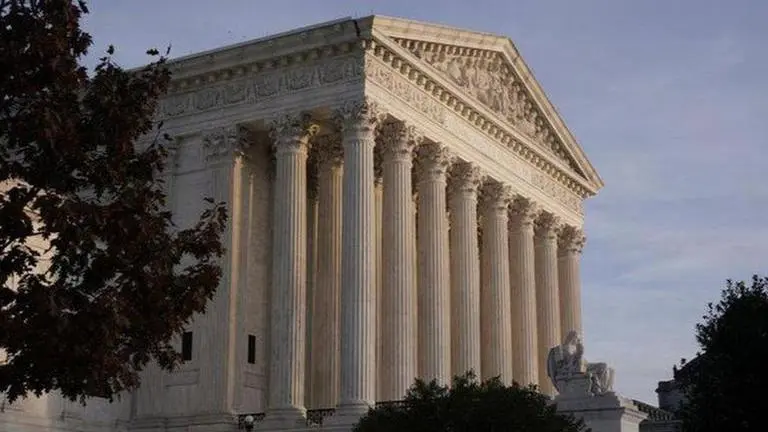
A more conservative Supreme Court appears unwilling to do what Republicans have long desired: kill off the Affordable Care Act, including its key protections for pre-existing health conditions and subsidized insurance premiums that affect tens of millions of Americans.
Meeting remotely a week after the election and in the midst of a pandemic that has closed their majestic courtroom, the justices on Tuesday took on the latest Republican challenge to the Obama-era health care law, with three appointees of President Donald Trump, an avowed foe of the law, among them.
But at least one of those Trump appointees, Justice Brett Kavanaugh, seemed likely to vote to leave the bulk of the law intact, even if he were to find the law's now-toothless mandate that everyone obtain health insurance to be unconstitutional.
Chief Justice John Roberts, who wrote two earlier opinions preserving the law, stated similar views, and the court's three liberal justices are almost certain to vote to uphold the law in its entirety. That presumably would form a majority by joining a decision to cut away only the mandate, which now has no financial penalty attached to it. Congress zeroed out the penalty in 2017, but left the rest of the law untouched.
Advertisement
"It's never a sure thing to predict how a Supreme Court case is going to come out, but it sure sounded like from the argument today that there were at least five votes to say that even if the mandate is now unconstitutional, that the rest of the law should still remain intact," said Mark Sherman, an Associated Press Supreme Court reporter.
In the court's third major case over the 10-year-old law, popularly known as "Obamacare," Republican attorneys general in 18 states and the administration want the entire law to be struck down. That would threaten coverage for more than 23 million people, as well as millions of others with preexisting conditions that now would include COVID-19.
Advertisement
Associated Press Reporter Ricardo Alonso-Zaldivar said the healthcare law acts as a "circuit breaker" for those suffering from the public health crisis and the ongoing economic fallout.
"For people who've lost their jobs they have an option, even though they have lost their jobs, to see if they can cobble coverage back together for them and their families. So that would go away if the law is repealed in its entirety," Alonso-Zaldivar said.
The Supreme Court could have heard the case before the election, but set arguments for a week after. The timing could add a wrinkle to the case since President-elect Joe Biden strongly supports the health care law.
If the case turns on the legal doctrine of severability, it would be in line with other rulings in recent years in which the justices have excised a problematic provision from a law and allowed the rest to remain in force.
In the first big ACA case in 2012, Justices Samuel Alito and Thomas voted to strike down the entire law. Roberts and Justices Stephen Breyer, Elena Kagan and Sonia Sotomayor voted to uphold it.
Roberts has endured a torrent of conservative criticism, including from Trump, for his earlier opinions, including the initial case in 2012 that upheld the mandate.
A limited ruling would have little real-world consequence. The case could also be rendered irrelevant if the new Congress were to restore a modest penalty for not buying health insurance.
"Now that might not be very likely to happen, especially if Republicans end up in control of the Senate," Sherman said. "But it is a possibility and one that sort of underscores how unusual this this moment is."
A decision from the Supreme Court is expected by late spring 2021.