
US Space Force scrambles to secure its space assets after Russian anti-satellite test
US Space Force research and development program is now focused on developing the technology that would keep its space assets safe and counter such an attack
- World News
- 4 min read

;'%3e%3cpath%20d='m8,15.99c4.41,0,7.99-3.58,7.99-7.99S12.41,0,8,0,0,3.59,0,8s3.58,7.99,7.99,7.99Z'%20style='stroke:%23fff;%20stroke-miterlimit:10;%20stroke-width:.02px;'/%3e%3cpath%20d='m3.08,3.37l3.82,5.11-3.84,4.15h.87l3.37-3.64,2.72,3.64h2.94l-4.04-5.39,3.58-3.87h-.86l-3.1,3.35-2.5-3.35h-2.94Zm1.27.64h1.35l5.97,7.99h-1.35l-5.97-7.99Z'%20style='fill:%23fff;'/%3e%3c/g%3e%3c/svg%3e)


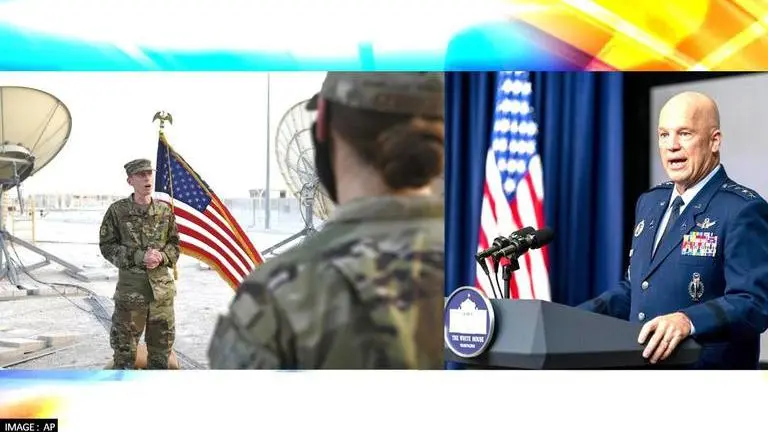
After Russia launched an anti-satellite missile that attacked its own old derelict spy satellite ‘Cosmos 1408’ exploding it into 1,500-plus bits of flotsam in space and elevating concerns about the astronaut’s safety, US Space Force on Thursday scrambled to enhance its space assets’ safety taking the unforeseen move as a warning. Experts and US military officials told the Air Force Magazine that the Russian ASAT test exposed the vulnerability of the US orbital assets on which the country’s armed forces completely rely for ensuring security on the ground.
The US Space Force research and development program is now focused on developing the technology that would keep its space assets safe and will boost the capability of countering such an anti-satellite missile system in order to keep its critical communication, surveillance, and other capabilities on the ground operational.
US Space Force's focus on 'resilience' for its satellite platforms
Director of the Space Control Technology Branch of the Air Force Research Laboratory, Brian Engberg, told the Air Force Magazine that the US military and space force’s priority after Russia’s recent launch is converged on establishing defensive measures and resilience for its satellite platforms.
He continued that the idea is that “even in the teeth of an attack using weapons like the one Russia tested Nov. 15, Space Force orbital assets should continue to provide critical space-based services like communications, navigation [and] timing, operational awareness, information dominance, which then enable strong offensive and defensive advantages for [our terrestrial forces] on land, sea, and [in the] air,” Air Force Magazine quoted Engberg as saying.
Advertisement

In this photo taken from video distributed by Russian Defense Ministry Press Service on Monday, Oct. 4, 2021, a new Zircon hypersonic cruise missile is launched by a submarine of the Russian navy from the Barents Sea. Credit: Russian Defense Ministry Press Service via AP
Meanwhile, the US Space Force director of staff, Lt. Gen. Nina Armagno in a statement, cited by Sputnik, said that the US Space Force has now been exploring means and effective methods to make US space assets more difficult to find or “less juicy”. “We’re doing this mission area by mission area. We need to take our missile-warning assets, we need to add layers of orbits, hybrid capabilities, smaller satellites, and commercially provided capabilities. That will all complicate Russia targeting our prime missile-warning capabilities”, she told the agency.
Advertisement
Furthermore, she argued that Russia’s test of an anti-satellite missile was in actual ‘a weaponry’ since if it can destroy the Russian satellite, it can, as well destroy an American satellite. The test was undermined by the Russian Foreign Ministry spokeswoman Maria Zakharova at a news conference where she stressed that the anti-satellite hit the defunct Russian spacecraft Tselina-D, despite the fact that the attack spiralled floating junk in space close to the International Space Station (ISS) prompting the crew to run for safe cover.
“The debris created by Russia's [anti-satellite test] will continue to pose a threat to activities in outer space for years to come, putting satellites and space missions at risk, as well as forcing more collision avoidance maneuvers,” stated General James Dickinson, head of the US Space Command, in a press release on Monday. “Space activities underpin our way of life and this kind of behavior is simply irresponsible.”
US Department of State spokesperson, Ned Price condemned Russia's move at a White House briefing by labelling it 'dangerous and irresponsible, as he said: “Earlier today, the Russian Federation recklessly conducted a destructive satellite test of a direct-ascent, anti-satellite missile against one of its own satellites, and Russia’s dangerous and irresponsible behaviour jeopardizes the long-term sustainability of outer space and clearly demonstrates that Russia’s claims of opposing the weaponization of space are disingenuous and hypocritical."