
Expert: Still chance for survivors in Fla. collapse
Rescuers searching for a fifth day for survivors of a Florida condo building collapse used bucket brigades and heavy machinery Monday as they worked atop a precarious mound of pulverized concrete, twisted steel and the remnants of dozens of households.
- World News
- 4 min read

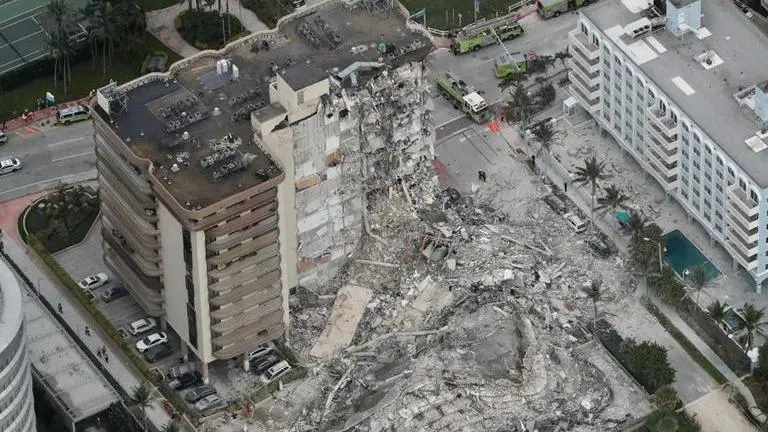
Rescuers searching for a fifth day for survivors of a Florida condo building collapse used bucket brigades and heavy machinery Monday as they worked atop a precarious mound of pulverized concrete, twisted steel and the remnants of dozens of households.
Authorities said the efforts are still a search-and-rescue operation, but no one has been found alive since hours after the collapse on Thursday. Ten people have been confirmed killed, and more than 150 others are still missing in the community of Surfside, just outside Miami.
The pancake collapse of the 12-story building left layer upon layer of intertwined debris, frustrating efforts to reach anyone who may have survived in a pocket of space.
Underscoring the dangerous nature of the work, he noted that families who rode buses to visit the site on Sunday witnessed a rescuer tumble 25 feet down the pile. Workers and victims must both be considered, he said.
Advertisement
Relatives continued their visits on Monday. From outside a neighboring building, more than two dozen family members watched teams of searchers excavate the building site. Some held onto each other for support. Others hugged and prayed. Some people took photos.
The intense effort includes firefighters, sniffer dogs and search experts using radar and sonar devices.
Advertisement
"In the right void there could be survivors still today," said Jeff Saunders, Director of Texas A&M Task Force 1, an urban search and rescue team.
Early Monday, a crane lifted a large slab of concrete from the debris pile, enabling about 30 rescuers in hard hats to move in and carry smaller pieces of debris into red buckets, which are emptied into a larger bin for a crane to remove. The work has been complicated by intermittent rain showers, but the fires that hampered the initial search have been extinguished.
Jimmy Patronis, Florida’s chief financial officer and state fire marshal, said it was the largest deployment of such resources in Florida history that was not due to a hurricane. He said the same number of people were on the ground in Surfside as during Hurricane Michael, a devastating Category 5 hurricane that hit 12 counties in 2018.
While most rescue teams were from the area, others came from elsewhere, including a small group of rescue workers from the Mexican group Cadena International.
The group was using a suitcase-size device that uses microwave radar to “see” through concrete slabs and pick up heartbeats and other sounds up to 40 feet inside and under the rubble. But as of Monday, the group had not detected any heartbeats or sounds, said Ricardo Aizenman.
After that time, hydration becomes the biggest challenge, he said. He added that the on-and-off rain happening since the collapse could actually help as a source of water.
Authorities on Monday insisted they are not losing hope.
Deciding to transition from search-and-rescue work to a recovery operation is agonizing, said Dr. Joseph A. Barbera, a professor at George Washington University. That decision is fraught with considerations, he said, that only those on the ground can make.
Barbera coauthored a study examining disasters where some people survived under rubble for prolonged periods of time. He has also advised teams on where to look for potential survivors and when to conclude “that the probability of continued survival is very, very small.”
As time goes on, he said, teams will begin a process called "rapid delayering, where you take more risk by moving larger amounts of rubble, because you recognize you’re running up against the time factor for survival.”
How long a person can survive depends on a host of issues, including the availability of water, the severity of any injuries and the degree to which they are trapped, Barbera said.
“The human dimension is huge -- the uncertainty that you could be leaving someone alive behind by ending too early,” Barbera said.
The ultimate decision to move into the recovery phase, he said, will have to be made "with the involvement of the political authority because they’re the ultimate authority over this.”
The building collapsed just days before a deadline for condo owners to start making steep payments toward more than $9 million in repairs that had been recommended nearly three years earlier, in a report that warned of “major structural damage."
A federal team of scientists and engineers who examine structural failures are conducting a preliminary investigation at the site and will determine whether to launch a full probe of what caused the building to come down.
The National Institute of Standards and Technology also investigated disasters such as the collapse of the twin towers on 9/11, Hurricane Maria’s devastation in Puerto Rico and a Rhode Island nightclub fire that killed 100 people. Previous investigations have taken years to complete.
IMAGE: AP