
Know about Apollo 11, the American spaceflight that first landed humans on the Moon
Armstrong and Aldrin climbed into the lunar module Eagle and began the descent, while Collins orbited in the command module Columbia.
- World News
- 3 min read

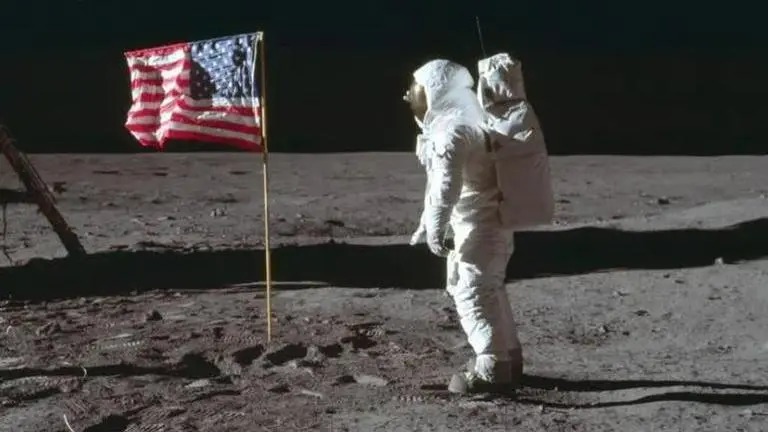
On July 16, 1969, Apollo 11 astronauts Neil Armstrong, Buzz Aldrin and Michael Collins were launched aboard Saturn V rocket from Launch Complex 39A at the Kennedy Space Center. They became the first humans to ever walk on the moon. The three-stage 363-foot rocket used 7.5 million pounds of thrust to propel the first humans in space creating history.
As the engines fired, Apollo 11 cleared the tower and in approximately 12 minutes the crew reached the Earth's orbit. Apollo 11 got a "go" for what mission controllers called the "Translunar Injection." It was time for humans to head for the moon. Three days later the crew was in lunar orbit.
A day after that, Armstrong and Aldrin climbed into the lunar module Eagle and began the descent, while Collins orbited in the command module Columbia. "The unknowns were rampant," and "there were just a thousand things to worry about," Armstrong said about the launch. He became the first man to set the first human foot on Earth's satellite. The crew splashed down off Hawaii on July 24 and the men from Earth finally walked on the moon and returned safely home.
A national goal set by then US President John F. Kennedy
The primary objective of Apollo 11 was to complete a national goal set by then US President John F. Kennedy on May 25, 1961: perform a crewed lunar landing and return to Earth, according to NASA. The other objectives of the missions were scientific exploration by the lunar module, or LM, crew; deployment of a television camera to transmit signals to Earth; and deployment of a solar wind composition experiment, seismic experiment package and a Laser Ranging Retroreflector. During the mission, the two astronauts gathered the first samples of lunar-surface materials for return to Earth. They also extensively photographed the lunar terrain for the first time, and deployed scientific equipment to achieve both still and motion pictures of the moon's surface.
Advertisement

Buzz Aldrin climbs down the Eagle's ladder to the surface. Click image to enlarge.Credits: NASA
US Commander Neil Armstrong, Command Module Pilot Michael Collins and Lunar Module Pilot Edwin "Buzz" Aldrin launched off the initial Earth-orbit of 114 by 116 miles as approximately 650 million people watched the historic feat. Armstrong described the mission as "...one small step for a man, one giant leap for mankind" in his July 20, 1969 remark. Armstrong and Aldrin spent 21 hours, 36 minutes on the moon's surface. Apollo 11 splashed down in the Pacific Ocean, 13 miles from the recovery ship USS Hornet as it made successful return to the Earth.
Advertisement

Crater 308 stands out in sharp relief in this photo from lunar orbit. Click image to enlarge. Credits: NASA