
UAE suspends $23 bn arms deal with US, analysts say 'allies depleting trust on Washington'
UAE had remained inclined towards acquiring advanced American F-35 warplanes despite the indirectly made objections by the then Israeli PM Netanyahu
- World News
- 5 min read

;'%3e%3cpath%20d='m8,15.99c4.41,0,7.99-3.58,7.99-7.99S12.41,0,8,0,0,3.59,0,8s3.58,7.99,7.99,7.99Z'%20style='stroke:%23fff;%20stroke-miterlimit:10;%20stroke-width:.02px;'/%3e%3cpath%20d='m3.08,3.37l3.82,5.11-3.84,4.15h.87l3.37-3.64,2.72,3.64h2.94l-4.04-5.39,3.58-3.87h-.86l-3.1,3.35-2.5-3.35h-2.94Zm1.27.64h1.35l5.97,7.99h-1.35l-5.97-7.99Z'%20style='fill:%23fff;'/%3e%3c/g%3e%3c/svg%3e)


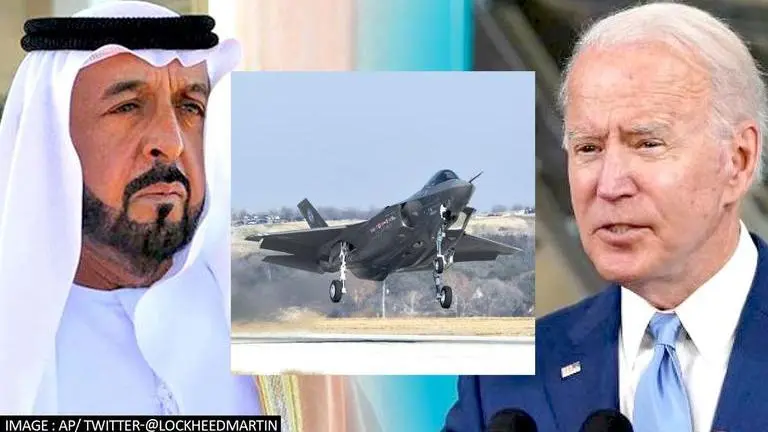
The United Arab Emirates’ suspension of the $23 billion deal to purchase 50 F-35 jets from the United States demonstrates Washington’s allies' depleting trust and reliance on US military might, according to the global analysts. Secretary of State Antony Blinken had insisted that the United States was prepared to sell F-35 fighter jets and the arms package to the UAE, fulfilling the deal negotiated by the former president Donald Trump before the federation threatened to scrap it.
The arms deal between Washington and the UAE was brokered after the former Trump administration signed the historic Abraham Accords and normalised ties between several Arab nations and Israel.
It is being speculated that the UAE’s decision was fuelled by the insecurity at large for the US’ regional partners and allies against using technologies that can be targeted by Chinese espionage. Just last month, a Chinese national and Deputy Division Director of the Sixth Bureau of the Jiangsu Province [Ministry of State Security] was convicted by the United States federal jury for conspiring to and attempting to commit economic espionage and theft of trade secrets.
The first ever legally convicted Chinese intelligence officer, Yanjun Xu, who was “guilty on all counts” used various aliases dating back to 2013 to steal the trade secrets of the leading US aviation companies. Xu targeted the aviation firms recognised as global leaders in the field of aviation to spy the secrets back to China. He allegedly stole information related to GE Aviation’s proprietary composite aircraft engine fan, an FBI investigation found.
Advertisement

US Defense Secretary Lloyd Austin speaks to reporters at Israel's Nevatim air base Monday, with an Israeli F-35 fighter jet in the background. Credit: AP Photo/Robert Burns
UAE was inclined to buy 'quite a few' American stealth jets
The US-UAE arms deal, which was hugely disputed and marred with controversies whilst in the making, was labelled as ‘rushed through’ and dangerous by the members of the Senate Foreign Relations Committee who had met with the Trump administration officials to hear about a proposed sale. “Hard to overstate the danger of rushing this though,” Democratic Sen. Chris Murphy had tweeted at the time.
Advertisement
But the UAE remained inclined towards acquiring the advanced American F-35 warplanes despite the indirectly made objections by the then Israeli Prime Minister Benjamin Netanyahu. Emiratis had expressed interest in buying “quite a few” of the stealth fighter jets, Trump had told a White House briefing. “It is the greatest fighter jet in the world, as you know, by stealth, totally stealth,” Trump had touted US weaponry and equipment, adding that the UAE “has the money and they would like to order quite a few F-35s.”
At the time, the three US senators — Murphy Murphy and Senate Foreign Relations ranking member Robert Menendez, along with Republican Rand Paul had also attempted to block the deal by using legislative instrument four joint resolutions. “Congress is once again stepping in to serve as a check to avoid putting profit over US national security and that of our allies, and to hopefully prevent a new arms race in the Middle East,” Menendez had said in a statement. But the UAE stood firm in its resolve of purchasing the F-35 fighter aircrafts from the then Trump administration that agreed the kingdom could use the weapons indiscriminately.

From left to right: Ex-PM Netanyahu, Ex-US President Donald Trump, Ex-Bahrain Foreign Minister Abdullatif al-Zayani and United Arab Emirates Foreign Minister Abdullah bin Zayed al-Nahyan are seen on the Blue Room Balcony after signing the Abraham Accords. Credit: AP
The UAE now threatened to derail the crucial $23 billion arms contract that would help the federation acquire stealth American-made F-35 aircraft from Lockheed Martin Corp, Reaper drones, and other advanced munitions, citing that the security requirements were too onerous. The think tanks, however, believe that it is perhaps the waning military credibility of the United States that may be provoking the UAE to step away. The UAE foreign ministry did not immediately respond to a request for comments.
Emirati Embassy in Washington confirmed that it would “suspend discussions" with the US via meetings at the Pentagon this week. “The US remains the UAE's preferred provider for advanced defense requirements and discussions for the F-35 may be re-opened in the future,” the embassy said in a statement.

US President Joe Biden (left) and then-Deputy Secretary of State Tony Blinken. Credit: AP
Former UK Ambassador to Syria Peter Ford, however, thinks that UAE may have exited the deal due to the objectionable clauses such as disabling any capacity of the aircraft that may harm Israel. "The Emiratis, rich but not stupid, have used this misstep as a pretext to halt the deal," Ford told Russia’s state-affiliated press Sputnik. He then added, "The withdrawal has forced all the Gulf states into the realisation that making their security wholly dependent on the US is unwise, and that some degree of detente with Iran is a better way of guaranteeing their security than becoming more and more beholden to the US.”