
How US And Israeli Bombs Destroyed Some Of Iran’s Most Cherished UNESCO Protected Monuments
Those Israeli airstrikes, on March 7 and 9, shook the monuments at Naqsh-e Jahan Square and the Chehel Sotoun Palace, two of Iran’s most treasured cultural complexes. Two weeks later, plaster and broken tile still crunched underfoot in some places.
- World News
- 15 min read

;'%3e%3cpath%20d='m8,15.99c4.41,0,7.99-3.58,7.99-7.99S12.41,0,8,0,0,3.59,0,8s3.58,7.99,7.99,7.99Z'%20style='stroke:%23fff;%20stroke-miterlimit:10;%20stroke-width:.02px;'/%3e%3cpath%20d='m3.08,3.37l3.82,5.11-3.84,4.15h.87l3.37-3.64,2.72,3.64h2.94l-4.04-5.39,3.58-3.87h-.86l-3.1,3.35-2.5-3.35h-2.94Zm1.27.64h1.35l5.97,7.99h-1.35l-5.97-7.99Z'%20style='fill:%23fff;'/%3e%3c/g%3e%3c/svg%3e)


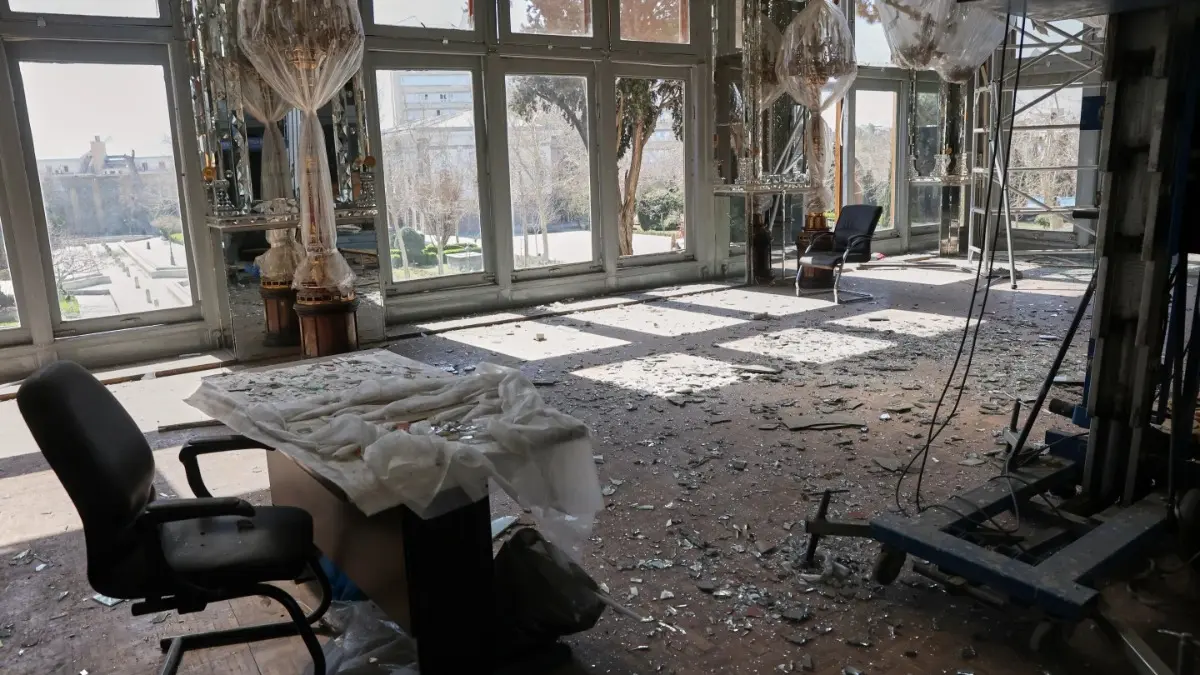
Isfahan: A first set of blast waves set ancient domes and minarets trembling around the most famous square in the ancient city of Isfahan. Another bombing in the city centre, two days later, blanketed the floors of a 400-year-old royal complex with shards of debris.
Those Israeli airstrikes, on March 7 and 9, shook the monuments at Naqsh-e Jahan Square and the Chehel Sotoun Palace, two of Iran’s most treasured cultural complexes. Two weeks later, plaster and broken tile still crunched underfoot in some places.
“These buildings were like part of us,” said Rasoul Mosavi, his head still bandaged in gauze from the injury he received in the explosion. He led Reuters journalists through the museum where he has worked as a security guard for 16 years. “This place is very dear to my heart.”

From the roof, the intended target of the March 9 bomb was visible less than 200 meters away: the Isfahan governor’s building, which was partially destroyed but also apparently empty when it was struck. In March, before the cease-fire in the U.S.-Israel war on Iran, Reuters journalists were granted rare access to the palace and Naqsh-e Jahan square and its surroundings, as well as two palaces in Tehran. They saw firsthand how the war has damaged Iran’s historic sites, including some protected under an international treaty administered by the U.N. cultural body UNESCO. In all, Reuters journalists observed damage at 11 historic buildings.
Advertisement
In addition, experts who track the war’s impact on world heritage sites said they confirmed damage at the Trans-Iranian Railway and Jameh Mosque in Isfahan, as well as an 1,800-year-old fortress near prehistoric caves settled by humans as long as 63,000 years ago.
In two decades of ground and air warfare by the United States and its allies in Iraq, Syria, Libya and Afghanistan, Reuters could find no examples of damage to cultural heritage sites listed at the time by UNESCO.
Advertisement
UNESCO hasn’t yet sent teams to the sites protected in its register, and has been limited to using satellite imagery to assess the damage. To date, UNESCO says it has verified damage at seven sites in Iran, including two on its international list as well as four cultural properties of national importance and a religious site.
UNESCO told Reuters it was not consulted either before or during the war but shared coordinates of critical sites with “all parties in the conflict.”
“UNESCO calls all parties to conflicts to respect international law, including the protection of cultural property, and to take all necessary measures to prevent damage to cultural heritage,” the world body said.
Ranging from shattered glass and broken tile to cracked walls and shaken foundations, the damage was mostly inflicted by bomb shock waves radiating out nearly 20 times faster than the speed of sound. Those waves can cause severe damage to structures nearly a kilometre away from the detonation itself, according to Wes Bryant, a former targeting specialist with the U.S. Air Force.
The Israel Defence Forces acknowledged targeting the governor’s office in Isfahan, which is adjacent to the UNESCO-listed palace complex. It said it had also struck a base belonging to the Islamic Revolutionary Guard Corps, a little over a kilometre from the historic sites, on March 7.
“The IDF operates in accordance with international law and targets military objectives only,” an IDF statement said. In general, the statement said, Israel’s strikes “were based on reliable intelligence, operational verification, established approval processes, and, where appropriate, legal review, and were carried out in accordance with applicable international law.”
Reuters spoke to eight experts in Middle Eastern archaeology and preservation of heritage sites who said the reporting shows a clear shift in U.S. targeting practices and priorities away from protecting internationally recognised historical landmarks. The shift comes two decades after widespread criticism of an American military base set up in the ruins of the ancient city of Babylon and the looting of the Baghdad Museum prompted the Pentagon to revamp its policies on protection of cultural sites.
In recent wars, Bryant said, historical landmarks would have been included on "no strike lists.” Dropping bombs on or near these sites, he said, required both a compelling military necessity, such as protecting the lives of soldiers, and high-level approval, sometimes even from the White House.
Among the sites damaged were Tehran’s Golestan Palace and bazaar; four sites at Isfahan's Naqsh-e Jahan Square; and the Chehel Sotoun complex, Reuters confirmed through visits. Mehrnoush Soroush, the director of the Center for Ancient Middle Eastern Landscapes, a University of Chicago organisation that is tracking damaged cultural sites in Iran, said her team had also confirmed damage at Jameh Mosque in Isfahan and at the Andimeshk railway station along the Trans-Iranian Railway, a UNESCO-listed site that links the Caspian Sea in the northeast with the Gulf.
Both Soroush and UNESCO also confirmed extensive damage at Falak-ol-Aflak, an ancient fortress in western Iran’s Khorramabad Valley. Reuters verified photos of damage to windows of the fortress. Israel’s military issued warnings for Iranian citizens in early April to avoid trains, and Israel’s statement to Reuters said the Qom railway bridge was struck to prevent Iran from moving weaponry.
Iran’s UNESCO representative provided a list of 134 cultural heritage sites it said were damaged by the war to the U.N. cultural body and shared it with Reuters. Though not all are listed on the UNESCO roster, they are some of Iran’s most popular tourist attractions, bringing in millions of visitors every year.
Of the UNESCO sites that were harmed, only the railway suffered a direct hit. Iran marked some of its most culturally significant sites with giant blue shields, including the bazaar in Isfahan, the fortress in the Khorramabad Valley, and the Sa’dabad complex, which houses some 18 historic palaces in Tehran. The shields are an internationally recognised symbol denoting their protected status as cultural heritage.
“It’s just unbelievable. In my wildest dreams I never thought this would happen. These are not really military sites,” said Farshid Emami, an associate professor at the department of art history at Rice University in Texas and an author of a book on Isfahan architecture. The Pentagon declined to comment.
“Operation Epic Fury was scoped around key objectives: destroy Iran’s ballistic missiles, demolish their production facilities, sink their navy, weaken their proxies, and ensure they can never possess a nuclear weapon,” said Anna Kelly, a White House spokeswoman, using the Trump administration’s operational name for the war in Iran. “Unlike Iran, the United States does not target civilians.”
‘THE GLOVES ARE OFF’
The 1954 Hague Convention, a treaty dedicated to safeguarding cultural heritage, explicitly protects sites like those in Isfahan during armed conflict. The intentional targeting of civilian cultural property is considered a war crime under international law, and any strikes on nearby targets must be carefully weighed against any damage they might sustain.
The UNESCO designation covers a small minority of culturally significant buildings and monuments in any given country, and some countries put more emphasis on having their landmarks officially listed by the U.N. body. Iran has 27 sites on the list, which range from 55 in Italy to just one in countries such as Uganda and Costa Rica.
In Iraq, the most notable case of damage during a U.S.-led war was to the ancient city of Babylon, which was eventually listed as a UNESCO heritage site in 2019. Coalition forces used Babylon as a military base from 2003 to 2004, digging trenches and installing other infrastructure at a site that had already been damaged by Saddam Hussein’s forces before the Americans arrived. Iraq suffered other cultural losses as a result of ground combat, such as the destruction of the old city of Mosul and the mass looting of antiquities following the U.S. invasion. Trump withdrew the United States from UNESCO in 2017 and again in 2025, citing its support for “woke, divisive cultural and social causes.” The 2025 action takes effect at the end of this year.
In Syria, in 2017, U.S.-led coalition forces bombed the eighth-century walls of Raqqa, in support of ground troops who were fighting ISIS.
“As devastating as that was, it feels like a golden time compared to what’s happening now, when the gloves are off and nobody cares,” said Stephennie Mulder, a professor of Islamic art and architecture at the University of Texas at Austin. She is among the more than 400 scholars and researchers who signed a letter that started circulating in mid-April condemning the damage to cultural sites in Iran by the United States and Israel. Israel reported damage from an Iranian strike in Tel Aviv’s White City, a collection of modernist, Bauhaus-influenced buildings from the 1930s that is also listed by UNESCO. The U.N. body said it was investigating.
U.S. Defence Secretary Pete Hegseth has largely dismissed rules of military engagement, claiming there would be “no mercy” shown to the enemy. President Donald Trump warned in April that Iran’s “whole civilisation would die” if it did not agree to end the conflict. Neither made a direct reference to heritage sites.
CULTURAL JEWEL
Even by Iranian standards for historical significance, Isfahan is considered a cultural jewel, drawing comparisons to the centers of Rome, Athens or Kyoto.
Also home to one of Iran’s nuclear sites, Isfahan sits at the heart of a vast plain in the high Iranian plateau and straddles the river Zayanderud, a Persian word that means “lifegiving.” The river halves the city into the older, northern section that is home to historic sites, and the wealthier neighbourhoods to the south with more modern residential compounds.
The monuments and heritage sites around the Naqsh-e Jahan square, close to the Chehel Sotoun Palace, were popular places for residents to gather. The square, which is as large as 14 soccer fields, is one of three UNESCO world heritage sites in the city. Like many large cities across Iran, Isfahan was gripped by protests earlier this year as anger over dire economic straits boiled over. The street demonstrations led to the biggest crackdown since the Islamic Revolution of 1979, leaving thousands dead, wounded, and jailed. Among the reasons given for the launch of “Operation Epic Fury” in late February was Trump’s desire for Iranians to topple their regime.
Some of the Isfahan protests and clashes with government forces were in the Naqsh-e Jahan square, and the bazaar briefly shut down during a general strike, according to footage verified by Reuters.
On March 7, Israeli bombs struck 300 meters from the 400-year-old Si-o-se-pol bridge over the river, targeting IRGC sites. Among them was a complex that former residents of Isfahan say served as a detention centre run by the elite militarised force. Israel’s military acknowledged targeting the base.
When bombs rained down on the IRGC site, blast waves reverberated a kilometre away, shaking Naqsh-e Jahan square, witnesses said.
Two days later, on March 9, another volley targeting the governor’s office shook the square again and the neighbouring Chehel Sotoun Palace complex.
It was around 2 p.m., and Mosavi, the elderly security guard, was finishing his shift at the Museum of Decorative Arts, which had been converted from a 17th-century royal palace within the complex. But, he said, that day a queasy “inner feeling” kept him at work.
Just 10 minutes later, jets flew overhead, followed by twin explosions.
Most of the windows in the museum were shattered. The ceiling of the main hall collapsed, exposing the building’s bones. Plaster and glass surrounded mannequins wearing traditional colourful Iranian garb.
The top floor of the governor’s office, less than 200 meters away, was all but destroyed. The governor was not injured in the strike. Reuters was not allowed access to the building, but the team met with the governor in a cafe in the bazaar.
At the entrance of the museum, Mosavi showed Reuters twisted grey metal, fragments of what he and other employees described as shrapnel from the bombs that hit the governor's office. The fragments resembled those seen by Reuters at Tehran’s Sa’dabad complex, a 19th-century site that was hit in March.
Heritage sites, like hospitals or schools, are normally on no-strike lists compiled and updated by military and intelligence agencies, according to two former military targeting specialists and the U.S. Committee of the Blue Shield, a nonprofit that advocates for the protection of cultural sites in war. Under international law, the expected military advantage of striking a location close to a cultural or heritage site must be proportionate to any possible collateral damage.
“There’s no country that would be exempt from the obligation to avoid targeting cultural heritage sites,” said Patty Gerstenblith, who leads the U.S. Committee of the Blue Shield, which has run training with the American military in the past to protect cultural sites during war.
Gerstenblith and other experts said when Mosul and Raqqa were reclaimed from Islamic State, the Blue Shield committee and other organisations prepared informational materials that were distributed to the troops involved ahead of time. Without more information, she added, she could not judge whether the strikes in Iran had been appropriate militarily.
At Naqsh-e Jahan square, an initial assessment by Isfahan heritage authorities found the bombings caused structural damage to the foundations of buildings there, according to the document. There was no way to independently confirm those findings.
Emami, the architectural historian at Rice University, said a more thorough investigation would be needed to confirm any structural damage.
At Ali Qapu Palace, the bombings in early March shook a terrace overlooking the vast square, its music chamber, its marble fountain, and 18 wooden columns. Pictures taken by heritage officials and by Reuters showed a crumbled wall, cracks on the body of the building, and shattered glass.
The initial Iranian assessment of Ali Qapu Palace said more than 70% of the glass in windows and doors was broken, and the plaster of two porches had separated from the main structure.
At the southern edge of the square, the bombings shook the two minarets of the Shah Mosque, famed for its double dome and archway, according to Ali Bordbar, who ran outside his small carpet shop in the bazaar during the March 7 bombing.
“It took hundreds of years to build this site,” said Bordbar. “In one moment it can be destroyed.”
When Reuters visited the Shah Mosque, which is part of the Naqsh-e Jahan square complex, employees brought in a sack filled with pieces of blue tiles that had fallen off. A picture attached to the Iranian damage assessment of the Isfahan heritage sites showed a crack in one of the mosque walls.
An artisan silver engraver in the bazaar said the economic consequences from lost tourism revenue due to the war were as devastating as the shattered windows or property damage.
“This war paralysed us,” the engraver said.
During the two days when Reuters visited later in March, the bazaar's main alleys were almost empty of visitors except for young men running and cycling through the passageways. In the afternoon, artists and musicians set up in the bazaar and a few visitors arrived.
Iranians are careful when speaking to foreign journalists, because of the risk of arrest or worse. Many said they felt distraught over the damage to historic sites, while others offered more nuanced thoughts.
Saeed, a 32-year-old who sells nougat in the bazaar, said that the airstrikes broke all of the windows and glass in his neatly organised sweet shop. Like many Iranians, he declined to express any specific opinion about the war.
“We are waiting for a happy ending,” he said.
'I WAS IN SHOCK'
In Tehran, a stone’s throw from that city’s famed old bazaar, sits the Golestan Palace, a centuries-old royal complex. Shopkeepers in the labyrinthine bazaar originally kicked off the protests that began in December last year, with labour strikes quickly spreading from the historic heart of Iran’s economy to university campuses and cities across the country. Next came a brutal Iranian government crackdown, followed by the assasination of the supreme leader in the opening salvo of the war, and weeks of bombing. On the night of March 1, American and Israeli forces struck Tehran’s judicial buildings adjacent to the ancient palace, which became a sea of debris, with shattered wooden artwork and mirrors knocked down from the ceiling.
A sharp cracking sound echoed off the large ceiling of the palace as Reuters journalists stepped over glittering shards of glass on the floor. UNESCO, which lists the palace as a world heritage site, has expressed “concerns” over the site’s damage.
An archaeology employee who has worked in the palace for nearly 30 years choked back tears as she described the morning after the attacks.
“When I came in here, I was in shock, and frozen in place amid the glass,” she said on condition of anonymity.
In the throne room, she held her chador tightly around her neck and said the space had sustained most of the damage from blast waves.
A few meters away, the hall of mirrors was another sea of glass that before had adorned the walls, ceilings and pillars of the room.
The Reuters team was not given access to a third part of the palace that employees said had been damaged by blasts from the March 1 strikes. That area, they explained, is a prohibited zone because it was adjacent to the government building that was the target of the U.S.-Israel attacks. That building is affiliated with the judicial authority in Iran.
The judiciary in Tehran is notorious for sentencing young Iranian men and women who have dared to oppose the regime to long prison sentences and executions. The judicial building that came under attack was nearly 300 meters away from the palace.
When Reuters visited the palace in March, two weeks after it was ravaged, the female employee paced the halls, voicing fears about damage invisible to even her trained eye.
No one was killed in the blasts, but two employees suffered minor injuries, the employee said.
After 15 minutes, she suddenly said it was time for everyone to leave – and quickly. She scurried ahead and pointed at the ceiling, which, she said, might collapse at any moment. (Reporting by Maggie Michael, M.B. Pell, Mari Saito and Ryan McNeill. Additional reporting by Mayaan Lubell. Visuals by Alaa al-Marjani and Haider Kadhim Nour. Edited by Lori Hinnant and Sarah Cahlan.)