
What Is Boeing's Bunker Buster Bomb? Why It's Critical For Israel Against Iran
Washington's GBU-57 Massive Ordnance Penetrator (MOP) could derail Iran's nuclear ambitions against Israel. But how impactful are bunker-buster bombs?
- World News
- 4 min read

;'%3e%3cpath%20d='m8,15.99c4.41,0,7.99-3.58,7.99-7.99S12.41,0,8,0,0,3.59,0,8s3.58,7.99,7.99,7.99Z'%20style='stroke:%23fff;%20stroke-miterlimit:10;%20stroke-width:.02px;'/%3e%3cpath%20d='m3.08,3.37l3.82,5.11-3.84,4.15h.87l3.37-3.64,2.72,3.64h2.94l-4.04-5.39,3.58-3.87h-.86l-3.1,3.35-2.5-3.35h-2.94Zm1.27.64h1.35l5.97,7.99h-1.35l-5.97-7.99Z'%20style='fill:%23fff;'/%3e%3c/g%3e%3c/svg%3e)


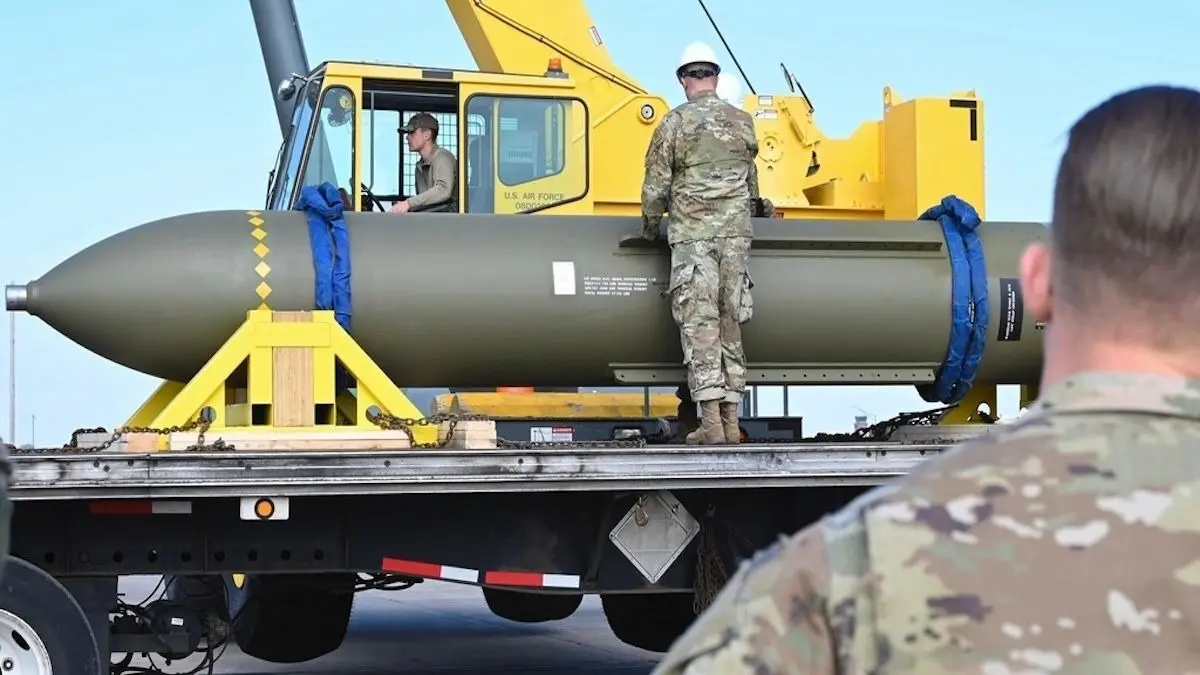
As Israel intensifies its military campaign to dismantle Iran’s nuclear program, global attention has turned to the United States and its powerful GBU-57 Massive Ordnance Penetrator, known as the "bunker buster" bomb. Designed to destroy deeply buried, heavily fortified targets like Iran’s Fordo nuclear facility, this 30,000-pound weapon could play a pivotal role if the U.S. were to engage in the conflict. With speculation swirling about its potential deployment, here’s an in-depth look at the GBU-57, its capabilities, and the high-stakes implications of its use against Iran’s nuclear ambitions.
The GBU-57: A Weapon Built for Fortified Targets
The GBU-57, developed by Boeing for the U.S. Air Force, is a 20-foot-long behemoth designed specifically to penetrate deeply buried bunkers. Weighing 30,000 pounds, it can burrow through up to 200 feet of earth or reinforced concrete before detonating its 5,000-pound explosive payload. “You make sure you save them for places like Iran and North Korea because you don’t need something that goes that deep” in normal circumstances, said retired Col. Steve Ganyard, to ABC News.
Unlike conventional bombs, the GBU-57 is engineered to explode only after reaching its subterranean target, minimizing surface damage. “It wouldn’t be a massive blast. It would penetrate the ground and shoot up some debris but it won’t be a massive cloud,” Ganyard noted. Despite its destructive power, the bomb has never been used in combat, though it was tested successfully at White Sands Missile Range in 2009 and upgraded in 2012 to enhance its penetration capabilities.
The GBU-57’s unique ability to target fortified sites like Fordo, located 300 feet under a mountain in northwestern Iran, makes it a focal point in discussions about countering Iran’s nuclear program. Fordo, believed to house advanced centrifuges producing near-weapons-grade uranium, is nearly impervious to Israel’s arsenal, including the BLU-109 bombs carried by F-35 jets, which penetrate only 6 to 8 feet of concrete.
Advertisement
Why Fordo Is the Ultimate Challenge
Iran’s Fordo facility, near Qom, is a cornerstone of its nuclear program, producing uranium enriched to 60% purity—close to the 90% needed for a nuclear weapon. In 2023, the International Atomic Energy Agency (IAEA) detected uranium particles at Fordo enriched to 83.7%, fueling concerns that Iran could rapidly produce weapons-grade material. The facility’s deep underground location, shielded by rock and concrete, renders it resistant to most conventional strikes.
According to a 2023 report by the Arms Control Association, Fordo’s 2,000-plus centrifuges could produce enough enriched uranium for three to four nuclear bombs if further processed. Israel’s recent airstrikes, which damaged Iran’s Natanz facility, have had little impact on Fordo, as confirmed by IAEA on June 17, 2025. This resilience has led to speculation that only the GBU-57 could effectively disrupt Fordo’s operations, either by destroying its centrifuges or collapsing its entrance to halt production.
Advertisement
The B-2 Stealth Bomber: The Only Delivery Platform
The GBU-57’s immense size and weight mean it can only be deployed by the U.S. Air Force’s B-2 Spirit stealth bomber. Each B-2 can carry two of these bombs, making it a critical asset for such a mission.

While the B-2’s stealth capabilities are less critical given Israel’s destruction of Iran’s air defenses, its ability to deliver the GBU-57 with precision remains unmatched. No other military, including Israel’s, has access to either the bomb or the B-2, placing the U.S. in a unique position to influence the outcome of the Israel-Iran conflict.
Risks of Deployment: Nuclear and Diplomatic Fallout
Using the GBU-57 against Fordo carries significant risks. IAEA Director General Rafael Mariano Grossi warned last week that attacks on nuclear facilities could have “serious implications for nuclear safety, security and safeguards, as well as regional and international peace and security.” A strike on Fordo could release uranium hexafluoride gas, a toxic and corrosive substance used in enrichment, posing health risks to nearby populations. While Fordo’s underground design limits the chance of widespread radioactive fallout, even a contained release could complicate IAEA monitoring and cleanup efforts.
Diplomatically, deploying the GBU-57 would mark a major U.S. escalation in the Middle East. President Donald Trump has voiced support for Israel’s strikes and warned Iran against pursuing nuclear weapons but has remained noncommittal about direct U.S. involvement. A June 2025 statement from Vice President JD Vance suggested openness to military action, but analysts warn that a U.S. strike could inflame tensions, potentially triggering Iranian retaliation against U.S. bases or allies like Saudi Arabia.
Whilst speaking with journalists today, Trump said that “I may do it, I may not do it. I mean, nobody knows what I'm going to do. I can tell you this, that Iran's got a lot of trouble”.