
Who is Sébastien Lecornu? All You Need to Know About France's New Prime Minister
Sébastien Lecornu has been appointed as France’s new Prime Minister by President Emmanuel Macron, the fifth person to hold the office in under two years. A longtime loyalist, Lecornu previously served as France’s Armed Forces Minister, where he managed the country’s response to the war in Ukraine and advocated for a historic €413 billion defense budget.
- World News
- 6 min read

;'%3e%3cpath%20d='m8,15.99c4.41,0,7.99-3.58,7.99-7.99S12.41,0,8,0,0,3.59,0,8s3.58,7.99,7.99,7.99Z'%20style='stroke:%23fff;%20stroke-miterlimit:10;%20stroke-width:.02px;'/%3e%3cpath%20d='m3.08,3.37l3.82,5.11-3.84,4.15h.87l3.37-3.64,2.72,3.64h2.94l-4.04-5.39,3.58-3.87h-.86l-3.1,3.35-2.5-3.35h-2.94Zm1.27.64h1.35l5.97,7.99h-1.35l-5.97-7.99Z'%20style='fill:%23fff;'/%3e%3c/g%3e%3c/svg%3e)


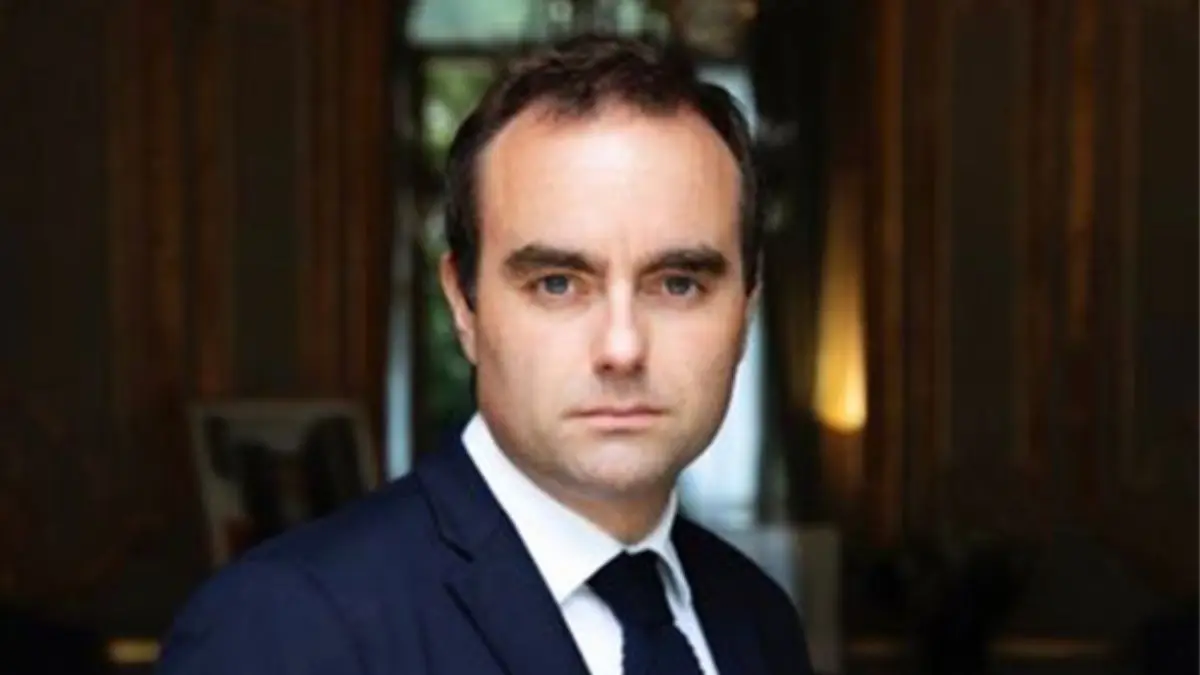
Paris: French President Emmanuel Macron announced the appointment of Sébastien Lecornu as France's new Prime Minister on Tuesday. This marks the fifth individual to assume the role of Prime Minister in France in less than two years, highlighting a period of considerable governmental turnover.
Sébastien Lecornu has been a consistent presence in Macron's administration since the president first took office in 2017. Over the past three years, he served as France’s Minister of the Armed Forces, where his responsibilities included overseeing the country's strategic response to the ongoing war between Russia and Ukraine. His continuity in government makes him the only minister to have remained in Macron’s cabinet without interruption since the start of the president’s term.
In a formal statement shared on social media, Lecornu expressed his commitment to his new duties, “The President of the Republic has entrusted me with the task of building a Government with a clear direction: the defense of our independence and our power, the service of the French people, and political and institutional stability for the unity of the country. I wish to thank him for the confidence he has shown in me by appointing me Prime Minister.”
This transition of leadership from the outgoing Prime Minister, Bayrou, to Lecornu occurs against a backdrop of significant social unrest. The nationwide “Block Everything” protests proceeded as scheduled on Wednesday, with participants expressing strong dissatisfaction with the political establishment and anticipated budget reductions. Demonstrators took to the streets, causing widespread traffic disruptions and engaging in confrontations with law enforcement.
Advertisement
Who is Sébastien Lecornu?
Prior to his promotion to Prime Minister, Sébastien Lecornu held the distinction of being the youngest defence minister in French history. Since 2022, he has also been the longest-serving sitting minister within Macron’s government. Originally a member of the conservative political sphere, Lecornu joined Macron’s centrist Renaissance party in 2017. His previous ministerial experience includes roles as Minister of Local Government and Minister of Overseas Affairs.
A notable moment in his career came in 2018, when the "yellow vest" movement emerged to protest social injustice. In response, President Macron selected Lecornu to lead a countrywide “great debate,” an initiative aimed at addressing public grievances and reducing social tensions. In his most recent role as Defence Minister, Lecornu was a key advocate for a substantial €413 billion defence spending package covering the years 2024 to 2030. This budgetary increase, largely motivated by the geopolitical context of Russia’s war in Ukraine, represents the most significant enhancement of French military funding in half a century. The allocated resources are intended to modernize France’s nuclear arsenal, increase intelligence capabilities, and advance the development of remotely operated weaponry.
Advertisement
By appointing a trusted loyalist like Lecornu, Macron appears to be emphasizing governmental continuity and a sustained commitment to his pro-business economic agenda, which includes certain austerity measures. However, this approach carries the risk of further alienating segments of the electorate and exacerbating public dissatisfaction, particularly as opinion polls indicate growing voter disillusionment with the perceived dysfunction of the country’s political system.
What Triggered Political Instability in France?
The origins of the current political instability in France can be traced to June 2024, when President Macron made the risky decision to call snap parliamentary elections, just two years into his second term. This move came on the heels of a significant electoral defeat for his Renaissance party in the European Parliament elections earlier that year. Macron’s objective was to secure “a clear majority in serenity and harmony” for his legislative agenda.
Instead, the election results produced a hung and deeply divided National Assembly, fractured into three primary blocs: a left-wing alliance that secured the most seats but fell well short of a majority; the far-right National Rally, which received the largest share of the popular vote but also lacked a majority; and Macron’s own centrist coalition, which retained enough seats to form a substantial third bloc but lost considerable ground.
This fractured legislature has created an environment where forming a stable governing majority has proven exceptionally difficult. Michel Barnier, who was appointed Prime Minister in September of the previous year, was forced from office after only three months due to an inability to pass a budget. His successor, Bayrou, met a similar fate after just nine months in office. Bayrou had argued that addressing France’s debt crisis necessitated sweeping government spending reductions totaling €44 billion.
It is within this context of political paralysis and proposed austerity that the “Block Everything” protests have emerged. What began as a grassroots movement opposed to fuel taxes has evolved into a broad-based uprising expressing anger over inequality, economic hardship, and a governing class viewed as disconnected from everyday citizens.
The scale of the unrest was evident on Wednesday, with nearly 200 protesters arrested and approximately 80,000 police officers deployed across the country, according to statements from the French interior minister.
France’s political and fiscal challenges are long-standing. For decades, the government has consistently spent more money than it collects in revenue, necessitating extensive borrowing to finance its budget. Official figures from early 2025 placed the nation’s public debt at €3,345 billion, equivalent to 114% of gross domestic product (GDP). This ratio is the third highest in the eurozone, trailing only Greece and Italy, and amounts to roughly €50,000 per French citizen.
The budget deficit reached 5.8% of GDP last year and is projected to be 5.4% for the current year. Compounding these fiscal pressures is the country’s demographic shift toward an older population. With a shrinking base of working taxpayers and a growing number of retirees drawing state pensions, public expenditures continue to rise relentlessly.
It was this unsustainable trajectory that led former Prime Minister Bayrou to propose drastic deficit reduction by reining in generous social programs, including the state pension system. On Monday, he characterized France as being on “life support” and addicted to excessive public spending. However, past efforts to reduce social benefits have proven politically perilous, as demonstrated by the widespread conflicts that erupted in 2023 over President Macron’s successful but highly controversial reform to raise the retirement age from 62 to 64.