
Why Is Bangladesh Boiling Again? Fresh Unrest Rocks Dhaka, Youth Leader Sharif Osman’s Death Triggers Violent Protests
Bangladesh experienced fresh unrest following the death of Inqilab Mancha spokesperson Sharif Osman Hadi, leading to violent protests in Dhaka. Demonstrators attacked and vandalized The Daily Prothom Alo and The Daily Star offices. The protests, filled with slogans, highlighted ongoing tensions and triggered widespread clashes throughout the capital.
- World News
- 3 min read

;'%3e%3cpath%20d='m8,15.99c4.41,0,7.99-3.58,7.99-7.99S12.41,0,8,0,0,3.59,0,8s3.58,7.99,7.99,7.99Z'%20style='stroke:%23fff;%20stroke-miterlimit:10;%20stroke-width:.02px;'/%3e%3cpath%20d='m3.08,3.37l3.82,5.11-3.84,4.15h.87l3.37-3.64,2.72,3.64h2.94l-4.04-5.39,3.58-3.87h-.86l-3.1,3.35-2.5-3.35h-2.94Zm1.27.64h1.35l5.97,7.99h-1.35l-5.97-7.99Z'%20style='fill:%23fff;'/%3e%3c/g%3e%3c/svg%3e)


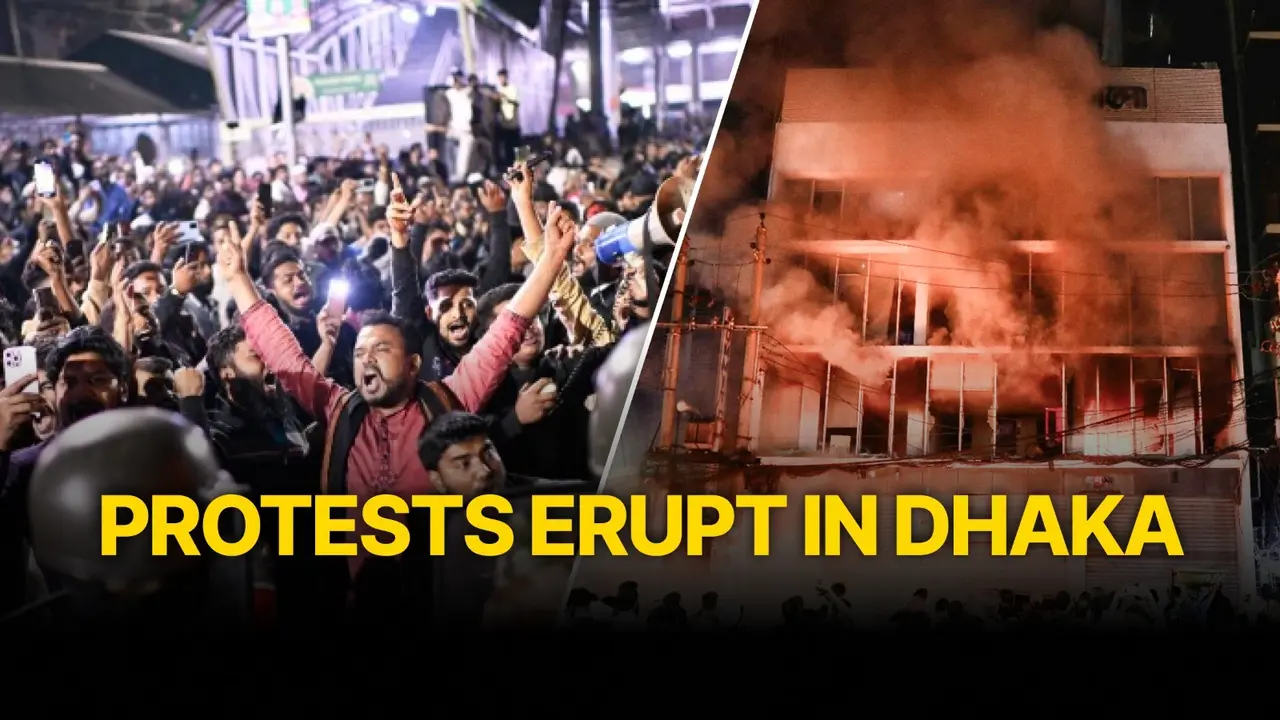
New Delhi: Bangladesh witnessed a fresh wave of unrest late Thursday night after the death of Inqilab Mancha spokesperson Sharif Osman Hadi, with protests spiralling into violence across parts of the capital. Offices of two of the country’s leading newspapers - The Daily Prothom Alo and The Daily Star - were attacked, vandalised and set on fire by protesters.
According to local reports, demonstrations that began at Shahbag following confirmation of Osman Hadi’s death escalated around midnight. Protesters allegedly ran from Shahbag and forced their way into the Prothom Alo office, where they vandalised the premises, threw papers and computers onto the floor, and set documents ablaze. The Daily Star office was attacked shortly thereafter, with similar acts of vandalism reported.
Sharif Osman Hadi, a prominent youth leader and spokesperson of Inqilab Mancha, died after battling for his life for seven days. He passed away on Thursday night while undergoing treatment at Singapore General Hospital. His death triggered immediate protests by students and members of the public across Dhaka, including at Dhaka University, Shahbag and several key intersections.
As news of his demise spread, protesters poured onto the streets chanting slogans such as “Delhi or Dhaka? Dhaka, Dhaka”, “Indian aggression-break it down, crush it”, “Inqilab, Inqilab-long live, long live”, and “The blood of martyrs will not be allowed to go in vain”. Some demonstrators were also heard chanting, “We will all become Hadi; we will speak even in the face of bullets”.
Advertisement
The protests continued late into the night, with reports of vandalism, arson and clashes in different parts of the capital. Visuals from Dhaka showed a tense situation, with streets filled with demonstrators and security forces on alert.
Bangladesh has been on edge since last year, when large-scale protests led by students and opposition groups resulted in the removal of then Prime Minister Sheikh Hasina. The protests were driven by public anger over governance issues and allegations of political repression. Though a new political setup followed, tensions on the streets never fully subsided.
Advertisement
In a highly controversial judgment on 17 November 2025, Bangladesh’s International Crimes Tribunal convicted Sheikh Hasina in absentia of crimes against humanity for her role in the violent crackdown on the 2024 uprising and sentenced her to death. The trial verdict coming just months before national elections scheduled for February 2026 sparked strong reactions across the political spectrum and added to an already charged atmosphere.
Student groups and youth organisations that were at the forefront of last year’s movement have continued to mobilise, often protesting against government actions and court decisions.
In this charged atmosphere, the death of Inqilab Mancha spokesperson Sharif Osman Hadi has acted as a trigger for renewed unrest. His death has led to protests across Dhaka, attacks on media offices and violence in several areas, once again pushing Bangladesh into a cycle of demonstrations and street violence.
The latest violence underscores simmering tensions in Bangladesh, where the death of a student and youth leader has once again acted as a flashpoint, pushing the country into another cycle of protests and street unrest.