
What is a 'Galaxy-Killing' Wind? The Brutal Force Starving the Early Universe
Astronomers using the James Webb Space Telescope and ALMA have discovered a powerful “galaxy-killing” wind in CRISTAL-02, revealing why massive galaxies in the early universe lived fast and died young. This breakthrough sheds light on galaxy evolution and star formation shutdown.
- Science News
- 3 min read

;'%3e%3cpath%20d='m8,15.99c4.41,0,7.99-3.58,7.99-7.99S12.41,0,8,0,0,3.59,0,8s3.58,7.99,7.99,7.99Z'%20style='stroke:%23fff;%20stroke-miterlimit:10;%20stroke-width:.02px;'/%3e%3cpath%20d='m3.08,3.37l3.82,5.11-3.84,4.15h.87l3.37-3.64,2.72,3.64h2.94l-4.04-5.39,3.58-3.87h-.86l-3.1,3.35-2.5-3.35h-2.94Zm1.27.64h1.35l5.97,7.99h-1.35l-5.97-7.99Z'%20style='fill:%23fff;'/%3e%3c/g%3e%3c/svg%3e)


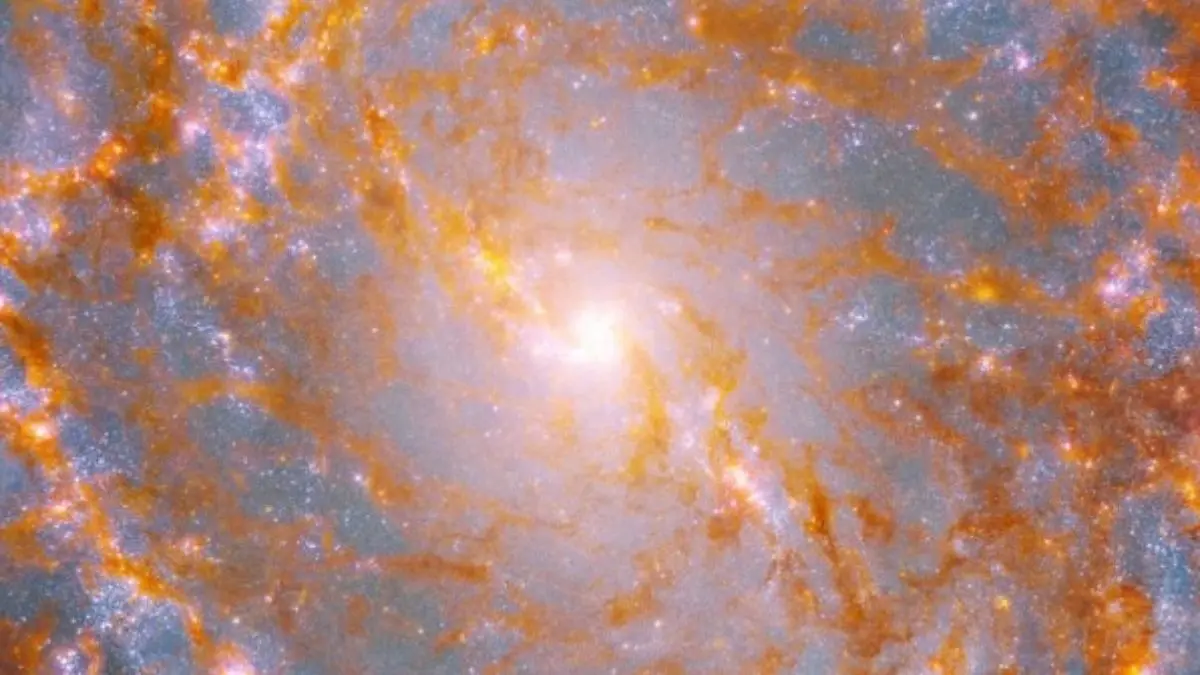
Space usually feels empty, but the early universe was a crowded, violent mess. Galaxies were constantly slamming into each other, growing fast, and making stars at a ridiculous pace. But then, a lot of the biggest ones just... died. They stopped making stars altogether, way sooner than anyone expected.
Now, thanks to the James Webb Space Telescope and ALMA, we finally know why. They choked on their own exhaust.
The culprit is something astronomers are calling a "galaxy-killing" wind.
Here is what that actually means: to make a star, a galaxy needs cold gas. No gas, no stars. A galaxy-killing wind is a massive, hyper-fast storm of this gas being violently blasted right out of the galaxy and dumped into the middle of nowhere. Once the wind strips the galaxy clean, the star-making factory shuts down permanently. The galaxy starves.
Advertisement
How a Galaxy Accidentally Kills Itself
It sounds backwards, but the very thing that made these early galaxies so massive is what ended up killing them. It is a three-step chain reaction:
The Pileup: Two or more galaxies crash into each other.
Advertisement
The Frenzy: The collision shoves massive amounts of gas right into the center of the pileup. This triggers a frantic, overdrive burst of new star formation.
The Detonation: The biggest stars created in this rush burn through their fuel incredibly fast. They die young and explode as supernovas.
When you have thousands of these massive stars exploding at roughly the same time, the combined energy forms a shockwave. That shockwave becomes a galactic wind, screaming out of the center and pushing the rest of the galaxy's raw star-making gas along with it.
Caught in the Act
Astronomers saw this self-destruction playing out in real-time when they pointed their telescopes at a merging system called CRISTAL-02, looking at it as it existed just a billion years after the Big Bang.
The data showed something crazy: the galaxy's wind is throwing away gas twice as fast as the galaxy can even use it to build stars.
It is completely unsustainable. At the rate it is blowing through its own supply, CRISTAL-02 will be totally dead in less than 50 million years—a total blink of an eye in cosmic history.
And because nearly half of the big galaxies back then were constantly tangling with their neighbors, this wasn't some rare cosmic freak accident. It was the norm. These giant systems lived fast, threw an absolute tantrum of star birth, and then blasted away their own lifelines, leaving behind a universe full of massive, early ghosts.