
Asian currencies subdued against dollar, Malaysian ringgit biggest loser so far this year
The key reason highlighted is that Fed Chair Powell has further raised his hawkish rhetoric, signaling at least two more rate hikes.
- Republic Business
- 3 min read

;'%3e%3cpath%20d='m8,15.99c4.41,0,7.99-3.58,7.99-7.99S12.41,0,8,0,0,3.59,0,8s3.58,7.99,7.99,7.99Z'%20style='stroke:%23fff;%20stroke-miterlimit:10;%20stroke-width:.02px;'/%3e%3cpath%20d='m3.08,3.37l3.82,5.11-3.84,4.15h.87l3.37-3.64,2.72,3.64h2.94l-4.04-5.39,3.58-3.87h-.86l-3.1,3.35-2.5-3.35h-2.94Zm1.27.64h1.35l5.97,7.99h-1.35l-5.97-7.99Z'%20style='fill:%23fff;'/%3e%3c/g%3e%3c/svg%3e)


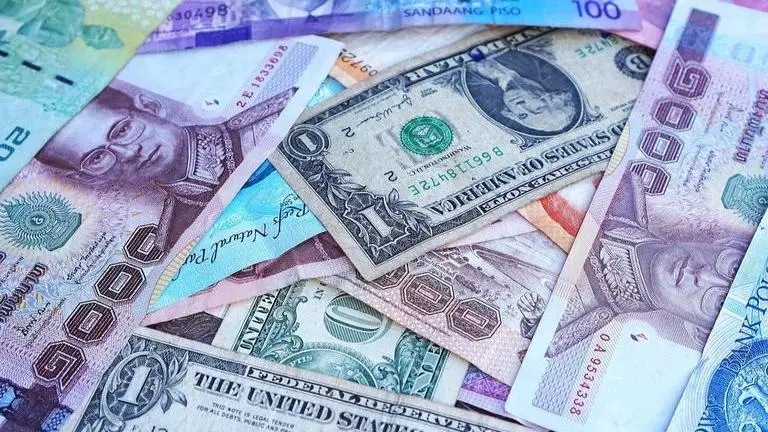
Asian emerging currencies showed little change on Friday, though as the first half of the year ended most were down against the dollar, with the Malaysian ringgit the weakest performer as it hovered near eight-month lows.
Latest US economic data raised the likelihood that the Federal Reserve will likely keep interest rates higher for longer, further pressuring risk-sensitive Asian assets.
Leading declines on Friday, the Malaysian ringgit and Philippine peso both eased 0.2 per cent. The ringgit, tightly bound to Chinese yuan, has lost 5.9 per cent in the first half of 2023.
The South Korean won also weakened 0.2 per cent on Friday despite the country's factory production unexpectedly jumping in May.
Advertisement
Analysts at ING said that weak forward-looking data and the recent decline in service activity in South Korea could suggest softer investment and consumption in the second half of 2023.
The Thai baht slipped 0.1 per cent after the country's factory output fell year on year and failed to meet forecasts. Down nearly 3 per cent this year and currently lingering at a seven-month low level, the baht remains under pressure as Thailand faces an uncertain path to selecting a new prime minister.
Advertisement
Back in the US, data showed an unexpected weekly declinin the number of Americans filing new claims for unemployment
benefits, and GDP growing, fuelling bets that the Fed will be forced to go for another round of rate hikes.
The "key reason (for Asian currencies softness against the dollar) is that Fed Chair Powell has further raised his hawkish rhetoric, signalling at least two more rate hikes," Irene Cheung, senior Asia strategist at ANZ said.
"This, coupled with strong US data, has seen the market fully price in a 25 basis point hike in September with about one-quarter
chance of second hike by November."
Investors are now waiting for the US Personal Consumption Expenditures (PCE) index reading, the Fed's favoured inflation
gauge scheduled to come later in the global day.
However, Cheung believes Asian central banks are done with rate hikes as inflation has been easing across the region. The Chinese yuan eased to 7.2615 per dollar on Friday, its weakest since Nov. 10, as China's factory activity declined for a third straight month in June and weakness in other sectors deepened. The yuan was set to end the first half nearly 5 per cent weaker.
Alex Loo, Macro Strategist at TD Securities, believes Chinese "policymakers are trying to draw a line in the sand around 7.25".
"However, today's PMIs suggest the economy needs more policy support, with markets hoping for major policy announcement at
the July Politburo meeting" Loo said, adding that the "slowdown in China's recovery and wide rate differentials will add pressure on the yuan unless there is a step-up in stimulus."
Equities in the region were mixed, with markets in Thailand gaining 1.6 per cent, while China and India were up 0.8 per cent.
For the first-half, equities in Seoul were set to show a gain of 14.6 per cent, while those in Malaysia and Thailand were set to show declines of 7.3 per cent and 9.8 per cent respectively.