
'Tesla's delayed entry will mature Indian EV market': Expert
Elon Musk today made a clear statement about Tesla's venture into India. Tesla's entry could be seen as a game-changer for the premium auto-segment in India.
- Republic Business
- 4 min read

;'%3e%3cpath%20d='m8,15.99c4.41,0,7.99-3.58,7.99-7.99S12.41,0,8,0,0,3.59,0,8s3.58,7.99,7.99,7.99Z'%20style='stroke:%23fff;%20stroke-miterlimit:10;%20stroke-width:.02px;'/%3e%3cpath%20d='m3.08,3.37l3.82,5.11-3.84,4.15h.87l3.37-3.64,2.72,3.64h2.94l-4.04-5.39,3.58-3.87h-.86l-3.1,3.35-2.5-3.35h-2.94Zm1.27.64h1.35l5.97,7.99h-1.35l-5.97-7.99Z'%20style='fill:%23fff;'/%3e%3c/g%3e%3c/svg%3e)


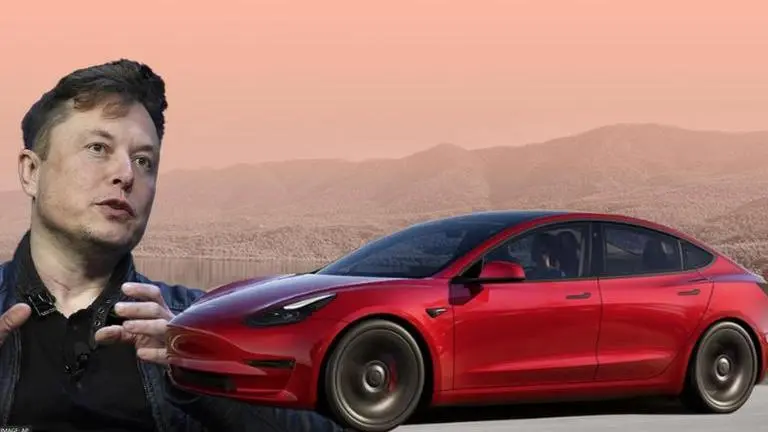
The foray of Elon Musk's Tesla in India could rapidly expand the volume of EV (electric vehicle) manufacturing in India. Telsa currently has only a single manufacturing facility for South Asia, based in China. The emerging EV market in India is poised to mature with Tesla's delayed entry.

"Tesla's entry to the Indian Market will definitely increase the competition and mature the Indian EV sector. The Indian market will witness a more versatile product as Tesla has a big name in the EV space. Indian consumers will have more options, brand name and new features that come up with Tesla," Vijay Chopra, CEO, Enoch Ventures told Republic.
"Tata Motors will be a major competition to Tesla as its share in the Indian EV industry is good with a good consumer base. Jaguar Land Rover, its subsidiary, has announced to invest $18.7 billion over the next five years in electric and autonomous vehicle technology which could make Tata a big and prime competitor to Tesla if it enters the Indian market," Chopra adds.
Musk has been eyeing the Indian market since 2019 and he met PM Modi in 2015. The Indian Government has repeatedly asked the company to set up its production facility, but the discussions could not gain momentum because of Tesla's demand for slashing import duties. Today's meeting will pave the way for a faster launch of Tesla in India.
Advertisement
Tesla's investment in India could be seen as a game changer for the premium auto segment in India. According to experts in the auto industry, batteries remain a major component of the sector and if Tesla is introduced in India, it should also find ways to localise the production of batteries in India cost-effectively.
In addition to this, incentives in India like FAME can be a big boost to Tesla's operations in India. The cost of manufacturing in India and labour is low in India, which can reduce the potential production cost, thereby offering its products to Indian customers at competing prices. Operational issues and logistics will not be major hindrances if Tesla plans for a production facility.
Advertisement
On the market side, Tesla's success and operations in the Indian Market will depend on factors like competitive prices, charging infrastructure, which is an existing issue on the Indian side, and additional performance criteria as needed by the Indian audience. At present, the Indian market is dominated by SUVs and MUVs, which offer style, design and performance. Pricing is going to be a major issue as an average Indian electric car ranges between 8 lakh to 14 lakh as compared to the premium price of Tesla which starts at $48,190, approximately 40 lakh.
It doesn't mean that Tesla, if introduced in India, can not gain the user base like any other place, but it will then be termed as a premium operating space which at present in India is dominated by Mercedes, BMW, Volvo and Audi. All these premium automakers offer different electric vehicles in India and the factor of differentiation has to be planned by Tesla to beat the market before it enters it.
The company has revealed plans to sell 20 million EVs globally by 2030. Competition with China's BYD is a concern as China possesses a good dominance in the South Asian markets like Singapore, Malaysia etc.
Taxation and registration charges in India are very high compared to other countries. This ends up in consumers paying a hefty amount to the government for the vehicles to hit the roads. A typical 1200cc vehicle in India will be charged 18 per cent as GST with 1 per cent cess, whereas automobiles with greater engine capacity will attract 28 per cent GST and 20 per cent cess.
At present, Electric Vehicles in India are majorly sold by companies like Tata Motors, Hyundai, Morris Garages and Mahindra. The list further included emerging two-wheeler EV makers like Ather and Ola. Recent statistics on electric vehicles reveal that a total of approximately 24 lakh units were sold till FY23. Tata Motor's affordable cars like the Tiago EV and Tigor EV have been popular choices for consumers, followed by MG and Hyundai.