
'Connectivity Should Respect Territorial Integrity': PM Modi's Subtle Dig At China's BRI
While addressing the largest Heads of State Council Summit in Tianjin, China, PM Narendra Modi said that connectivity which bypasses sovereignty loses trust and meaning.
- Republic Business
- 2 min read

;'%3e%3cpath%20d='m8,15.99c4.41,0,7.99-3.58,7.99-7.99S12.41,0,8,0,0,3.59,0,8s3.58,7.99,7.99,7.99Z'%20style='stroke:%23fff;%20stroke-miterlimit:10;%20stroke-width:.02px;'/%3e%3cpath%20d='m3.08,3.37l3.82,5.11-3.84,4.15h.87l3.37-3.64,2.72,3.64h2.94l-4.04-5.39,3.58-3.87h-.86l-3.1,3.35-2.5-3.35h-2.94Zm1.27.64h1.35l5.97,7.99h-1.35l-5.97-7.99Z'%20style='fill:%23fff;'/%3e%3c/g%3e%3c/svg%3e)


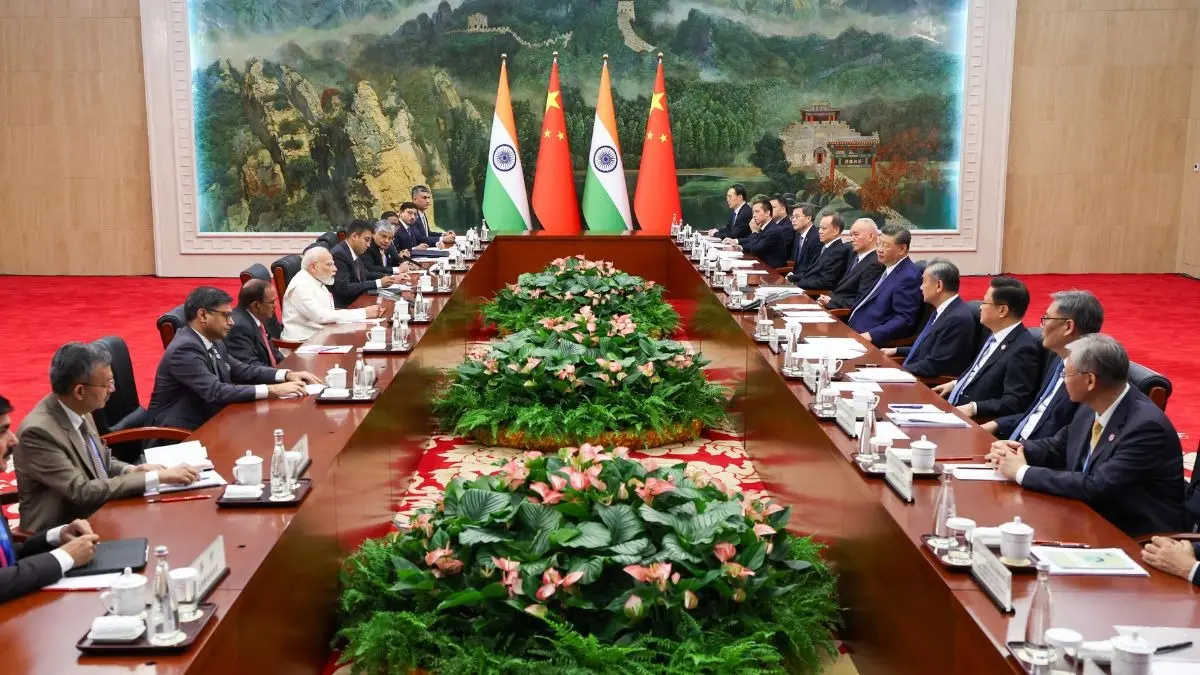
While addressing the largest Heads of State Council Summit in Tianjin, China, PM Narendra Modi said that connectivity which surpasses sovereignty loses trust and meaning.
"Connectivity should always respect sovereignty and territorial integrity-this is a fundamental principle of the SCO Charter. Connectivity that bypasses sovereignty loses trust and meaning," said PM Narendra Modi.
"India firmly believes that strong connectivity ensures not just trade but also trust and development. That is why we are working on Chabahar and the International North-South Economic Corridor, which will enhance connectivity to Afghanistan and Central Asia," he said.
His comments come in the backdrop of expansion in China-Pakistan Economic Corridor (CPEC) that passes through Pakistan-occupied Kashmir.
Advertisement
The CPEC, which connects Gwadar Port in Pakistan's Balochistan with China's Xinjiang province, is the flagship project under Beijing's ambitious Belt and Road Initiative (BRI). "
Our effort was to take SCO beyond governments -- to connect common people, youth, scholars, and startups together and take them forward," he stated.
Advertisement
In the SCO Summit last year, PM Modi had opposed China’s 'One Belt One Road' (OBOR) initiative, and withheld support for this connectivity project.
As part of SCO summit led by China, a joint statement revealed that other member states, including Russia, Iran, and Pakistan, expressed their backing for OBOR.
What Is ‘One Belt, One Road’ Initiative?
Called "One Belt, One Road" in Chinese, the Belt and Road Initiative started as a program for Chinese companies to build transportation, energy and other infrastructure overseas funded by Chinese development bank loans.
The stated goal was to grow trade and the economy by improving China's connections with the rest of the world in a 21st-century version of the Silk Road trading routes from China to the Middle East and onto Europe. Xi unveiled the concept in broad terms on visits to Kazakhstan and Indonesia in 2013 and it took shape in the ensuing years, driving the construction of major projects from railroads in Kenya and Laos to power plants in Pakistan and Indonesia.